
Immersion at the heart of esport performance
Spending time with esport players to understand their needs.
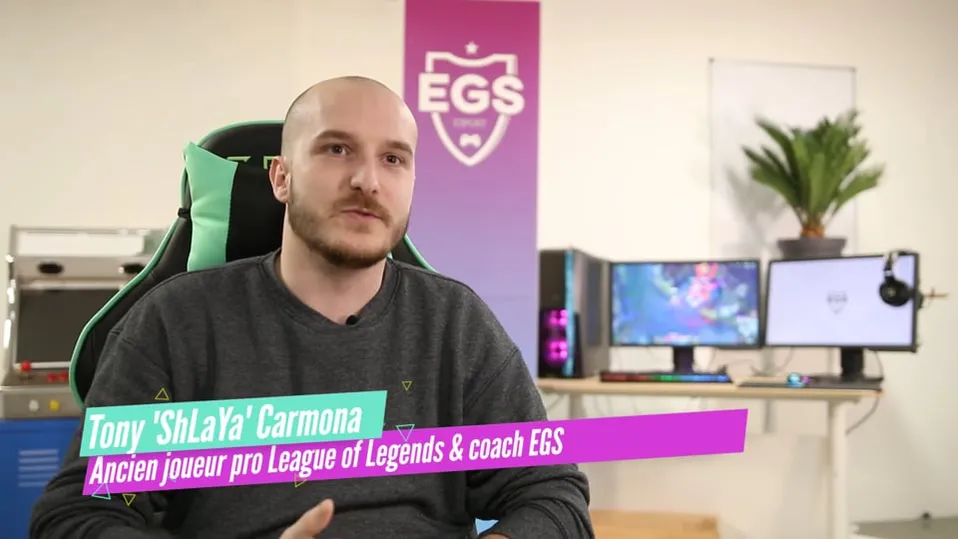
Equipped with observation grids and dedicated interview guides, we spent nearly a week immersed with a team of esport players in the European top 100 of League of Legends.


The interviews reveal that a relevant way to support performance in esport lies in improving and optimising the debriefing sessions.
Through quick feedback on their match, players could individualise their training by practising in the situations they find challenging.
A measurement-driven approach centred on the players' needs
Physiological measurements to complement traditional self-reported approaches.
Physiological signals such as electrodermal activity (skin sweating), heart rate and pupil dilation are known in the scientific literature to allow the identification of various cognitive states in operational situations: in the same way that we sweat when we are afraid, our body shows in many ways what is happening in our head.
An exploratory approach using the measurement of these signals is put in place to go beyond mere self-reporting and detect the manifestation of performance dips of play.


Novel data analysis
Making the most of scientific advances in Machine Learning to go further.
The physiological measurements are analysed after each match to try to spot the periods corresponding to performance dips.
A difficulty with physiological signals is that they can be influenced by a significant range of external factors: sweating can be tied to fear as much as to effort, for instance. So it is necessary not only to multiply the signal sources but also to analyse them all together.


In collaboration with INRIA Bordeaux (opens in new window) (POTIOC (opens in new window) team), we explore a new approach specific to the problem: Machine Learning algorithms are developed to enable the fusion of all the data from the different sensors, comparison with players’ subjective feedback, and an automatic classification of the situations studied. Individual normalisation data and cognitive-test scores from the clinical literature are also used to refine the analyses.
Operational recommendations for training
The approach is enthusiastically received by coaches and players!
The results lead to a better understanding of the importance of cognitive abilities for esport performance. With that in mind, work on training exercises and esport-specific tests is now under way.
A larger population of esport players is now putting the debrief-optimisation approach we developed to the test.