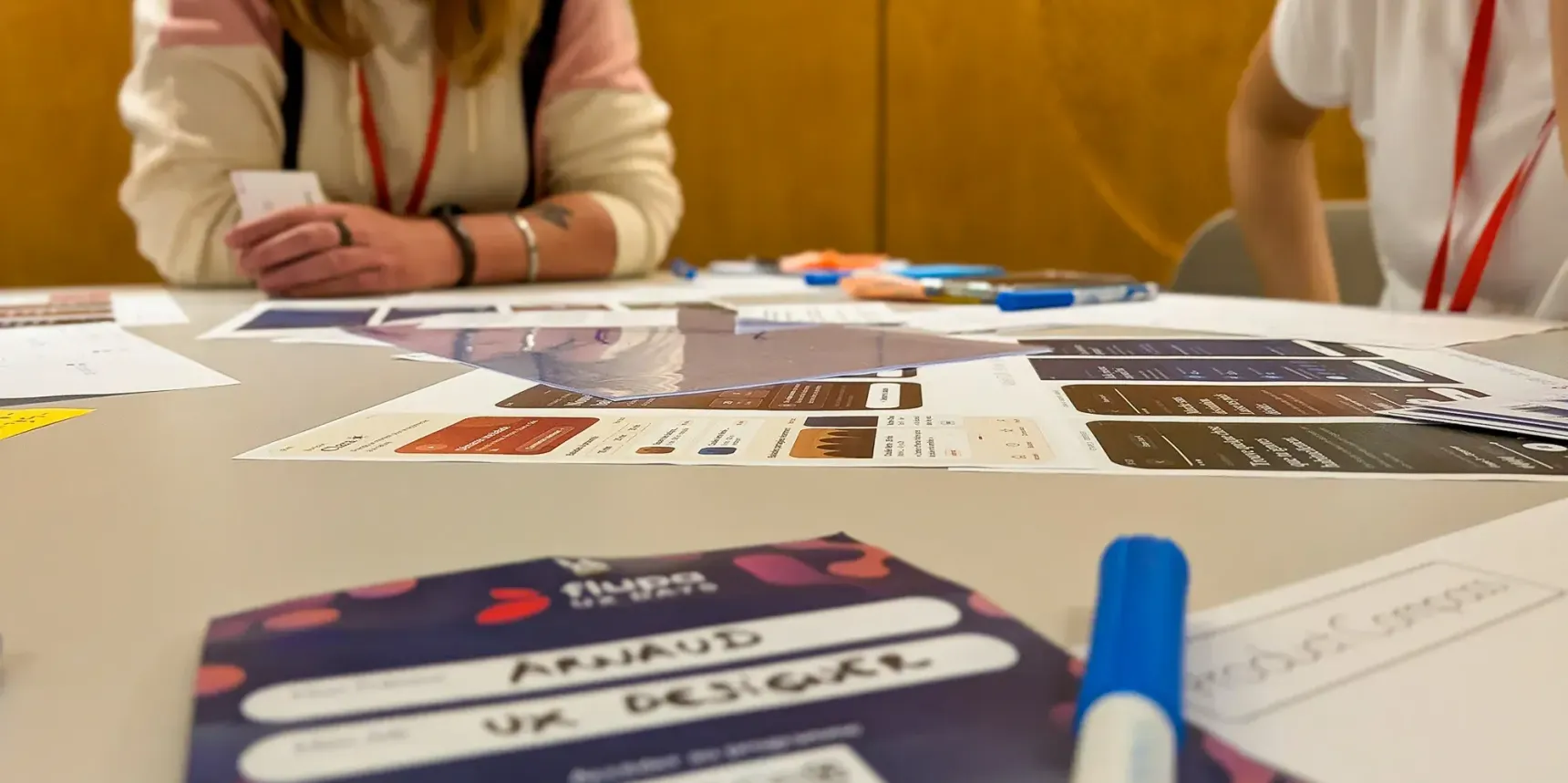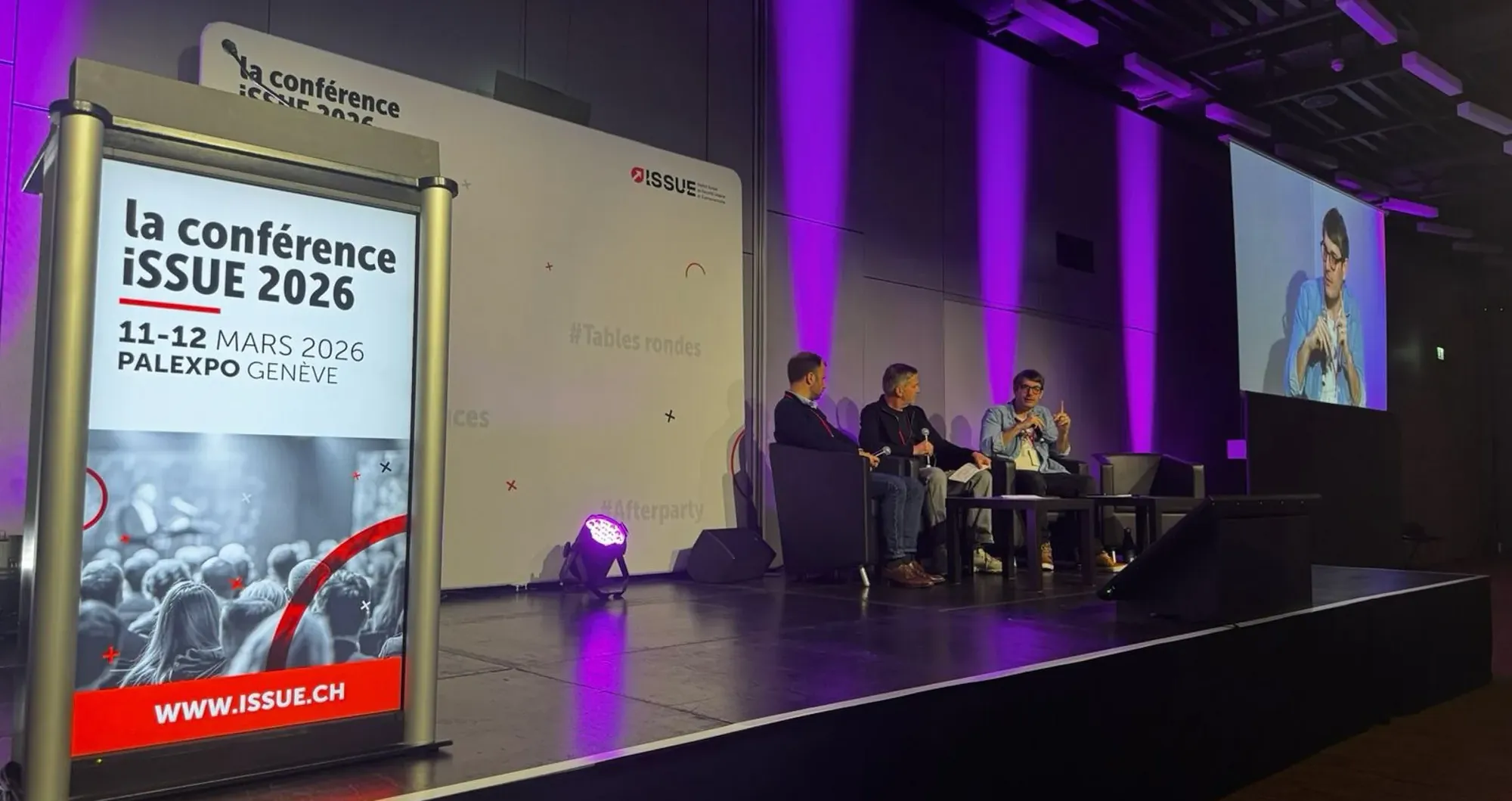
The Swiss Institute for Urban and Event Security (ISSUE) held its first edition at Palexpo on 11 and 12 March, and Pascal Viot, its president and a long-standing contact at the Paléo Festival, invited us to speak. Event security isn’t our usual beat; what we care about is uses and experience, whatever the field. Events, on the other hand, we know pretty well!
Pascal Viot opened the conference on a blunt note. The sector too often learns the hard way, too late, and rarely builds on what it learns.
The programme was built around three running themes (the field and lessons learned, threats and their proportionality, science and technology), with the aim of bringing together what usually stays apart.
Here’s what stuck with us, and why we think it reaches well beyond the question of security.
Procedures that exist on paper
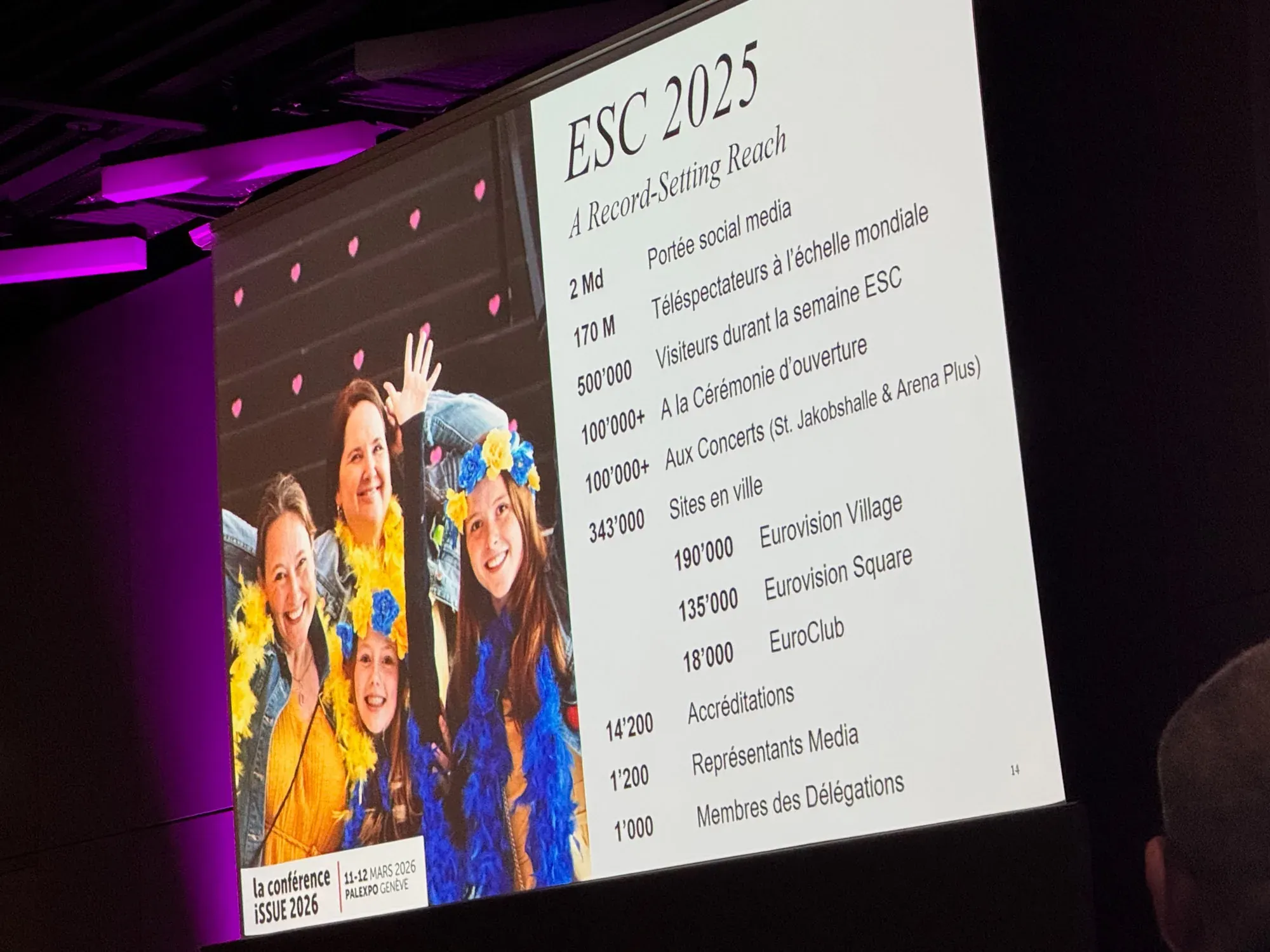
Aurore Châtard, Head of Safety for Eurovision Basel 2025, kicked things off with a debrief of the previous edition in Malmö. On security, she walked through the criteria matrices set up to sharpen anticipation, and the creation of a control room (a kind of mega security HQ) with a resilience role for crisis management. For attendees, she described spaces designed for different audiences: connected and disconnected zones, accessibility areas, even a disco space for the over-60s.
Between the two, it all comes down to how clearly everyone can read who does what, against a constant interweaving of security thinking and experience thinking that never fully resolves.
Morten Therkildsen, head of security at the Roskilde festival, which was scarred in the 2000s by an accident that killed nine people at the main stage, took the subject further. The best procedures count for nothing if no one knows who triggers them, and how. That word “activation” carries something “procedure” doesn’t, and it opens the door to the organisational side. Out of that experience, his teams built a “Stop Show” procedure, with a planning and decision-making structure that now underpins an international training programme.
The session on emerging risks asked much the same question from another angle: the idea of impermanence (everything changes, all the time), the need for a shared language between players, the role of the scenario, and the need to design systems around the timing and intensity of threats so they hold up and stay coherent.
The Crans-Montana accident brought two experts together, one French, one Swiss, to compare how the two countries handle fire-safety standards. Their frameworks complement each other, and the discussion showed that simulation and field feedback can move things along where the rulebooks alone fall short, because so much of it comes down to behaviour and how people are guided.
Experience doesn’t stop at the venue
Chris Kemp dug into the tension between what he calls “certainty” (over-planning, which makes everything rigid) and “uncertainty” (too little structure, weak organisation, weak integration, which leave teams improvising on the fly). Drawing on dozens of projects with major UK venues and festivals (Wimbledon, the O2 Arena), he laid out a framework for making sense of the “crowded space” (high-density areas) that looks as much at the big problems as at what causes them in the first place, in particular alignment between players.
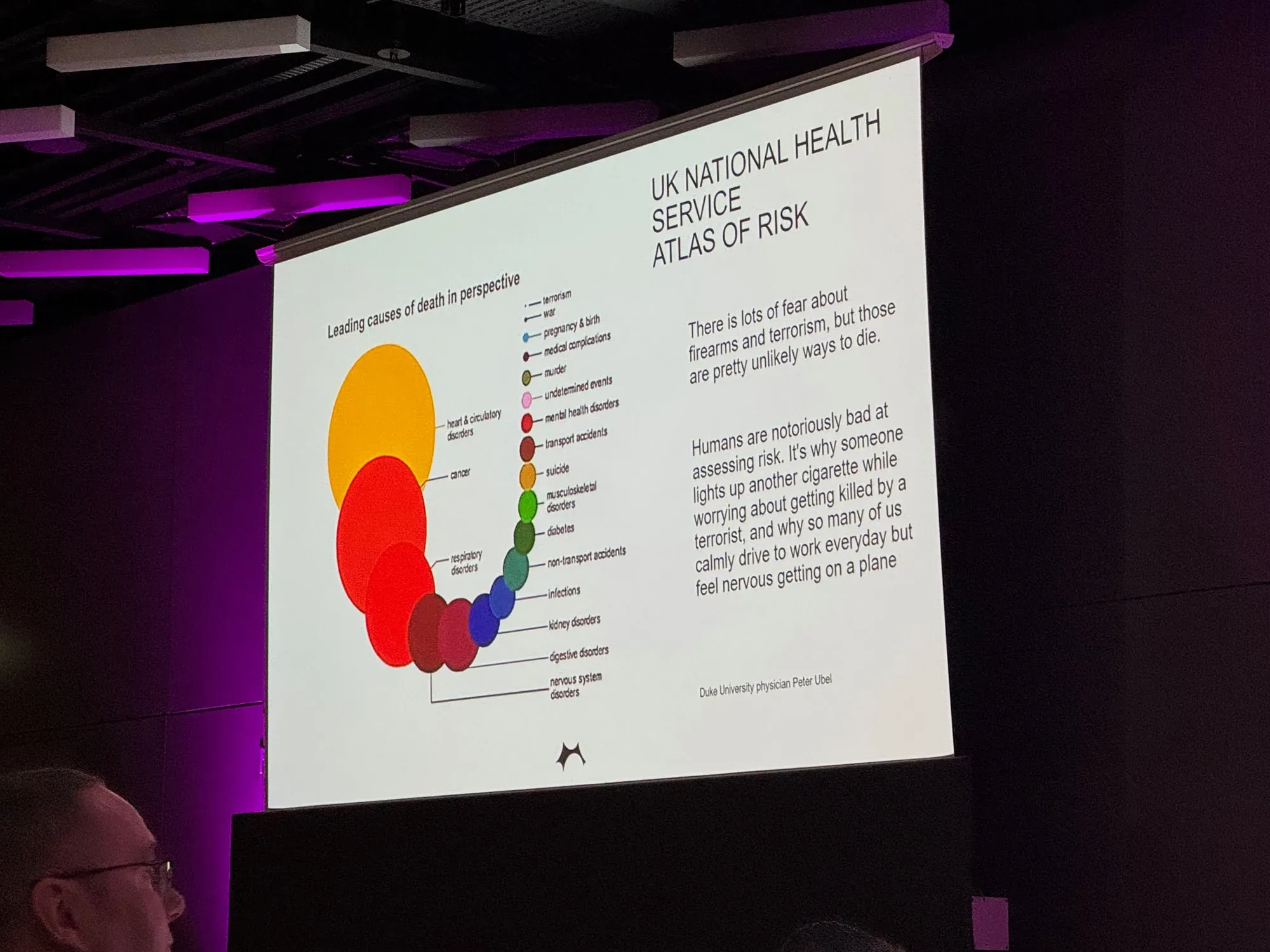
Pete Dalton, who spent several decades at Interpol, set out a method for preventive event security: threat analysis, vulnerability assessment, security by design, integration of operations, delivery assurance. Within that, he sees AI as a way to amplify what event-management professionals already do. Above all, he keeps a tight rein on the LLMs his teams use, and works strictly from open data.
One of us at Akiani wrote their thesis on mobility, so Franco Tufo’s talk (CITEC), “from tickets to memories”, landed close to home. With solid data and lessons from major events (Milan Cortina 2026, Paris 2024, the Pope’s visit to Geneva in 2018), he showed that transport is every bit as much part of the experience as what happens on site. The weight of data, and the in-house tools developed for sizing, were at the centre of his talk.
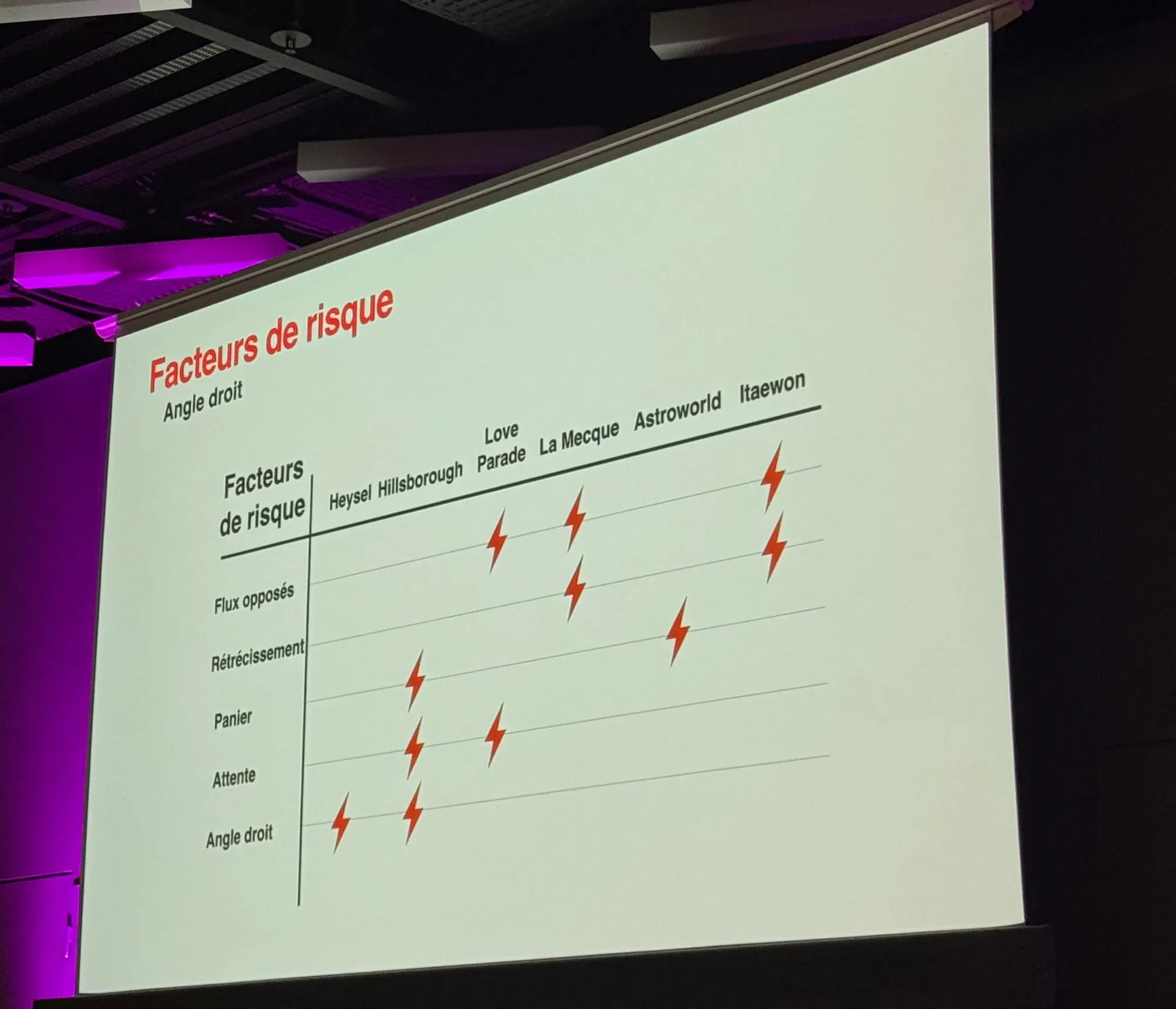
Mehdi Moussaïd, for his part, traced the science of crowds, from social-force models to granular matter. What caught our attention was how, when things get uncertain, it’s the “scouts” who shape everyone else’s behaviour. Drawing on real cases (the pilgrimage to Mecca, the San Fermín festival, the Love Parade), he pinned down the concrete risk factors: opposing flows, bottlenecks, the basket effect, waiting times, right-angle turns.
Finally, Thierry Rodrigues closed with a talk titled “Combining spectator experience with security”, through a service-design lens geared to crowd management. We recognised approaches close to our own. Spotting decision points along the spectator journey and placing wayfinding cues there, for instance, is exactly what we do.
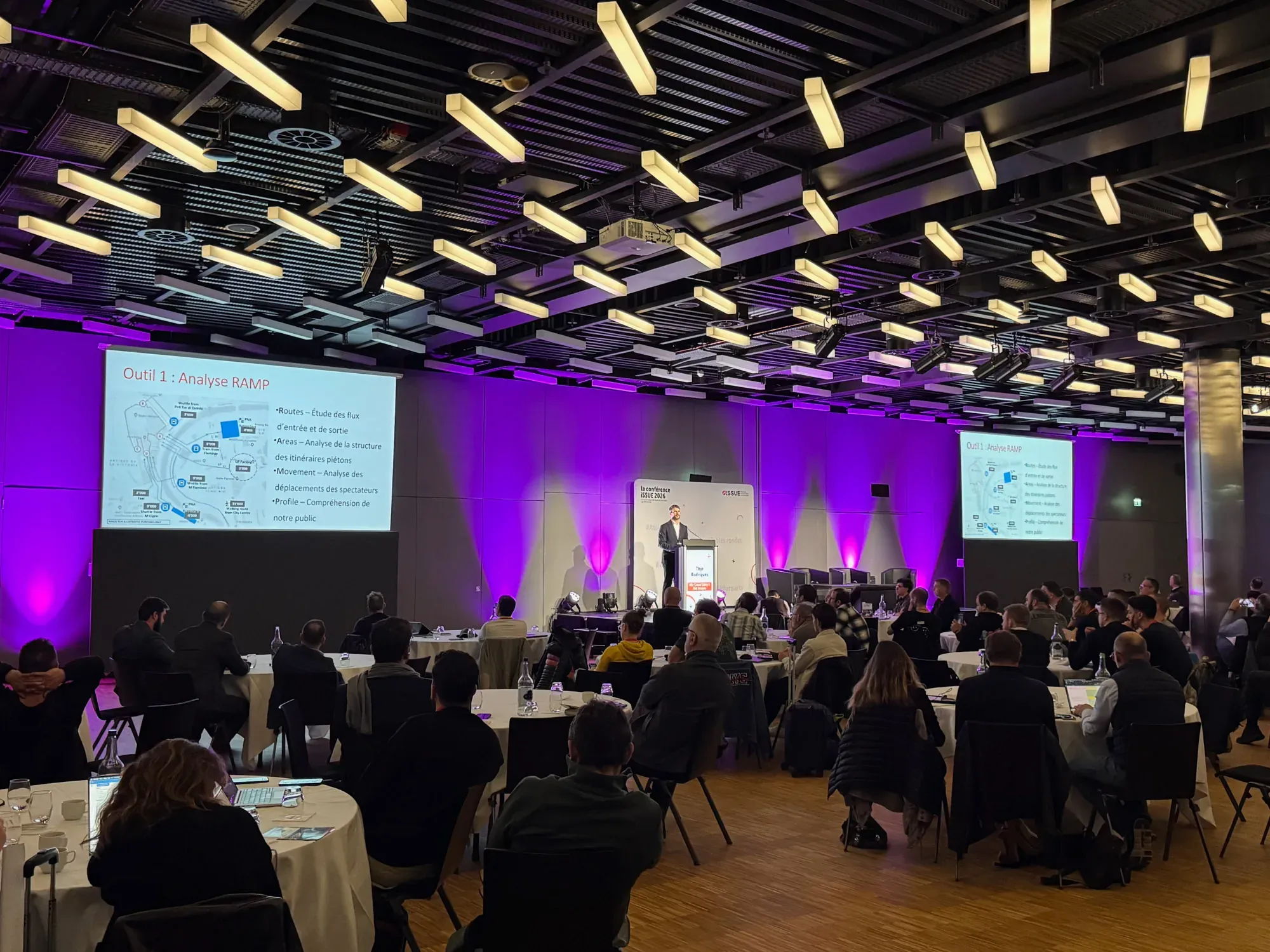
The session went on with a tour of how generative AI is being used in the sector, from querying documents to building personalised access tools. What made it worthwhile was that a security expert led it, not an AI expert, which kept the questions firmly on the business needs. The conference ended with a round table on training people in the field.
Technology doesn’t fix what we haven’t understood
We took part in a discussion with a counting-technology provider, moderated by Mario Fossati, secretary general of the Paléo Festival. We were glad to see him again in this setting, picking up the thread of our work together on experience journeys at Paléo.
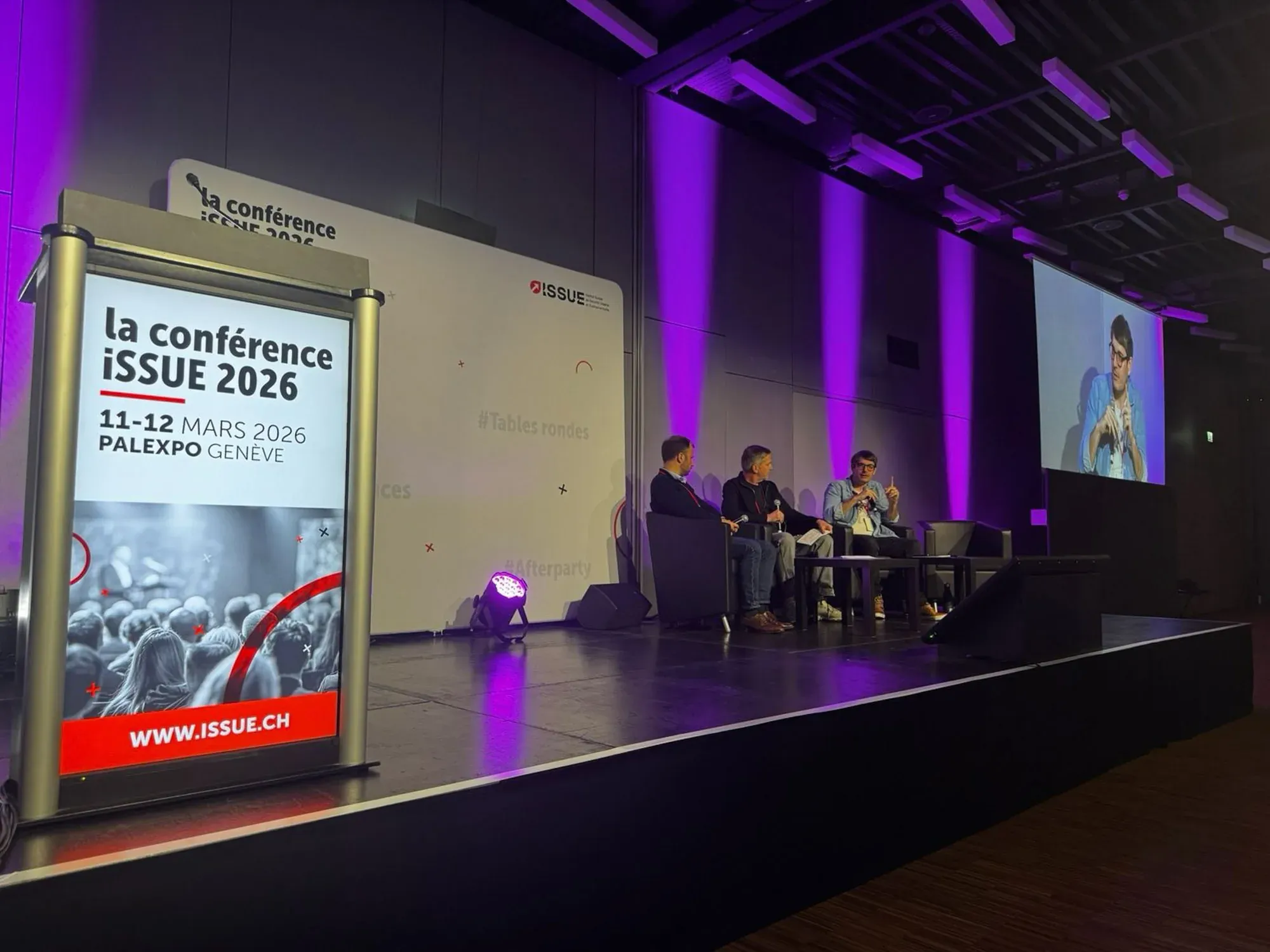
Our argument: there’s no such thing as an off-the-shelf solution. Before you bolt on a layer of technology, there’s real groundwork to do on how the organisation actually runs. How does it work today? Who decides what, with what information, and how quickly? Graft technology onto an organisation you haven’t looked at closely, and you won’t fix its silos, you’ll just make them visible. On the user side, we covered usability (a technology is only a technical proposal until people adopt it), then acceptability (you’re capturing my data, but what do I get out of it?), and finally connectivity, the idea that we’re both sensor and receiver at once. We also opened up a few angles on AI.
We go into it in more depth in our talk at the Weezday Festival (replay available).
What we take away
The second day captured everything this conference had going for it: cognitive science, crowd science, mobility, service design. Break down the silos between perspectives, and the whole value chain of the experience comes into view, along with things you’d never spot when everyone stays in their own lane. Clashing uses, questions of acceptability and interference, established frameworks running headlong into the reality of an actual event.
Put an airport-style screening point next to a stadium, for instance, and the crowd won’t behave the way it does in a terminal.
We came in as outsiders to event security. We’re leaving with the sense that the questions we ask on every project come up here too. All of it chimes with what we’ve been working on for years with the Paléo Festival Nyon, alongside the Akiani agency.
Thanks to Pascal Viot for the invitation, and to the whole ISSUE team for putting it together.
See you in March 2027.