Design in the era of the generative economy
By Anne Asensio
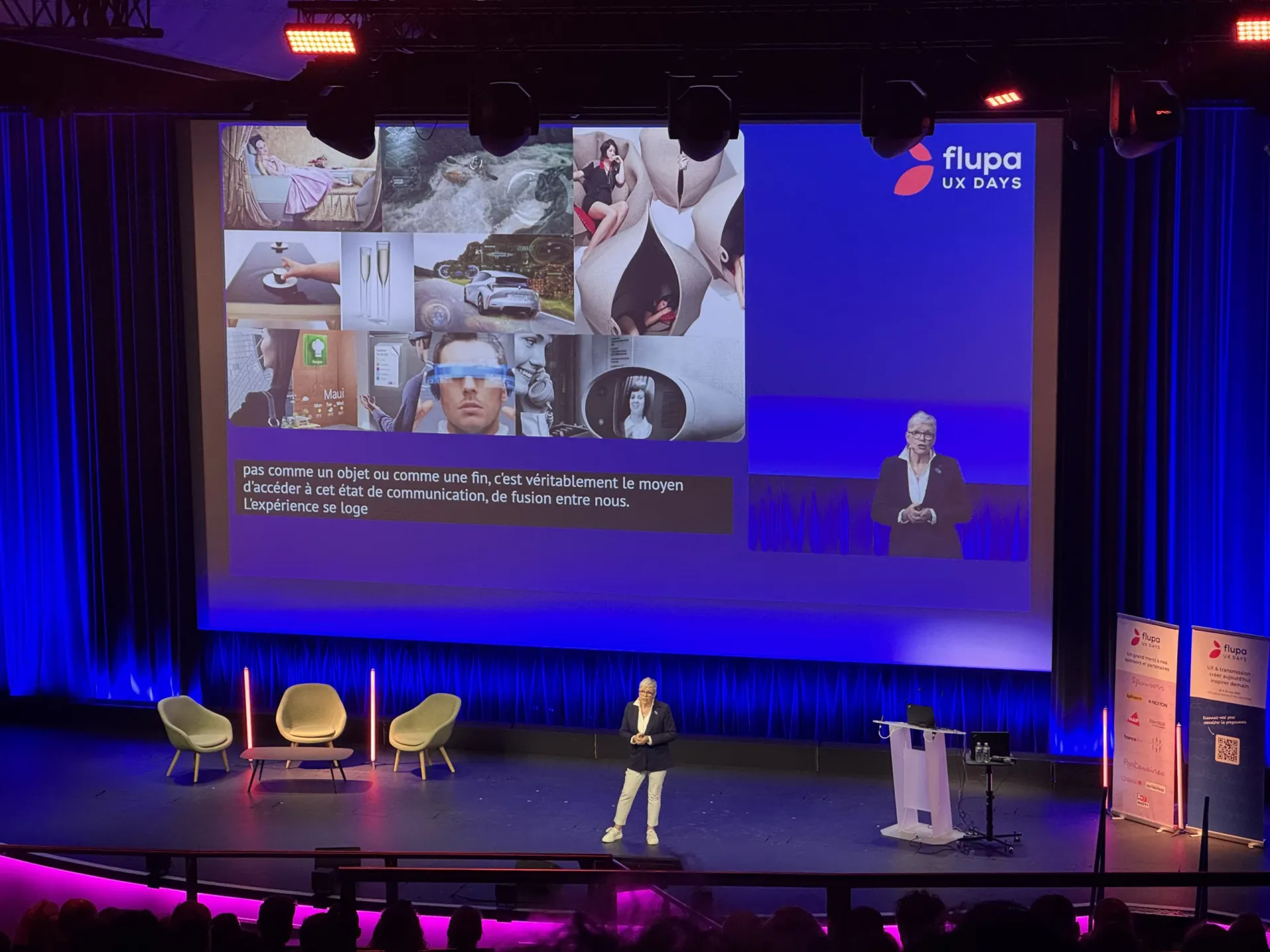
Design and humanity put to the test by digital simulation
This opening talk of the second day of UX Days offers a dizzying reflection (yes, it certainly took us by surprise) on how design can evolve in the era of virtual worlds, AI and the generative economy.
The introduction, which we will call “conceptual” out of diplomacy, traces the evolution of our capacity, as human beings, to make sense of what surrounds us. The thinking quickly leads us to a distinction between the human (real, tangible life) and the virtual (where simulation becomes the norm). Not easy to follow? Don’t worry, we also had to hold on tight.
From design thinking to “experience thinking”: a data-driven approach
Between humanist intentions and industrial reality, one question lingers: how do we preserve the essential qualities of humanity in the face of artificial environments steered by data?
The answer at Dassault Systèmes, brace yourselves, is design thinking. Sorry, “experience thinking”, presumably a little less 2010. An approach based on simulating experiences endlessly, compiling tonnes of data and creating digital scenarios to spot potential blockers for users, in a fully virtual world (yes, really). The digital twin ends up taking so much space that it overshadows the actual user. Visualising thermal flows and microparticles becomes far more exciting than asking whether anyone actually needs them.
On the internal communication side, on the other hand, everything is very serious: the various business teams work intelligently together and even use a common vocabulary to smooth out collaboration.
When AI drives the brief
The insights then move on to in-house use cases. At Dassault Systèmes, AI doesn’t sit idle. It:
- invents the personas,
- designs the train,
- even produces a trailer that is shown to us today.
A vision in which AI takes a very active part in the strategic and conceptual phase of design. All of it serving a projected piece of storytelling.
What we take away
While this technological approach has the merit of internal coherence, it also raises major questions: what about human sensitivity, real context, the diversity of uses? Standardisation through simulation risks creating technical and social biases, amplified by automated decision-making via AI. At Akiani, what we mostly take away is the paradox of this talk: in trying to humanise the digital, we can also drift dangerously away from it. The intention is admirable, but the means raise concerns.
Design for a living world
By Nicolas Roesch
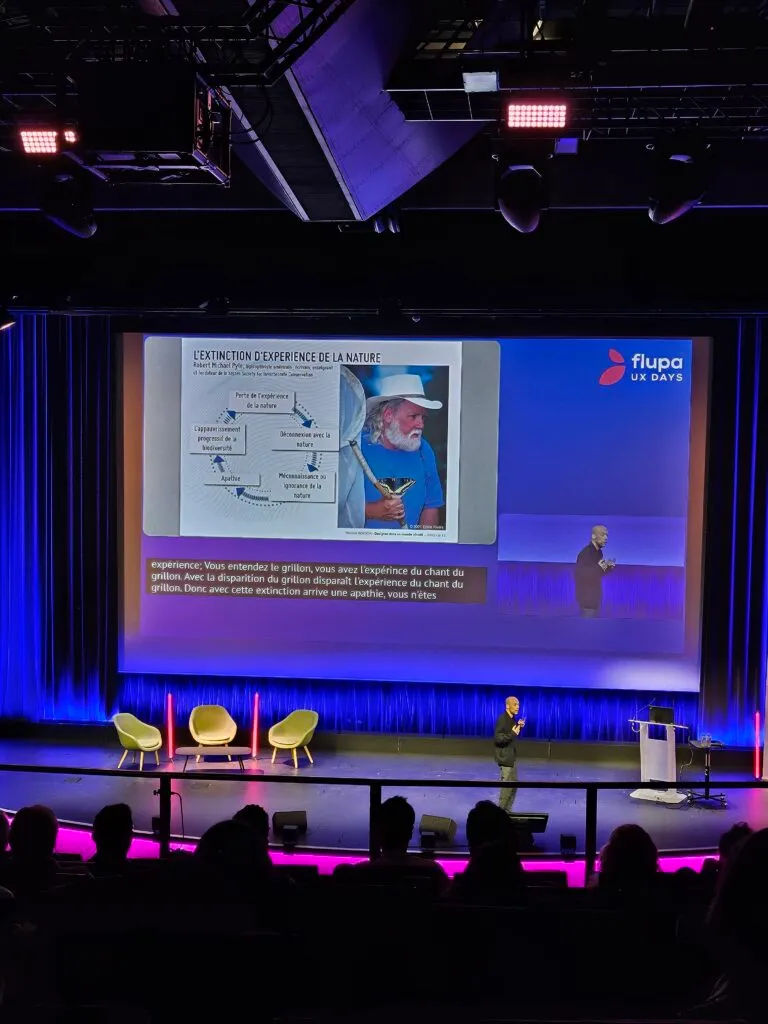
“How can we picture a desirable future without taking into account other forms of life?”
This central question is the spine of Nicolas Roesch’s talk. He is the founder of Zoépolis, an independent research lab that explores the relationships between humans and non-humans.
The extinction of the experience of nature
Nicolas starts by talking about “the extinction of the experience of nature”, a concept that describes how each generation takes the current state of the environment for granted, without realising the gradual losses of biodiversity. Without us being fully aware, biodiversity is gradually disappearing from our daily lives. It’s only through a few striking observations that we measure the scale of the problem.
Take insects. Nicolas mentions a time not so long ago, around twenty years, when they would splatter by the dozen on windscreens during every motorway trip. Today, nothing. This loss of everyday contact with living things leads to apathy and a lack of incentive to protect nature.
Recognise this or that tree leaf? Hard. By contrast, we can identify hundreds of logos. No surprise: they surround us all the time, while nature is becoming more and more scarce in an ever more urbanised environment.
What links between humans and non-humans?
In a well-documented, well-sourced progression, Nicolas describes the loss of biodiversity and the consequences for our societies and economies, highlighting the interdependence between humans and other living beings. The findings presented bring out that many essential ecosystem services, such as climate regulation and water purification, are at risk.
What role for designers?
His talk can be summed up as an invitation to switch from a human-centred approach to one that considers the needs of other “non-human” living beings. How? Nicolas shares several research areas, such as biophilic design (using biodiversity in the service of humans), design for biodiversity (designing for other species) and relational design (creating links between humans and non-humans).
Design as an ecological tool
Throughout his talk, Nicolas Roesch invites us to rethink our relationship with nature and to imagine solutions for a more harmonious coexistence between humans and non-humans.
Some examples are obvious: wildlife crossings, for instance, which let animals cross motorways safely.
These structures are designed to meet a double need: a human need (a motorway) and a need of the living world (letting animals move freely from point A to point B, without danger).
This is precisely the role of the designer: thinking about a harmony that is too often sacrificed for our own needs alone.
When we design a park, a road, a city, or any infrastructure thought through for humans, it is our responsibility to include nature and its inhabitants, both to preserve biodiversity and to protect our own future.
What we take away
As a digital designer, it can be hard to feel concerned by a talk centred on infrastructure design. And yet, this one made us see a real social issue more clearly.
Of course, we are already well aware of the environmental challenges linked to urbanisation. When we cut down a forest to build a motorway just to save an hour of travel, we know full well that this isn’t a gesture in favour of local biodiversity.
But this talk pushes us to think more deeply about the mechanisms that lead to this gradual forgetting of nature. If we never come across trees, it’s easy to forget they exist.
Isn’t it then our job, whoever we are, to make sure that nothing and no one is forgotten? Mosquito or tree? How can each of us, at our own scale, think about how to relearn how to coexist with nature?
AccessibilityOps: scaling up accessibility
By Anne-Sophie Tranchet
The challenge: making accessibility everyone’s business
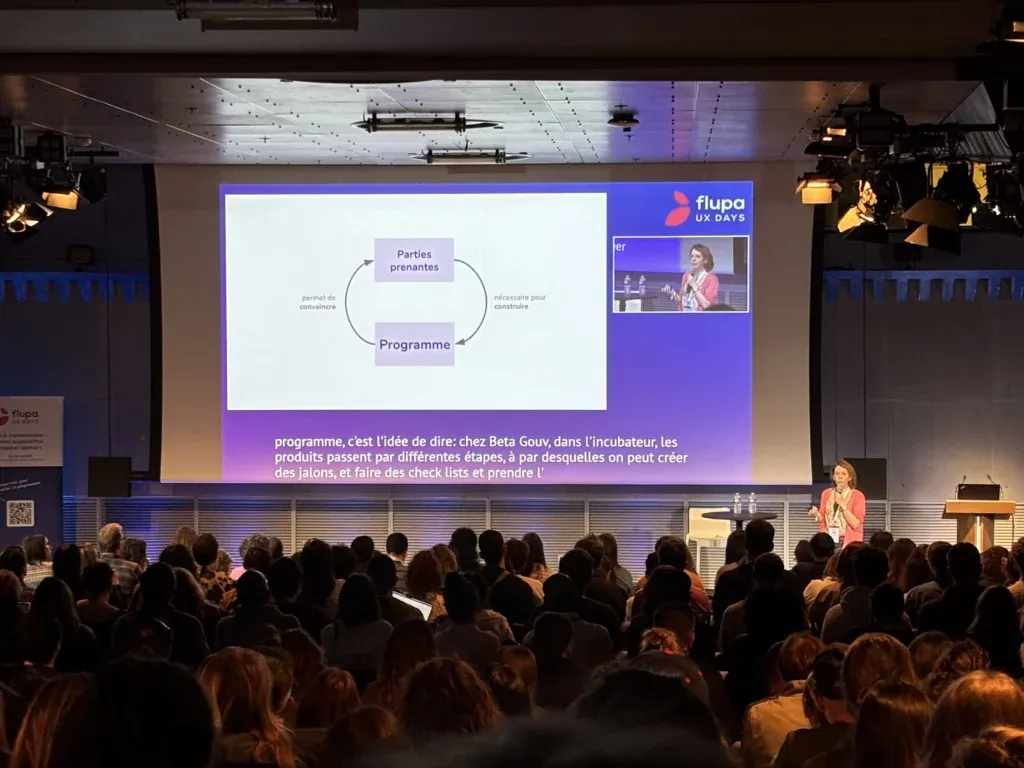
Can you do accessibility at scale without experts? That is the bet Anne-Sophie Tranchet has taken on, as lead design accessibility at the French State Digital Department. Since 2020, she has been working within beta.gouv.fr (opens in new window), the incubator for public digital services, structured as small, highly autonomous teams that often lag behind on accessibility. Faced with this widespread “zero level”, she starts with internal user research with the product teams. The aim of the operation: understand the blockers.
The clichés she then hears are varied; we’ll quote a few: “We don’t know how”; “It’s not in our roadmap”; “Accessibility is for later”; “Lean Startup isn’t compatible with that anyway”. The result is that teams cobble things together, push them back, or wait for an accessibility expert to come along.
The AccessibilityOps approach
Anne-Sophie proposes a comprehensive “AccessibilityOps” approach: a cross-cutting effort to link practices, people and tools. No silver bullet, but a realistic process to spread accessibility without delegating it, through:
- short awareness sessions (2 to 3 hours) to ask the right questions without aiming for expertise,
- ultra-concrete practical guides,
- “Easy Check” workshops: keyboard navigation tests of a service, then a roadmap,
- a support catalogue refined according to the teams’ concrete questions,
- a proactive approach rather than reacting to an already problematic situation,
- the cross-use of reports and KPIs to give visibility to efforts,
- the building of an internal community of allies to create a legitimate environment, where anyone can become a driver.
The three main principles proposed
- Embed accessibility directly in the design system, not as a post-rationalisation
- Be the voice of users with disabilities
- Don’t aim for perfection, aim for usability
What we take away
Anne-Sophie Tranchet presents a pragmatic approach. Where others would see standards as overly rigid tools or would invoke technical complexity to justify inaction, she equips and encourages people. She trusts teams to learn. Above all, accessibility is treated as a cultural issue, not as an audit to tick off.
This approach also raises questions: how far can you go without dedicated expertise? You don’t need to be an expert to write alt text, of course, but what do you do when it comes to drawing the line between basic accessibility awareness and the risk of doing things by halves?
And also: if everyone is responsible, who actually owns it? The approach works when there is an Anne-Sophie to carry it, train people and support them. In a less structured environment, or without an identified champion, does this model still hold up?
In short, the approach feels effective for raising the bar collectively. It should not entirely rule out deep expertise, if only for complex cases.
How do you document a design system that encourages critical thinking?
By Silvia Griso Sayas
A framework for thinking rather than a framework for execution
Silvia Griso Sayas, a specialist in language sciences and applied linguistics for over 10 years, asks an ambitious question: can we design a design system that doesn’t impose, but makes people think?
According to her, a good design system should leave teams real power of discernment: following best practices when they are relevant, or, on the contrary, deviating from them in an informed way when the context changes. In short, a design system thought of as a framework for thinking rather than a framework for execution.
Encouraging critical thinking, really?
Silvia mentions the work of Daniel Kahneman to remind us that our brain likes the fast lane (System 1) and that critical thinking (System 2) takes time and effort, which is not very compatible with the accelerated production logic encouraged in the working world. She questions in particular a certain managerial culture: do we value questioning or compliance?
Three principles for documenting your design system differently
Drawing on her work with the Qonto teams, she shares three areas:
- A systemic approach Documenting a component is not enough: it has to be put back into its ecosystem, with usage conditions and dependencies spelled out. The aim is to move away from a purely modular logic.
- Non-dogmatic language Drop the imperative, run from “you must”: prefer open, less normative phrasings. Language builds reality as much as it describes it.
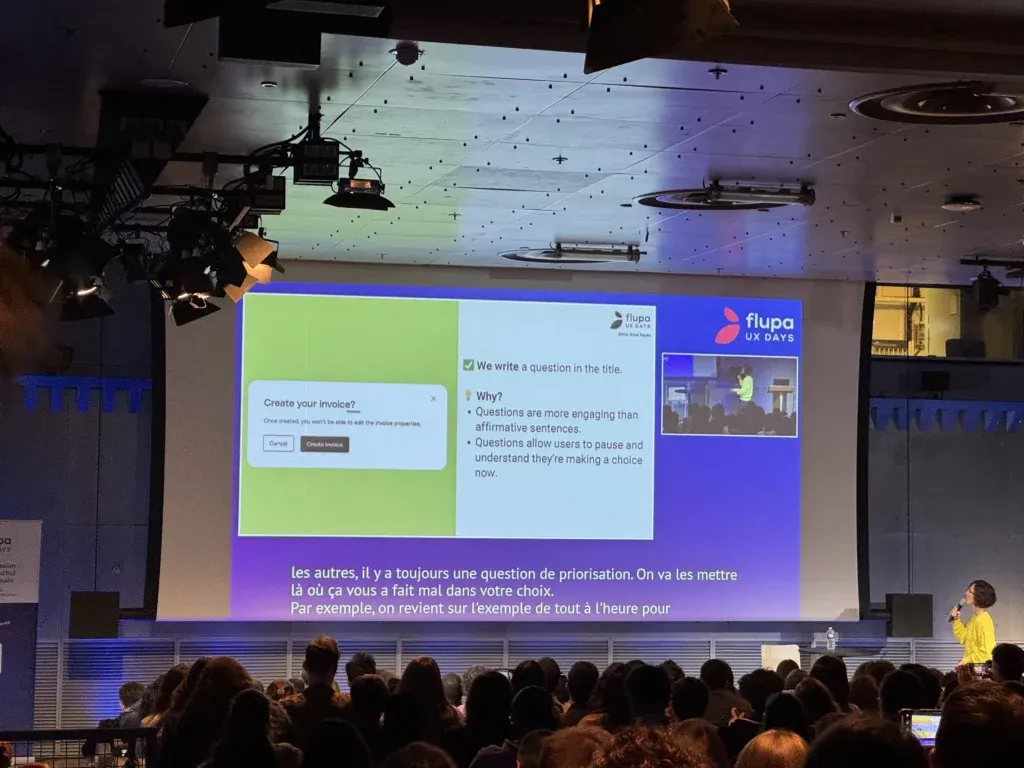
Explicit reasoning Every best practice should come with a “why”. The example Silvia gives to illustrate this point: “We prefer the interrogative form in pop-ups, because it creates a pause for the user and encourages engagement.”
The conclusion
The goal, according to Silvia, is not to get an army of executors, but to give people the keys so that anyone can choose not to follow the rules, “not to obey”. For her this idea is a necessity because “language has consequences”.
What we take away
On paper, the intention is admirable: move away from a rigid, normative design system to create a tool for informed choice. Fine. In practice, the proposal as presented stays methodologically very light, and the questions are many.
Adopting a systemic approach, documenting use cases and letting big principles coexist with context-driven variations is already part of the idea of a design system: in what way is the method shown here different?
In parallel, if the rules stop being normative, what is left of the design system? A guide of good intentions, an invitation to feel the context? Should we document and comment every component as if we were facilitating a workshop? If so, what happens to the principles of lower workload, brevity and concision? The work on language and context is interesting from an editorial enrichment point of view, but fragile when you look for a solid method.
And on top of that, at scale: how does this principle of “documented disobedience” apply in complex organisations?
The ideas presented stay on the surface, and the final impression is of attending a polite call to disobey without shaking the walls too much. We would have liked to see concrete examples where these theoretical principles are confronted with concrete constraints, but the short talk format probably doesn’t help.
UX writing for lower-impact digital design
By Clara Perrot & Apolline Rouzé
Lorem UX Writing
Clara Perrot and Apolline Rouzé take the stage with the promise of helping us shift our content practices towards more sobriety, less carbon footprint, less wasted energy. The message lands: UX writing can and must be a lever of environmental transformation. They remind us of the basics: digital already accounts for 4.4% of France’s carbon footprint. In the face of the current trend (always more screens, notifications and AI-generated content), another path opens up: designing differently, by encouraging more thoughtful interface design. They propose two areas of action: rethinking our production processes and putting a more responsible kind of writing into practice.
From “good UX writing” to “UX writing that does good”
Clara and Apolline put UX writing into practice through a grid they call the 6Es:
- The base “3Es”: Easy, Enjoyable, Engaging
- Then the “3Es” of writing that “does good” (which they call “Green UX writing”):
- Elementary: get to the point, limit unnecessary screens and interactions
- Efficient: structure the content to reduce cognitive load, errors and therefore energy
- Educational: get a message across, encourage more responsible use
Five good practices to put in place to do Green UX writing:
- Reduce: content (less, but better), design mobile-first to force concision
- Reuse: existing assets, systematise them through the design system
- Recycle: update rather than recreate
- Educate: slip nudges towards leaner choices into the journeys, inform users of environmental impacts, address them as aware citizens
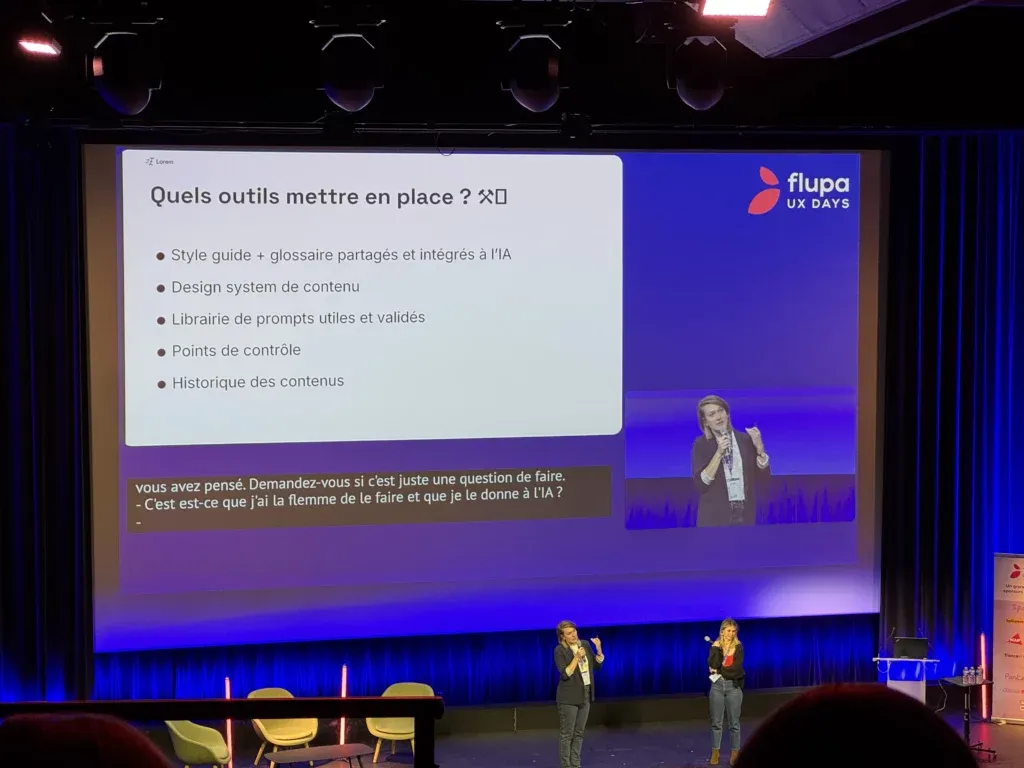
- Frame the use of generative AI: because AI can be a pollution accelerator if used without rules:
- for research, it helps to structure large masses of information,
- for ideation, it stimulates but doesn’t replace, for production, it supports quality if it respects a style guide,
- for localisation, it can refine, but never without cultural sensitivity.
What we take away
What we mostly take away is that “writing” is not neutral: every word costs energy, shapes a behaviour, extends a screen or avoids one. And that our role as designers is also to take a position. That said, the talk, while responsible, stays within familiar territory. Ethics and ecology are tackled from the angle of principles or small professional gestures that stay within common sense.
On top of that, the talk gets a little lost in a pile of lists, well structured ones (the 6Es, the good practices, etc.), but they are never embodied. No concrete example, no use case, no interface or content excerpt comes in to illustrate the recommendations or the problems encountered. To better anchor the ethics and sobriety message, we think it’s important to also show where it gets stuck and what solutions exist.
Health UX: passing information to better alert the doctor and better educate the patient
By Clémence Mayolle
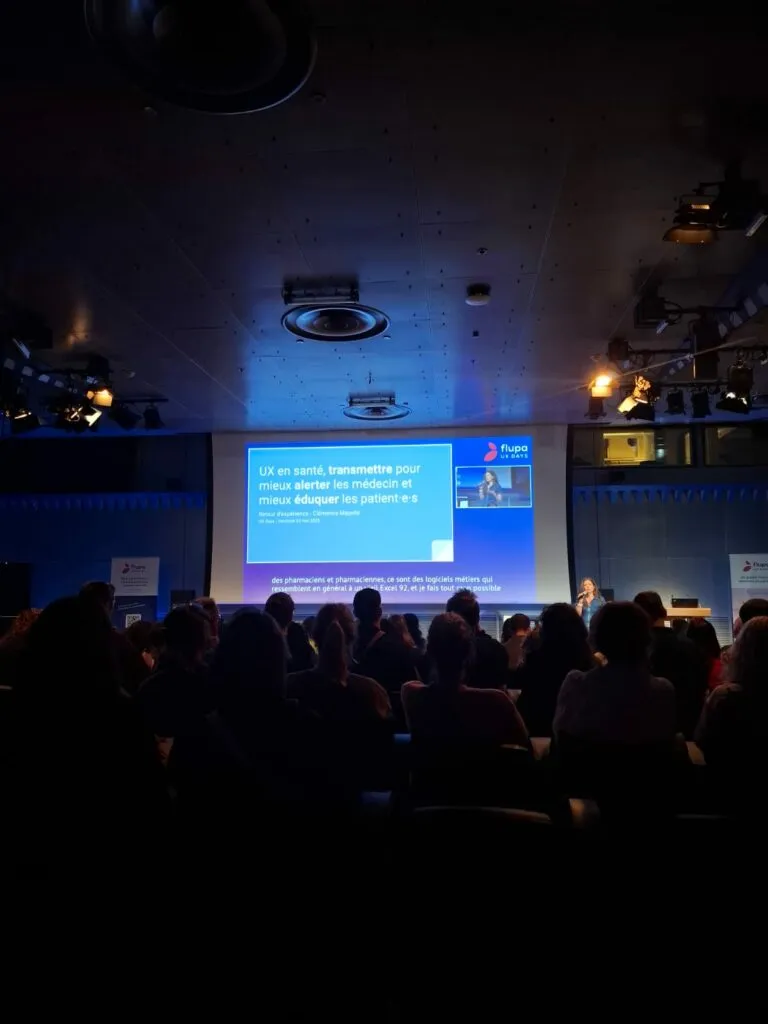
Clémence Mayolle, product designer at Posos, tells us about her experience as a UX designer in the healthcare field. How she turns complex problems into simple, intuitive solutions. She especially highlights the importance of passing on relevant information to doctors and patients in healthcare.
UX in the healthcare sector
Working on the UX of healthcare tools is a particular kind of experience. The mass of information, the specificity and the importance of that information. Relevance, urgency. Everything is crucial in passing on and sharing this data, whether for the doctor or the patient.
Clémence Mayolle explains that the challenge is to deliver the right information, at the right time, to the right person. You have to be able to deliver the information in a clear and accessible way, to help decision-making and understanding of the treatment.
Listening to your users
Of course, when working on this kind of platform, the first people to listen to are the users. Some information has to be put forward, others have to be secondary but accessible, and others are less relevant and just take up space for nothing.
To do this, our speaker highlights the specific points expected by her two user profiles.
Care professionals:
- Less cognitive overload: the flood of alerts and notifications doesn’t help to order information properly. So we make the alert relevant and actionable.
- We display the critical information without overloading the screen, and we allow quick actions.
Patients:
- Organise the information so as not to lose the user through a lack of understanding.
- Make the relevant key points easily visible.
What we take away
Listening to the user is the key to successful UX. But you also have to know how to give your recommendations. Among all this relevant information, we remained puzzled by the fact that “doctors don’t like clicking, so we showed them the information on hover” (with the example of a huge paragraph on hovering over a piece of information).
So yes, you have to listen to your user, especially for software as specific as healthcare ones, but isn’t it our job as UX designers to advise them and steer them towards better practices?
In the end, we attend a talk that highlights established UX practices and lets us discover all the work that can be done on topics as complex as medical ones. While we don’t come out blown away by new discoveries, we are still won over by this work that is thought through and built for its users.
Designer in 2030: a forward-looking workshop to take charge of your own evolution
By Marie-Valentine Gallon
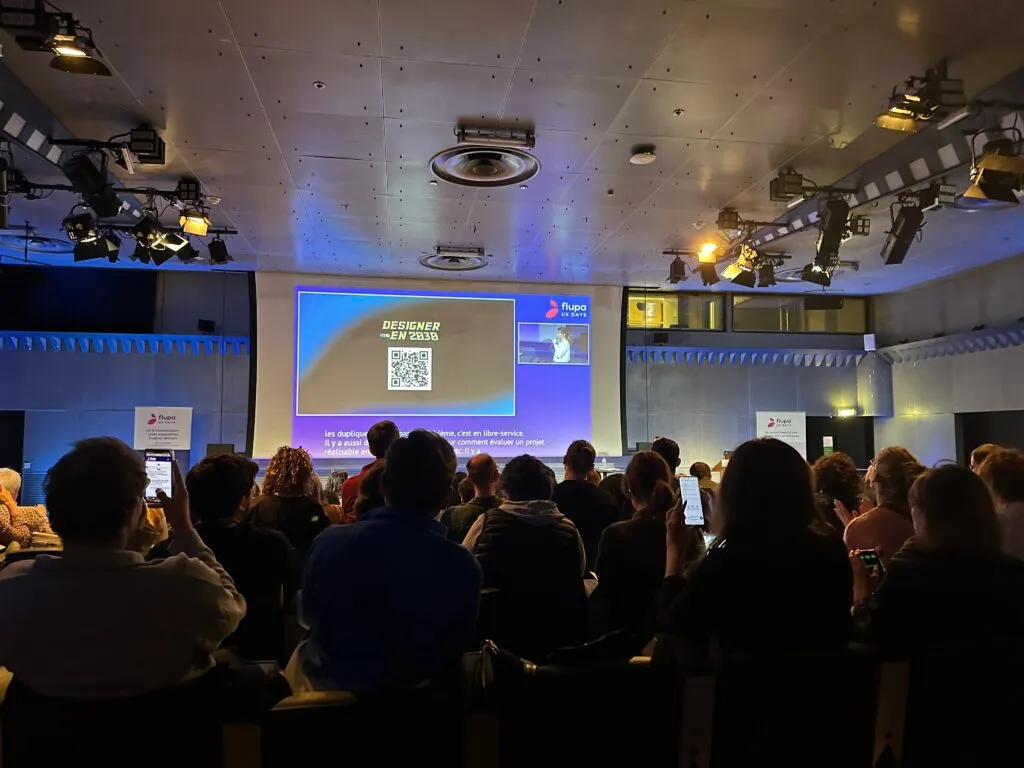
Marie-Valentine Gallon, design ops, presented the results of a workshop she runs with her teams: “The designer in 2030”. This workshop aims to get designers to think about their value in the face of AI, exploring how the craft evolves through a journey in time, a product challenge with skill cards, and a roundtable. Participants put together a group manifesto and a personal roadmap to embed AI as a tool serving their strategic expertise and user centricity, while staying agile, accountable and proactive about change.
The designer as the basis for a workshop on how a craft evolves
Surviving AI by becoming a Magic hero?
She tells us: the start of the workshop consisted in retracing the evolution of the designer’s role from 2005 to a projection in 2036, with participants able to see the constant mutation of the designer’s profession. A projection in 2036 offered the vision of a designer connected with the whole world, with a virtual chat assistant, able to code interfaces directly and to discuss strategy with a board of directors.
“Professions have always evolved and will keep evolving. The aim of this day-long journey in time was to rationalise change.”
Once the notion of change and evolution was set out, the rest of the workshop was devoted to what comes next. How do you picture the designer of the future?
We then project ourselves five years out, in 2030. Two teams have to imagine a company and its product, and propose an innovative and reliable solution based on the team’s skills.
As part of this product challenge, the teams had to pick “booster cards” representing different skill families (data, strategy, tech, society) to develop their solutions. These cards, inspired by the Magic game, helped designers identify the skills to acquire over the next five years and to form multidisciplinary teams to convince a jury.
“This exercise let the designers visualise the skills valued by organisations and gain confidence in their future evolution.”
How do you turn this workshop into real consequences for the craft?
A roundtable allowed each participant to break down silos around AI and to express the team’s legitimate fears to managers. This was followed by the writing of a manifesto on AI use and on the direction to take as a team of designers. Then everyone put together a personal roadmap, picking one or two skills to develop by 2030 and identifying the means to do so.
“The idea is to anchor the team around a shared vision.”
What we take away
It is up to us to define our role for the future and not to resist change passively. As at Akiani for example, our board is made up of designers, so we’re already in the future, really.
The talk is very positive on how design evolves in the face of AI, but a certain scepticism is allowed. As with any major transformation, the design market won’t be able to absorb every professional. We also note the workshop format presented (and we salute the companies that allocate resources and headcount for this kind of experience). It’s a great source of inspiration for supporting business teams faced with their fear of change, and for including them in the decision-making process. In the digital age, the topic of how professions evolve is a challenge we meet every day as designers. The way this workshop unfolds, with a timeline and nice playing cards, is refreshing. It’s also interesting to see designers as the participants for once.