Opening keynote: designing the world of tomorrow
https://www.youtube.com/watch?v=syZkkJjElvI&list=PLP7rKNixzebY3lYx1NRTdqMShVMsbxurJ&index=2
What we took away, in short:
In the face of the climate and societal challenges to come, we have to push for a shift towards more ethical design. We need to bring frugality into design work. We also have to tackle these issues head-on within our organisations and with our various stakeholders.
It is critical to take an interest in, or even train ourselves on, the situation we are currently living through. According to Jean-Marc Jancovici: “politicians won’t do anything to change things, the initiative has to come from citizens.”
Our recap of the talk:
This day of talks at UX Days opens with a keynote by Jean-Marc Jancovici. A great opportunity to listen to this specialist on energy and climate-impact issues, who has been working on these topics since the late 1990s.
Jean-Marc Jancovici comes back to the main factors of physical disturbance of the atmosphere introduced by humans, such as: the use of coal, deforestation and methane emissions.
Contrary to what you might think, no technical innovation (such as the introduction of electricity) has helped reduce these emissions and therefore their impact on the atmosphere.
The atmosphere will never return to an original state, not today, not tomorrow.
Jean-Marc Jancovici - UX Days 2022 / Paris
The conclusion is clear-cut, the excess CO₂ we have produced cannot be undone. Only nature could absorb this excess and bring it down. A process that would take thousands of years.
This time span has to be put in parallel with the mismatch with the average time it takes to put corrective measures in place in companies, which is around 3 years.
Jean-Marc Jancovici also points out how ineffective the COPs (“Conferences of the Parties”) are. These United Nations conferences gather every year at a global summit to adopt actions to fight climate change. He shows that the quantity of CO₂ in the atmosphere has followed a linear, growing trajectory since the COPs were set up: proof, according to Jancovici, that these mechanisms are not enough for a real improvement of the situation.
Even the Paris Agreement seems out of step with reality. To reach the goal of limiting global warming to 1.5°C, and preferably to 2°C, by 2050, unrealistic scenarios are presented. Future generations would have to consume ten times less and emit three times less than today, or there would need to be an exceptional event that drastically reduces these emissions.
Reducing global carbon emissions is the most realistic solution.
Jean-Marc Jancovici stresses that coal power plants play the biggest role with 20% of emissions, followed by agriculture (18%), transport (15%), industry (12%), deforestation (11%), gas and fuel oil (9%), cement (4%) and buildings (4%). The other sectors represent the rest of the emissions (around 7%).
It is in this slice that the emissions caused by digital sit.
Jancovici insists on the fact that digital practices are not at all “dematerialised” the way we usually describe them. On the contrary, we are seeing a materialisation, even more pronounced than before, with the creation of digital tools that have a high renewal rate: computer servers, smartphones, smart objects, and so on.
Such an observation inevitably creates some frustration, given how few solutions are offered at the end of this talk. But it’s up to us as designers to take up these challenges by turning towards a more ethical design, both in our practices and in our dialogue with our counterparts.
For the more curious, we invite you to check out The Shift Project (opens in new window), a think tank working towards an economy freed from the carbon constraint, of which Jean-Marc Jancovici is the chair.
The creative brain
https://www.youtube.com/watch?v=4GQJ2RjS5PY&list=PLP7rKNixzebY3lYx1NRTdqMShVMsbxurJ&index=7
What we took away, in short:
Children are not always the ones with the highest level of creativity.
You have to put in place methods that get the brain out of fixation states.
Our recap of the talk:
Anaëlle Camarda, a researcher in cognitive development psychology, talks to us about creativity and “Think outside the box!”.
Creativity, Anaëlle Camarda explains, is the ability to generate ideas that are new and adapted to today’s society.
As human beings, we are all called to solve simple problems, on average for thirty minutes once a week. And complex problems for thirty minutes once a day.
This ability is a faculty intrinsic to human beings. It is possible to describe its variations in intensity through a model: the “Four C Model of Creativity”, ranging between a low level (“mini C”) and a high level (“big C”) of creativity.
If everyone is involved in the creative process, Anaëlle Camarda explains, the same is true when we talk about the blocks in the process. These famous “fixation effects” are biases that don’t let the human brain fully move forward in exploring new solutions, called the “expansion phase”.
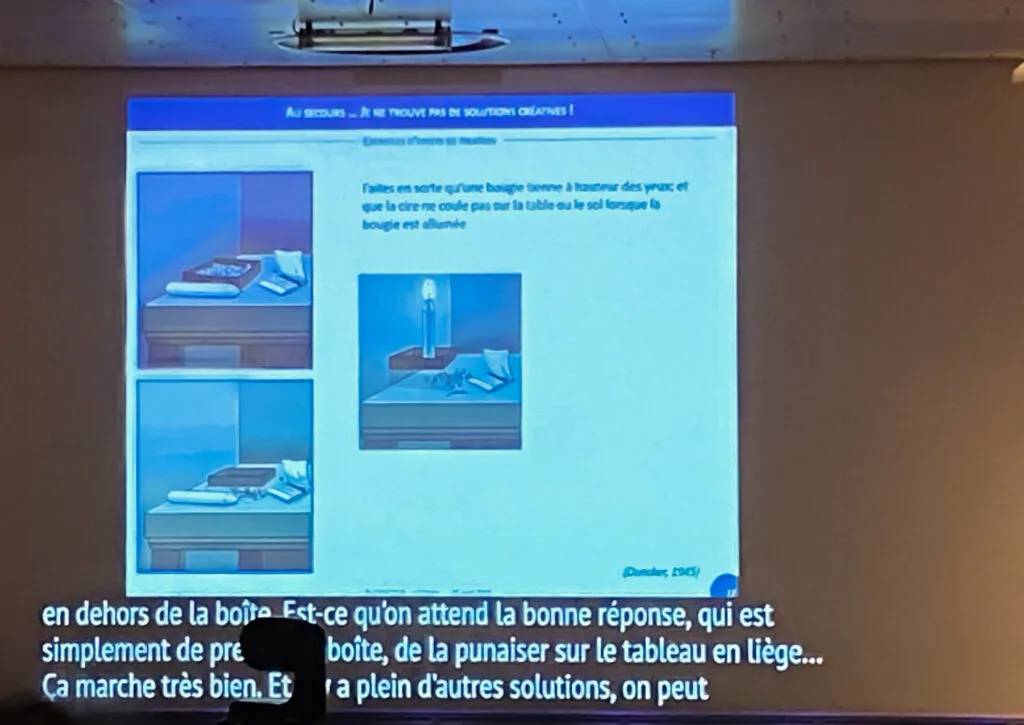
To illustrate her point, she sets out the following problem: how do you make a lit candle stand on a table without the wax dripping onto it? In the visual shown, you can see the candle, the table, but also a box and some drawing pins.
Usually, most of the people asked don’t take the last 2 objects into account in solving the problem. The ideal solution is to use the box as a stand for the lit candle, after emptying it of the drawing pins.
The initial use of the box, Anaëlle Camarda explains, is to hold the drawing pins, and our brain has a hard time repurposing its original use. This is indeed an example of a fixation effect. By lowering this effect, the brain becomes more creative.
How do you activate creativity?
Does already having examples of solutions help or hinder creativity? The results of the studies presented show that the level of creativity is lower when we use examples that involve fixation effects. It is higher when we use examples that don’t carry fixation effects. And the level is in the middle when we don’t use any example for inspiration at all.
As for the myth of the child always being more creative than the adult, Anaëlle Camarda points out that this isn’t always the case. The level of creativity is in fact higher in children when they use a given example. It is, on the other hand, higher in adults when they work without an example.
As adults, we also better detect items of interest through the brain’s “salience network”. 3 networks sit behind creative processes in the brain:
- the default network, also called “mind wandering”, which is constantly reasoning,
- a salience network, which detects items of interest,
- and finally the control network, which controls what can be explored.
To illustrate her point, Anaëlle Camarda sets out the following problem:
“Propose a solution to make sure a chicken egg dropped from a height of ten metres doesn’t break”.
Statistically, the people asked propose 2 lines of solution:
- 81% of the solutions consider using a device to protect the egg (a mattress, a parachute, etc.): they involve fixation effects and are generated from the brain’s automatic, intuitive system.
- The remaining 19% are made up of solutions that don’t suggest a device. To generate them, the brain uses the analytical system, which is more costly than the first, but offers a higher level of creativity.
Should we bet everything on the brainstorming method? The results show that this method, which is supposed to reduce the social effects of the group in which it is used, is not effective at the collective level. The presence of leaders in the group will always cause fixation effects.
To stimulate creativity, you therefore have to introduce moments of individual generation and use the KCP methods to benefit from the input of knowledge in idea generation.
How do ideas emerge and develop (for a designer)?
https://www.youtube.com/watch?v=74a9gs_xlBk&list=PLP7rKNixzebY3lYx1NRTdqMShVMsbxurJ&index=8
What we took away, in short:
A nice presentation of the work of Étienne Mineur, a French designer, publisher and teacher, exclusively centred on experimentation, tinkering and the marriage of the physical with the digital.
A talk to take for what it is: a great opportunity to marvel at the richness of the projects presented and to see the creative processes of this personality with a wild imagination (with a welcome touch of humour). You walk out with stars in your eyes while being aware that it’s hard to reproduce these creative processes in our day-to-day work.
Our recap of the talk:
How do ideas emerge and develop (for a designer)?
Étienne Mineur answers this question by inviting the audience to discover his lines of thinking and his practices through various projects. All based on experimentation, tinkering, and the marriage of the physical and the digital.
By way of introduction, he mentions the work of Gunpei Yokoi, a designer at Nintendo and creator of the famous Game Boy. It was while watching passengers on a train play with their calculator that he had the idea of creating a pocket electronic game aimed at adults, easy to use and to carry. The Game and Watch, an ancestor of the Game Boy, was born.
Observing the world around us, repurposing uses and constantly questioning ourselves to develop creative ideas.
From this observation, Étienne Mineur presents a series of projects he worked on alone or with a team: websites with carefully crafted aesthetics, the use of artificial intelligence in the creative process, or the design of digital games on a tablet or in paper format.
You come out with stars in your eyes and one question: how can we reproduce such mechanisms in the reality of our day-to-day work? The answer is not given, but what we’ll take away is that, for a designer, ideas don’t come and develop without the ability to observe, to question, and even a bit of courage.
The triumph of Bullshit: A brief history of methodology!
https://www.youtube.com/watch?v=HU6m1eh9CkE&list=PLP7rKNixzebY3lYx1NRTdqMShVMsbxurJ&index=9
What we took away, in short:
The designer’s craft relies too much on methods, which end up becoming an end in themselves rather than a means. There are also too many different methods, no one can tell them apart, and that holds back creativity.
A talk that feels like a chat between colleagues, with the merit of raising a few questions.
Our recap of the talk:
It’s the turn of Laurent Chastrusse, a UX designer, to share his view on the borders of the design world and its limits.
According to Laurent Chastrusse, at the root of methodology lies the quest for good practice in order to do the designer’s craft at its best level. A parallel is drawn here with parenting: to be a good designer, just as to be a good parent, you first have to be present and reassuring.
Not finding more concrete guidance than that on the processes to follow, the designer (parent) will then run their research on social media and cling to “alternative” pedagogies that put the user (child) at the centre. Montessori, Freinet, Steiner methods for the parent. Design sprint, systemic design, service design, design thinking methodologies for the designer.
In the case of design, these methods have an undesired side effect: the industrialisation of the craft, with predefined processes and standardised tools. Creativity is then penalised. The workshops that come out of them all end up looking like benchmark slideshows without analysis. All of this leads to a loss of credibility, and to fix that, new methods are invented, meant to regain legitimacy by giving an idea of a scientific approach to the creative process.
Concretely, the added value of the craft is no longer perceived. Laurent Chastrusse’s verdict is final: methods have no guarantee of success other than making it easier to sell services such as design thinking, design sprint, and so on.
How do you communicate a solution without inventing a new method? According to Laurent Chastrusse, we should:
- go back to basics, without imprisoning ourselves in the method
- reclaim our need to adapt to the context
- stop selling two- or three-day training sessions in which we put fictional methods into practice to fit time constraints, promising people they’ll come out designers (*applause from the audience*),
- stay curious, feed our brain to go beyond the methods we’ve seen over and over and the same books read again and again
In the end, Laurent Chastrusse reminds us, it isn’t the methods and the tools that make a good designer. We all have to vouch for the value of the expertise we’re bringing.
Being a designer today: ethics, posture and vision.
https://www.youtube.com/watch?v=jJcLgHn1MR0&list=PLP7rKNixzebY3lYx1NRTdqMShVMsbxurJ&index=6
What we took away, in short:
For design to be a real lever for change, we have to define a collective work ethic rather than bet on individual initiatives.
Recap of the talk:
The day of talks at this UX Days closes with the contribution of Mellie La Roque, Service Designer at SNCF Connect&Tech and co-chair of Designers Éthiques. The introduction picks up the concepts of challenging the consumer model and the scenarios of infinite growth that we also came across elsewhere over these two days (Papanek and Meadows are among the most cited references across all the sessions), a tangible proof that these topics are priorities for the future of our craft.
Mellie La Roque sets out three areas for design to be a lever for change:
- understand change and shift the paradigm
- develop an ethical stance
- reorient our practice
Area 1: understand change and shift the paradigm
Three stances should drive this paradigm shift:
- moving from “anthropocentrism” to “ecocentrism”, based on the principle of interconnection between humans and nature
- switching from growth indicators (GDP) to wellbeing indicators
- moving from hypertechnology to reasoned technology, which takes social and economic impact into account (the example given is the “Fairphone”, which takes responsibility for the entire lifecycle of the tool)
Mellie La Roque then mentions her three ways of taking on this change in her professional day-to-day:
- studying the forces of change towards digital sobriety and their impact in 2030-2050
- opening up to a variety of expertise
- co-building a long-term vision, by imagining 2030 scenarios, in order to steer product choices right now
Area 2: develop an ethical stance
La Roque defines ethics as the action of our deep conscience to act without harming what surrounds us. Defining an ethical frame in design rests on four principles:
- usefulness: the design represents an answer to real needs
- sustainability: the design has minimum impact and contributes to regenerative dynamics
- universality: the design can be taken up by anyone (the notion of accessibility)
- autonomy: the design respects users’ freedom
Based on these four principles, Mellie La Roque can make her design choices more consciously, by accepting or refusing to work on a project, or by steering the work in the best possible direction.
In the day-to-day, the actions to align practice with these principles are the following:
- driving change with the technical teams
- writing guidelines that point in a more virtuous direction (the notion of digital sobriety)
- making these guidelines operational (for example: measuring the sobriety of the service)
Area 3: reorient our practice
By reorienting our skills, for example:
- getting fully up to speed on the evolution of the climate
- looking into history to understand the reasons behind these changes
- adopting an interdisciplinary approach, which means working with a range of profiles
- developing critical thinking by proposing alternative trajectories
- developing technical skills such as digital eco-design
Mellie La Roque explains how these skills have been developed in her work setting:
- running a stocktake and an audit on environmental impact (Example: the Greenspector solution)
- raising awareness and training product designers in digital eco-design
The closing thought invites us to reflect on the fact that ethics isn’t just a professional question, it is also a generational one.
Conclusion
The themes covered during this second day of UX Days feed debates and reflections kicked off within our team, and when that happens, it’s always a good sign.
A big thank you, then, to all the speakers who led this second day of talks, as well as to the Flupa teams.
See you next year for a new edition of UX Days 🙌
🎥 To watch the videos of the talks, it’s right here (opens in new window)