
What participant recruitment involves
Plenty of situations call for recruiting participants: experiments, interviews, user tests.
Good recruitment should let you find a set number of participants who:
- match precise criteria
- are available during the experiment’s time slots
- and can be found within a given time frame.
The idea is to draw in enough participants while already doing a first round of sorting. Bringing in people who can’t actually take part is counterproductive for everyone, ours and theirs alike, and it tends to leave a sour taste.
If there’s nothing in the experiment for the participant, a little incentive goes a long way, all the more so if they have to travel for it. That could be a cash payment, a gift card or simply a snack.

Crafting the recruitment message
For recruitment to work, the very first job is to write the message. It needs to be as clear as possible, carry the key information, and be easy to tweak as you go. A message that is clear, complete and pitched at the right audience will pull in your target group and only them. That makes the sorting easier and saves you time.
Start by listing the essential information to give participants. It should include, among other things:
- a brief description of the experiment, or even of the task to be carried out
- the acceptance or rejection criteria set by the experiment
- the conditions (number and length of the sessions, equipment needed, etc.), location and date(s) of the sessions
- contact details to reach the experimenter(s).
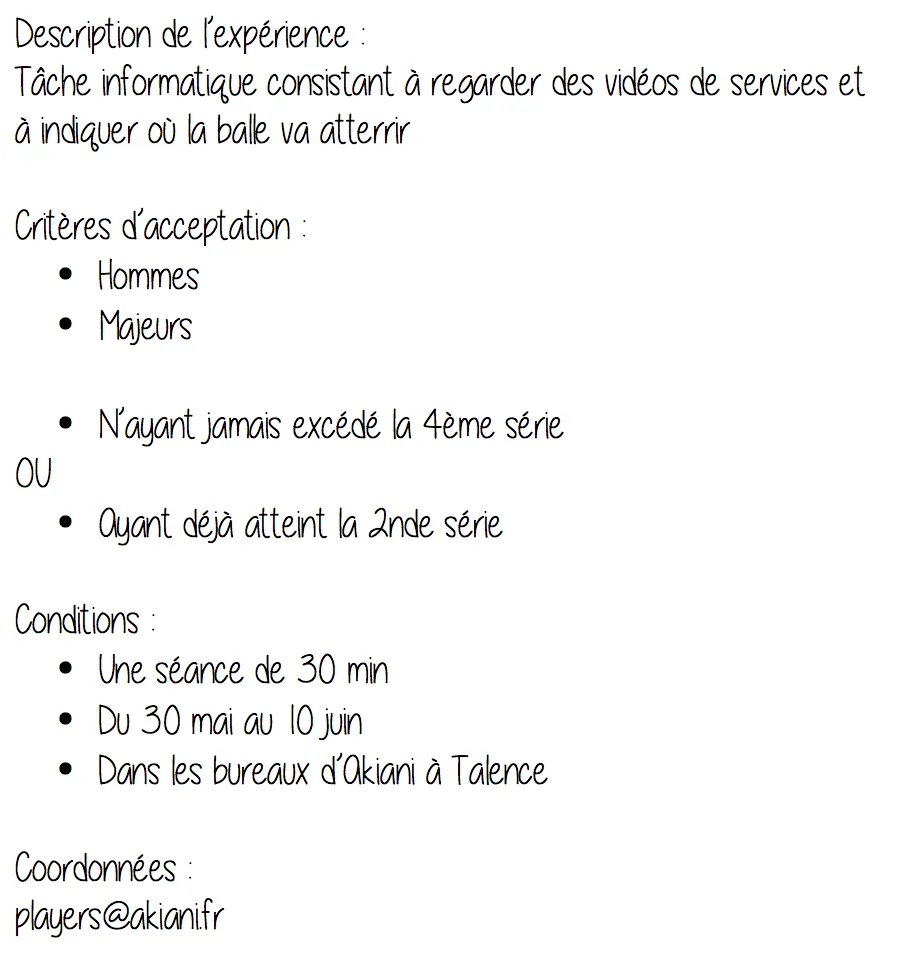
Information essential to recruitment for our project
Once the list is done, you can draft a template recruitment message, putting clarity ahead of stylistic flourishes. Steer clear of any ambiguity that might attract people who don’t fit the criteria, or put off the ones who do.
Finally, fit the template to both its audience and its channel. The conventions shift depending on who you’re targeting and how you reach them (phone, email, social media, classified ads, and so on). The tone and the words you use change with the person on the other end.
Recruitment message (opens in new window) posted on Akiani’s Facebook page
Distribution channels and the right timing for recruiting participants
Distribution channels
Which channel or channels to favour for recruitment depends on the target audience and on the contacts the experimenter(s) already have among them.
We started by putting the word out around us, mainly through word of mouth, social media and our direct contacts in the field. The results fell short, so we went on to contact the region’s tennis clubs directly, first by phone to make initial contact, then by email to nail down the details. We also asked participants to spread the word among the people around them.
Right timing
Once the channels are set, the last question is timing: when should you start recruiting? Start too early and the people you contact may struggle to picture themselves that far ahead. They won’t want to commit to an appointment so far in advance, or they’ll simply forget to show up. Start too late, on the other hand, and you risk finding no one free at all. And pushing back the session dates isn’t always an option.

Finding the right timing to recruit participants is no exact science. It depends on:
- how easily you can reach the target audience and how many participants you need (finding around ten fighter pilots to run simulator tests inevitably takes more time and/or more contacts than finding thirty-odd men and women of all ages to test a website),
- how long the experiment runs (asking someone for 15 minutes is a very different ask, logistically, from asking them for 3 hours),
- the time and place (it’s fairly hard to find students at the start of the school year, during exams or over the holidays, for example),
- along with other factors (depending on the conditions, you can sometimes keep recruiting once the sessions are under way) or quirks of context.
Our case
We were looking to recruit around forty fourth- and second-series tennis players for half-hour sessions. To do this, we kicked off recruitment a week ahead and kept it going after the sessions had begun. Even so, we struggled to find enough of them in time. Being based on campus, we were counting mostly on students. But they were either sitting exams or already away on holiday, while the working adults were caught up in tournament season. Our experiment dates were locked in by other constraints, so we couldn’t shift them. Still, we could have seen the shortfall coming and started recruiting earlier, straight through the clubs.
In short: recruiting participants
To recruit participants effectively for an experiment, we’ve seen that it pays to work on your message and to pick your date and channel(s) with care. Worth noting, too: some of these methods can be reused for user tests, whether in-depth or guerrilla. To give your experiments and tests some structure, have a look at our article on the experimental protocol, or see why focus groups are so useful for gathering qualitative feedback.