


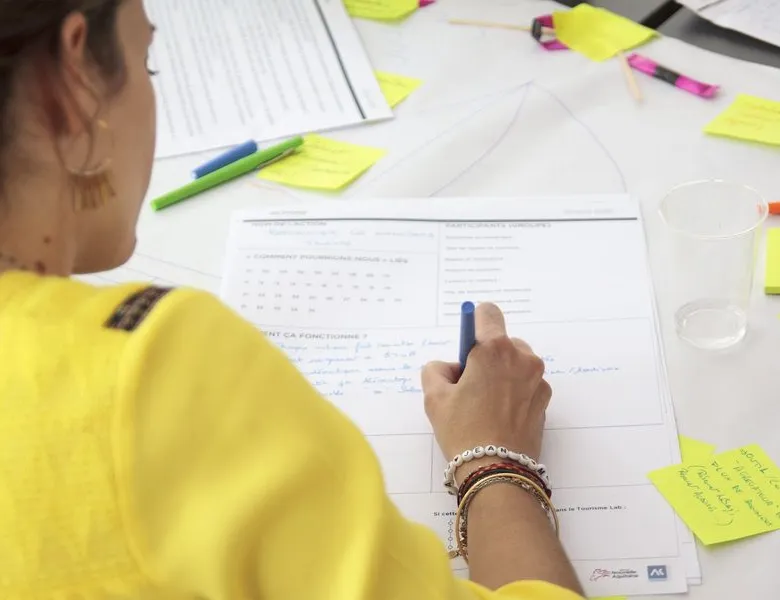


Service design is about designing for users by putting their needs at the heart of the thinking. This iterative approach is meant to be collaborative, so as to give users a service that is both useful and easy to use. Service design is a UX method that includes the work on journeys and looks at the different stages of the user's experience with the service. It's the UX method we use the most at Akiani. We're convinced it's essential to keep end users at the centre of the thinking, because we design to meet their needs.
A service doesn’t live only on a screen. When someone renews an ID card, applies for support or books a trip, they go through a website, sometimes a counter, a letter, a phone call, a queue. Service design shapes that whole journey, online and offline.
It’s the same user-centred approach as UX, carried out at a wider altitude. UX design draws the screens, UI gives them their form. Service design, in turn, connects these touchpoints to each other. It also looks behind the scenes, at the staff, their internal tools and the organisation, to check that the whole thing stays coherent from the point of view of the person using it. At Akiani, it extends UX. Research stays upstream, graphic design stays downstream, and service design keeps the whole journey coherent.
The public sector is a natural ground for service design. People don’t choose their administration the way they choose a brand. If they can’t complete a task online, they call, they show up, or they give up. The service therefore has to work for everyone, on every channel, including for people who are least at ease with digital tools.
That’s why this approach often shows up in projects around regions, mobility and access to public services. We work on whole life journeys, such as moving house, growing older or starting a business. That’s how people actually go through their procedures, rarely in one go and almost never on a single channel.
A service design project doesn’t only produce a mockup. Depending on the topic, it goes through a few ingredients that come up often.
01
Map the journey
An experience map or a service blueprint lays out the steps, the channels and the friction points, seen from the user's side as much as the teams' side.
02
Look behind the scenes
We observe the back office, the staff's tools and the gaps between services. A service is not fixed by its façade alone.
03
Co-design with the field
Workshops bring users, staff and business teams together to build the solutions hand in hand, from the start.
04
Connect the channels
We decide what happens online, at the counter, by phone or on paper, and how these channels hand over to each other without making the user repeat themselves.
We’ve run this kind of project for tourist offices, public support schemes and life journeys. For concrete examples, you can browse our service design case studies.
A service designer does the same job as a UX designer, at a different altitude. They draw on research to understand needs, on interaction design and graphic design for the digital touchpoints, and they orchestrate the whole so the service stays coherent from end to end. That’s why, at Akiani, service design stays a facet of UX rather than a separate discipline.
If you have a service to design or rethink, here’s how we support that kind of project.
At Akiani, there isn't really one. You could sum it up by saying that UX deals with what the user experiences, and service design adds everything that describes the actions of the people who make that experience happen. What is particular about a service, as opposed to a product, is that it takes varied forms and most of the time relies on a set of touchpoints that have to be coordinated with each other. Doing UX while involving internal stakeholders is already doing service design.
As with the other design specialities, the toolbox is well stocked. The tools that look at the organisation and the processes of a group are more represented in it. A blueprint is often used to bring out everything that happens on the business side, behind the scenes of the visible experience. Ecosystem maps, which show the stakeholders of the system and their relationships, are also widely used.
Digital services and physical services are both concerned. Any service that has users can apply the method. It is a way of thinking about design that works for one as well as for the other.
You often hear about key performance indicators (KPIs), but you should be wary of them. As soon as a measure becomes a target, it stops measuring well: that's Goodhart's law. You can look at the tangibility of a service, at its reliability or at its responsiveness. But the surest way to measure the quality of a service is still to ask its users.



An innovation-management method built on 5 pillars that make for a useful thinking framework. A heads-up: it's no magic recipe.
Read more about Design thinkingPersonas come out of work on user-profile modelling. They highlight behavioural archetypes that prove useful when designing.
Read more about PersonasThe design sprint is a format, not a method, that condenses the design thinking steps into 5 days to tackle a problem as a group.
Read more about Design sprintA storyboard illustrates a usage scenario in context. It is a UX tool for exploring a service idea or specifying the sequence of interactions.
Read more about StoryboardThe user journey breaks a process down into steps to surface user needs and expectations for a given goal.
Read more about User journeyDrawing on collective intelligence, these workshops align stakeholders and surface solutions with the team and/or the end users.
Read more about Co-designAn empathy map is a compact visualisation that captures the characteristics of a user's experience in a given context.
Read more about Empathy mapThe service blueprint represents the back-office side of the experience. It describes the organisation of the touchpoints the user crosses.
Read more about Service blueprintUX mapping represents a concept or a problem in a simplified form, to make it easier to understand and take ownership of.
Read more about UX mappingThe experience map focuses on the visible part of the experience: what a user goes through with a service or product, before, during and after.
Read more about Experience mapExperience design (UX design) shapes what the user encounters beyond the interface: journeys, emotions, contexts.
Read more about Experience designEveryone talks about user experience, service design, ergonomics...
It's not always clear, and you'd like to find out, or sharpen what you already know.