The aesthetics of ski runs
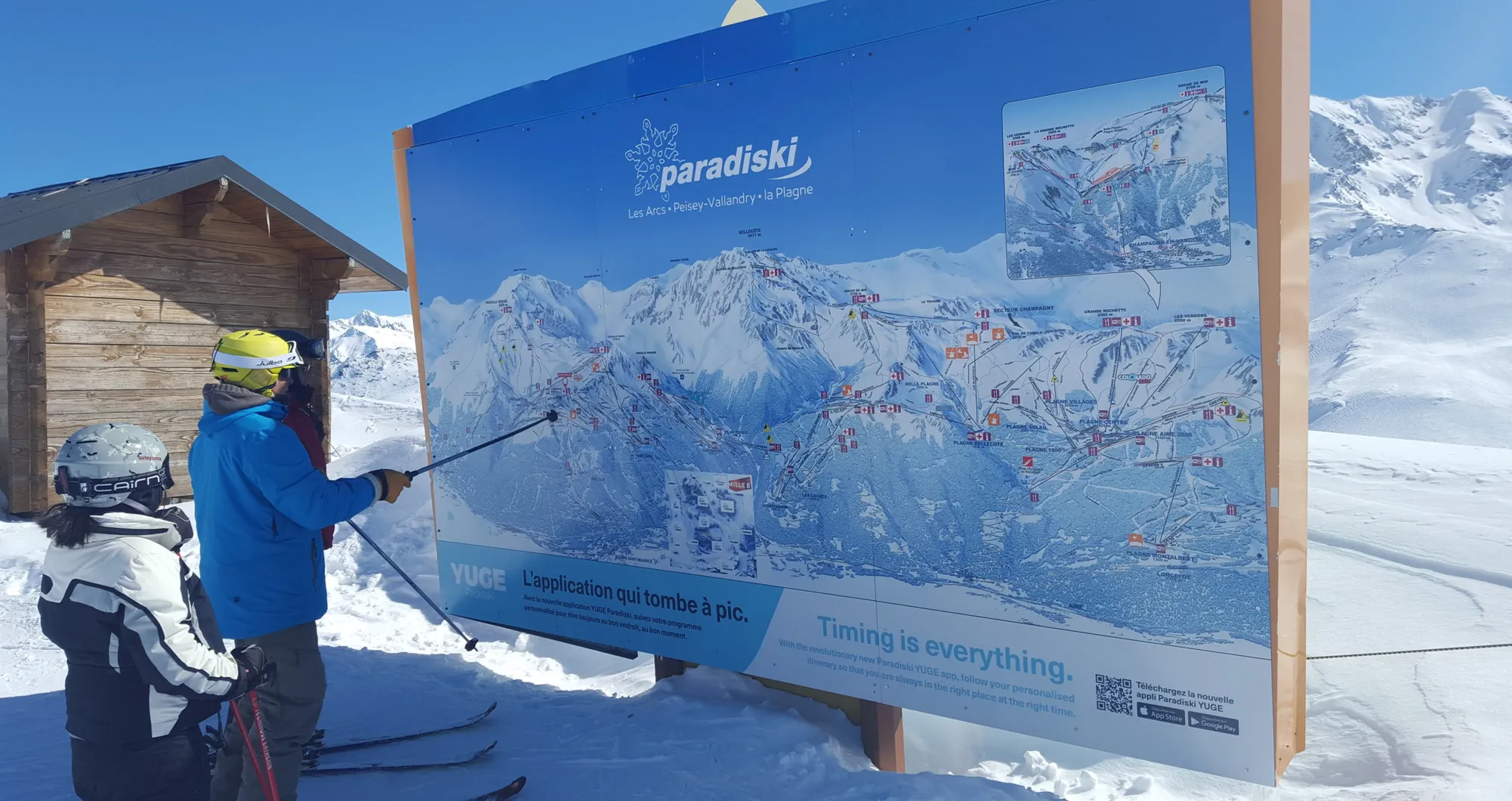
Not everyone has had the chance to be on skis, but almost all of us have probably glimpsed a piste map at some point. You’ll have been struck by the fact that they almost all look alike. And it isn’t a coincidence: these maps are all inspired by Pierre Novat’s work.
This INA video introduces the artist’s approach. He starts from aerial photographs and draws the landscape and the various ski runs by hand. In other words, his work is about mapping the mountain and projecting onto it the journeys the skiers will follow.
But the report also says that this is an interpretation. Its aim is for the piste map to also carry the image the resort wants to convey (sporty, close to nature, and so on). So, as the Revue de Géographie Alpine wrote in 2014:
“Novat has a very personal relationship with realism. At first glance, he seems to lean towards a form of hyperrealism in his depiction of the mountain. But his panoramas are only made possible by constant distortions of distances, as well as directions, heights and depths of field. The way he gives space to the foreground and the background is very characteristic of an art that exaggerates depth of field, in order to better bring out the ski area at the centre of the composition.”
https://journals.openedition.org/rga/2362 (opens in new window)
So it’s less about being perfectly accurate in transcribing the information collected than about applying an expert eye to shape it in a way that gives users and the business a useful tool.
When it comes to user journeys
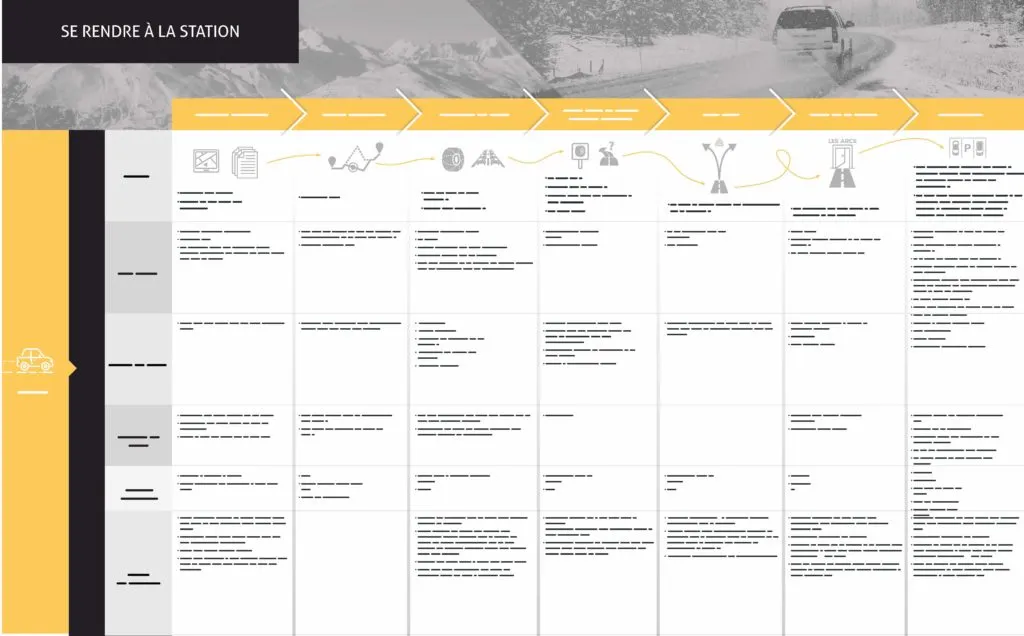
When user knowledge collected is formalised into an experience map, a user journey or a service blueprint, ergonomists and UX researchers can choose to take the same path as Pierre Novat. The approach to gathering needs is qualitative, as opposed to a quantitative approach. We meet a small number of users after careful selection and characterisation of that sample through relevant study variables. Even though feedback is collected with great methodological precision, the users’ words can’t be treated as sacred to the point of transcribing them in full.
This therefore calls for making expert choices, which can be perceived as introducing additional subjectivity into the process. This qualitative approach (and perhaps any qualitative approach?) is by nature subjective. First because what we’re trying to collect is precisely the subjectivity of the users we meet. And it is therefore the expert’s role to identify the elements that are specific and singular, distinct from those that are relevant and can be generalised, the ones that will serve the client’s objectives.
Experience and expertise
There is no magic recipe to grow into this expert stance. Ergonomists and UX researchers have been trained in the human sciences to carefully collect user behaviour, but also to analyse the contexts in which it shows up. They develop the ability to come up to speed very quickly on new business domains, and to identify just as quickly the critical points and the blockers among the “simple” frustrations expressed by users.
The observation grids and questionnaires they build help them carry out this collection, but their eye sharpens as they come across analogous situations. Experience then feeds expertise, and there is no doubt that ergonomics and UX research are two fields that obviously rely on a bit of common sense (we wouldn’t want to upset those who keep telling us so all year round), but above all on a lot of theory learned and hands-on practice.

To wrap up, we often notice some unease or reserve among students we teach. The same goes for the young professionals who join us, when it comes to bringing their expertise into the selection of information shown in user journeys. That hesitation is understandable, and it is then up to us to pair them with expert colleagues, so they can practise as much as possible and sharpen their analysis and synthesis skills through contact with them.
References on user journeys
https://www.franceculture.fr/emissions/la-vie-numerique/de-la-belle-inexactitude-des-plans-de-pistes-de-ski (opens in new window) Christophe Gauchon, “Frédérique Novat, Arthur Novat, Laurent Belluard, Plans des pistes, les domaines skiables de France dessinés par Pierre Novat”, Journal of Alpine Research | Revue de géographie alpine [Online], Notes de lecture, 2014, published online on 22 July 2014, accessed on 29 July 2020. URL: http://journals.openedition.org/rga/2362