





Information architecture structures and organises the content of a product or service so that users find what they're looking for and understand where they are. It applies everywhere, whether on websites, applications, signage or complex services. It's the foundation of UX design, the first stone to lay before detailing the components more finely.
Generally, it's said that the user should be able to reach their goal in 3 clicks at most for good information architecture. Obviously, it all depends on the complexity of the service or product on offer.
A page is divided into different sections: the header, the hero, the content, the footer… Then each of these sections is made up of various components: title, subtitle, cards… The arrangement of these components forms the information architecture of the interface.
Information architecture is designed in relation to users' needs. You need to know what the user has to do, what they need to know and the order of these elements. We generally run co-design workshops to prioritise the sections and the components with the business teams.
In the work of UX designers, information architecture is a central discipline. Once the foundations are laid, you can build the rest of the interface. Without attention to the overall organisation, the effectiveness of everything that is put in place is likely to be affected. Information architecture (IA) is a founding discipline of UX design. Without a consistent architecture, the other design efforts lose their effectiveness: a visually perfect interface on an inconsistent navigation structure will remain difficult to use. IA is particularly critical for high-volume content sites (e-commerce, media, intranets, government services) where findability is directly linked to satisfaction and conversion.
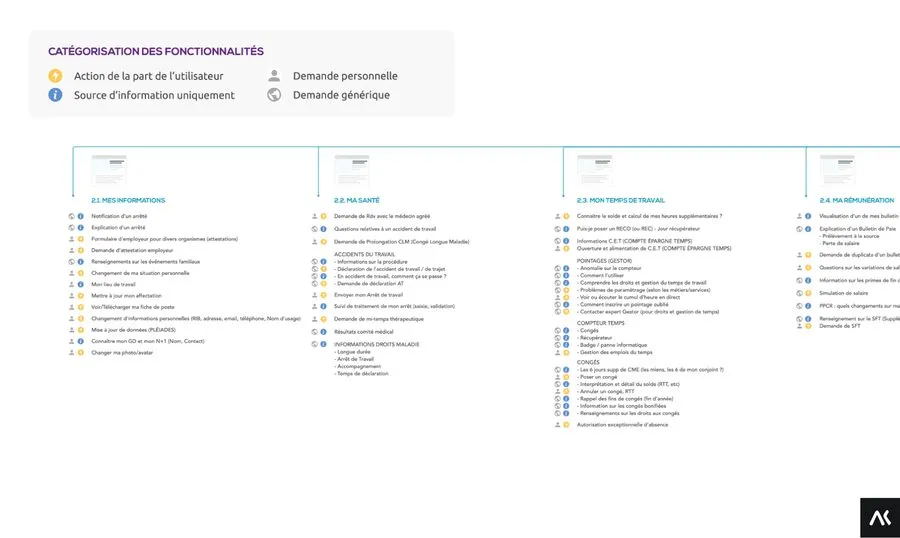




A site map of a website or app reflects the hierarchical, logical way its pages and features are organised. Proposing a sound site map means choosing a categorisation that fits the mental model users already have.
Read more about Site mapZoning is the visual representation of an interface through the placement of its simple content blocks, without detail: no text, no images.
Read more about ZoningA mockup with no graphic elements, describing the zones and essential components an interface should contain.
Read more about WireframeThis sorting method lets users group cards into categories, in order to establish the site map architecture of a website or an application.
Read more about Card sortingA mental model is the representation a user builds of a system. Designing in line with those models reduces errors and friction in use.
Read more about Mental modelEveryone talks about user experience, service design, ergonomics...
It's not always clear, and you'd like to find out, or sharpen what you already know.