


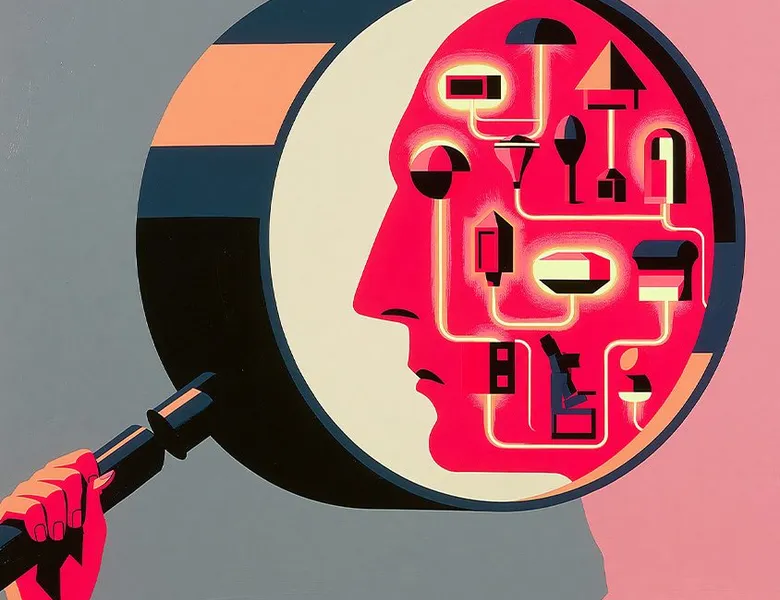


A flagship concept of cognitive psychology, the mental model structures the way a human being grasps a given situation. It sets out the principle that every one of us has a personal history that shapes how we approach the objects around us.
When you try to understand someone's behaviours, attitudes or opinions, you are in a way trying to identify what sits inside their mental model. Designing a product or a service means making a certain number of choices, putting forward a certain logic, a certain model of how things work. A user's interaction with that product is where the model imagined by the designer meets that user's own operating logic (highly specific, by definition).
Cognitive science also uses the term mental representation, which in some ways comes close to the mental model.
The theoretical definition of the mental model is fairly broad. And yet a user often does not really know why they think what they think. Tacit knowledge is the term for the things we do out of habit, the things we no longer think about.
Reaching mental models is all about getting people to put words on the links between a personal history, past experiences, beliefs and the way they approach an object, a concept or a technical solution. To dig in the direction of mental models during user research projects, you can draw on several techniques. You rely on explicitation exercises, such as spontaneous recall or sharing an anecdote, and you get people to tell you about a past experience, good or bad.
You can also observe first, before confronting the user with what they do (self-confrontation). It works too when you ask them to comment on the way other users carry out one particular action. You can also have the user draw how they picture a system, and so on.
Mental models and interaction design. In a way, every UX approach aims to limit the friction between users’ internal models and the models chosen for a product or a service. Card sorting is one of the methods most concerned with measuring how far the two sides meet (or diverge). With each new interaction with an external system, internal rules can be reinforced, rightly or wrongly, and new ones can be created. Taking an interest in the mental model means taking an interest in the source of how the world is interpreted, in the mechanics of decision making, in performance or in errors; in short, it is fascinating! If you want to know more, we gave a Blendwebmix talk on mental models and their links with interaction design in 2018.
Using an interface means submitting a conceptual model to your brain. When you do that, all sorts of things go through our heads: habits, services we have used, personal history, and so on. All of it is taken into our mental model, which draws on what we already know and on what the interface gives us to see and to understand.
When skeuomorphism appears, the ambition is clear. The idea is to build on everything that is triggered in a user faced with an object. Drawing on the notions of affordance and mental models, design sets out to guide users so they can picture how the thing in their hands works.
Mental models are both highly dynamic and highly stable, and they form a genuine base of knowledge for each individual. A gesture repeated hundreds of times often reflects a mental model tested by practice. Conversely, a new situation that calls for problem solving will make a mental model evolve. The next time a comparable situation comes up, what was learned is an integral part of the user's mental model.


Cognitive psychology studies how the brain processes information. Memory, attention, perception: the scientific foundations of UX design.
Read more about Cognitive psychologyCognitive ergonomics turns the way the brain works into design principles. Perception, memory, mental load: the foundations of UX design.
Read more about Cognitive ergonomicsGestalt theory explains how the eye groups the elements of an interface.
Read more about Gestalt theoryPersonas come out of work on user-profile modelling. They highlight behavioural archetypes that prove useful when designing.
Read more about PersonasInformation architecture organises content and navigation so that users find what they're looking for. It guides interface design
Read more about Information architectureInteraction design defines what a user can do and how a product responds to actions: flows, states, transitions, feedback.
Read more about Interaction designEveryone talks about user experience, service design, ergonomics...
It's not always clear, and you'd like to find out, or sharpen what you already know.