





The term “human-computer interaction (HCI)” is used to refer to the interfaces that let a user communicate with a machine, a program or a computer system.
From the keyboard to the touchscreen, by way of voice and haptic feedback (vibrations), HCI is the visible part where the human and the machine communicate.
The term has two complementary meanings. First, it refers to the concrete interface, the device that makes a machine operable, such as a dashboard, a control screen or a remote control. It also refers more broadly to the field that studies how humans interact with systems, at the crossroads of computer science, ergonomics and cognitive science. Interface ergonomics and, more recently, UX design grew out of this discipline.
01
Skeuomorphism
it means giving an object, a shape, an appearance that refers to the appearance it had in the past. Think of Apple (the old “stamp” icon for email, the sound of the camera shutter…). Skeuomorphism made the affordance of human-machine interfaces easier by copying the real world.
02
Flat Design
from 2013, human-machine interfaces adopt a modern, pared-down style. This minimalist design removes 3D effects, simplifies shapes and makes adaptation to responsive design easier.
03
Material Design
overlapping with Flat Design, since it appears in 2014, material design emphasises bold colours, depth and distance effects, notably for interactions. As well as being suited to responsive design, it also lets interaction design take its full place and therefore improves the user experience.
All systems where a human interacts with a machine. This encompasses software and websites, mobile applications, the interfaces of embedded systems such as a car, a plane or medical equipment, as well as voice and gesture commands. HCI covers a broad spectrum, from the most everyday interface to the most specialised.
Affordance refers to the ability of an interface element to signal the way it should be used. A raised button indicates that you can press on it; underlined and coloured text indicates a link. These affordances help the user understand the interface without having to learn it. The concept comes from the psychologist James Gibson, and it was Don Norman who applied it to the design of objects and interfaces.
Through expert frameworks first, such as Nielsen's ten heuristics or the criteria of Bastien and Scapin, for a methodical evaluation. Through user-centred methods next, tests and questionnaires, which gather what users actually feel. An HCI is generally judged on three dimensions: its effectiveness (reaching the goal), its efficiency (the effort required to reach it), and the satisfaction it provides.
HCI is the historical field that studies the interaction between humans and machines, born with computer science and ergonomics. UX design is a more recent development of it, centred on the user's overall experience, their emotions and their usage, beyond the interface alone. UX builds on what HCI established, widening the view from the device to the person.
No. The screen is only one modality among others. An HCI can rely on voice, gesture, touch, sound, or physical controls such as buttons and levers. In critical systems, a cockpit or a control room, these non-visual modalities are often essential, because they leave the eyes free to monitor something else.
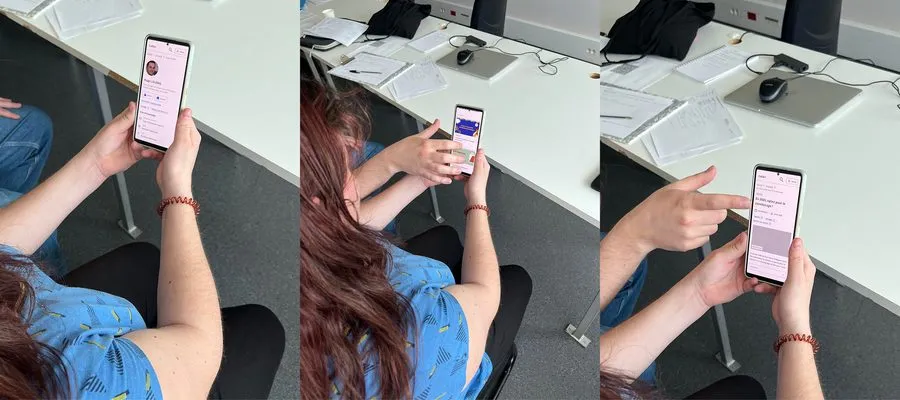




Interaction design defines what a user can do and how a product responds to actions: flows, states, transitions, feedback.
Read more about Interaction designUI design shapes the visual layer of a product: layout, colours, typography, components. It turns the experience into tangible elements.
Read more about Interface designExperience design (UX design) shapes what the user encounters beyond the interface: journeys, emotions, contexts.
Read more about Experience designErgonomics adapts tools to human capabilities. Born in factories, it now applies to interfaces through cognitive ergonomics and UX design.
Read more about ErgonomicsCognitive ergonomics turns the way the brain works into design principles. Perception, memory, mental load: the foundations of UX design.
Read more about Cognitive ergonomicsAffordance is the ability of an interface element to suggest its use. Donald Norman popularised the concept: only perceived affordance counts.
Read more about AffordanceBastien and Scapin propose 8 ergonomic criteria and 18 sub-criteria. This French academic framework is more rigorous than Nielsen's heuristics.
Read more about Bastien and Scapin's criteriaGestalt theory explains how the eye groups the elements of an interface.
Read more about Gestalt theoryNielsen's 10 heuristics let an expert evaluate an interface without users. The most widespread method for diagnosing usability.
Read more about Nielsen's heuristicsCognitive psychology studies how the brain processes information. Memory, attention, perception: the scientific foundations of UX design.
Read more about Cognitive psychologyEveryone talks about user experience, service design, ergonomics...
It's not always clear, and you'd like to find out, or sharpen what you already know.