


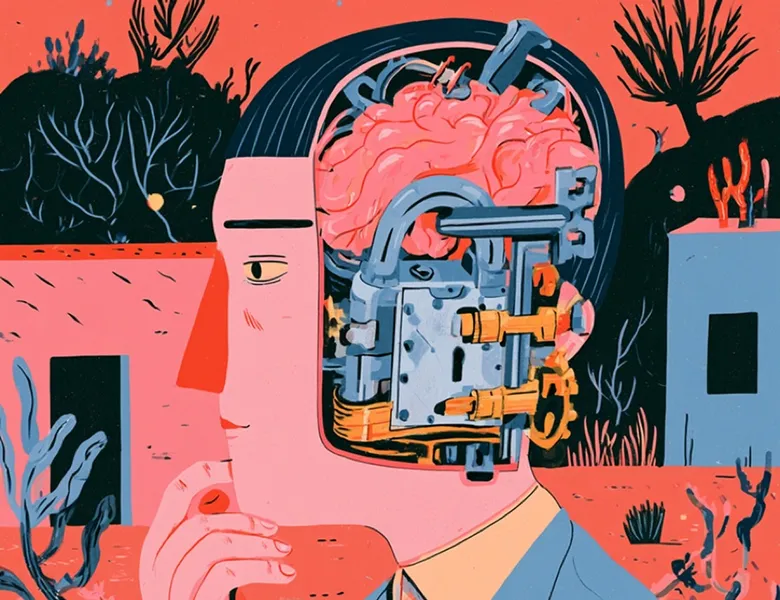


Cognitive ergonomics is an approach that focuses on users' mental processes such as perception, attention, decision-making, or working memory. Cognitive ergonomics aims to translate the knowledge of cognitive psychology into design principles. A move from science to design that is essential to our professions.
Along with usability, cognitive ergonomics is one of the foundations of the experience design approach.
01
Perception
how information is captured visually. Applied to design, this draws on the size of texts, contrasts, visual hierarchy, the laws of Gestalt, and so on.
02
Attention
which is selective and limited. We cannot process all the information around us at once. Applied to design, this means guiding the gaze, limiting the number of elements presented on a page, and so on.
03
Working memory
where the human processes information. It has a limited capacity. For UX, this translates into successive steps, offering a common thread, and so on.
04
Reasoning and decision-making
how we make sense of the world around us. For design, this means: mental models, tree structures, navigation labels, and so on.
Physical ergonomics focuses, to put it roughly, on the gestures and postures of humans in a work situation. Cognitive ergonomics focuses, in a complementary way, on everything that mobilises the individual's brain in carrying out their tasks.
You can sum it up by saying that what cognitive psychology describes about mental activities, cognitive ergonomics translates into the adaptation of systems to the capacities (and limitations) of users.
Taking into account how the human brain works in a given situation makes it possible to anticipate certain problems or certain interferences during the design phase.
Cognitive load, also called mental load, expresses the fact that each task to be carried out corresponds to a certain mental effort. Performance on a task depends on the user's capacity to provide the necessary effort in a given context.




Ergonomics adapts tools to human capabilities. Born in factories, it now applies to interfaces through cognitive ergonomics and UX design.
Read more about ErgonomicsHCI (human-computer interaction) refers to the means of interaction between a human and a computer system.
Read more about Human-computer interactionInteraction design defines what a user can do and how a product responds to actions: flows, states, transitions, feedback.
Read more about Interaction designCognitive psychology studies how the brain processes information. Memory, attention, perception: the scientific foundations of UX design.
Read more about Cognitive psychologyGestalt theory explains how the eye groups the elements of an interface.
Read more about Gestalt theoryA mental model is the representation a user builds of a system. Designing in line with those models reduces errors and friction in use.
Read more about Mental modelEveryone talks about user experience, service design, ergonomics...
It's not always clear, and you'd like to find out, or sharpen what you already know.