





A benchmark is a study that explores current trends in usage and design. Benchmarking is about going looking for both the good ideas and the bad ones. The ideas that inspire and are worth considering or even adapting, and the ones that act as warning signs, the directions not to take. Within the project's own sector and in comparable areas, you'll look at what has already been done to draw out the key lessons. For instance, it can be relevant to focus on mobile-interaction trends when designing a mobile app.
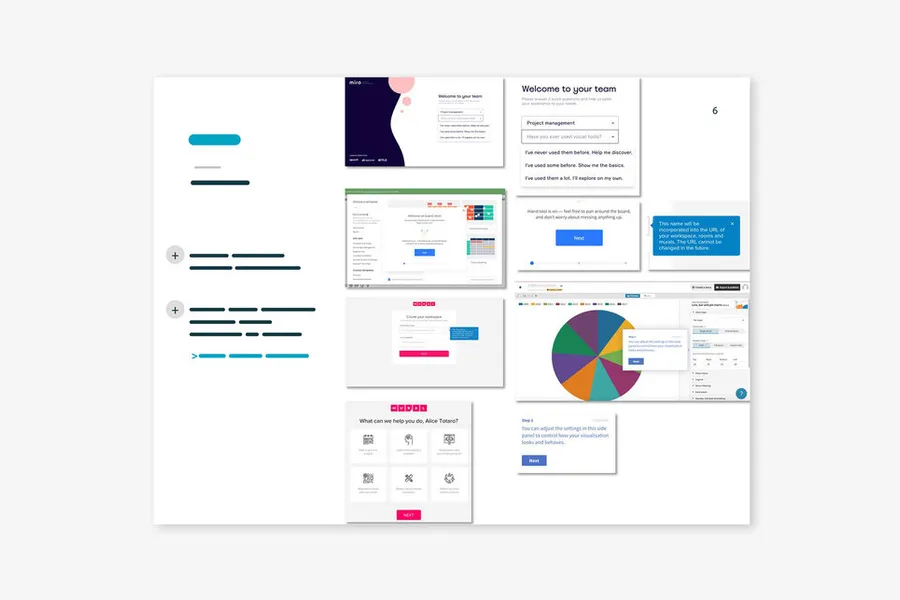
Running a benchmark can prove very useful during a usability discovery phase or in an ideation phase on the design side. The principle is fairly simple. From our exploration, a set of services is identified and their interfaces are analysed closely:
01
Define the products or services to analyse
You know your sector best, and you share with us a list of competing sites or offerings you'd like analysed. We complete that list using the priority criteria for this comparison.
02
List the criteria to keep in mind during the benchmark
Depending on your goals and the type of project, we agree on the most important criteria to consider together. The way the offer is presented, the features available and how they work, and the interactions on offer are all examples worth weighing.
03
Go through the products or services
Based on the agreed criteria, each competitor or service provider is unpacked for a close analysis of its strengths and weaknesses.
04
Document the recurring patterns and the differences
The most important thing in a benchmark is not to settle for saying that everyone does the same thing. The point is to gather, in one place, the various elements, both shared and specific, that make up the experience of the field or the current trend.
05
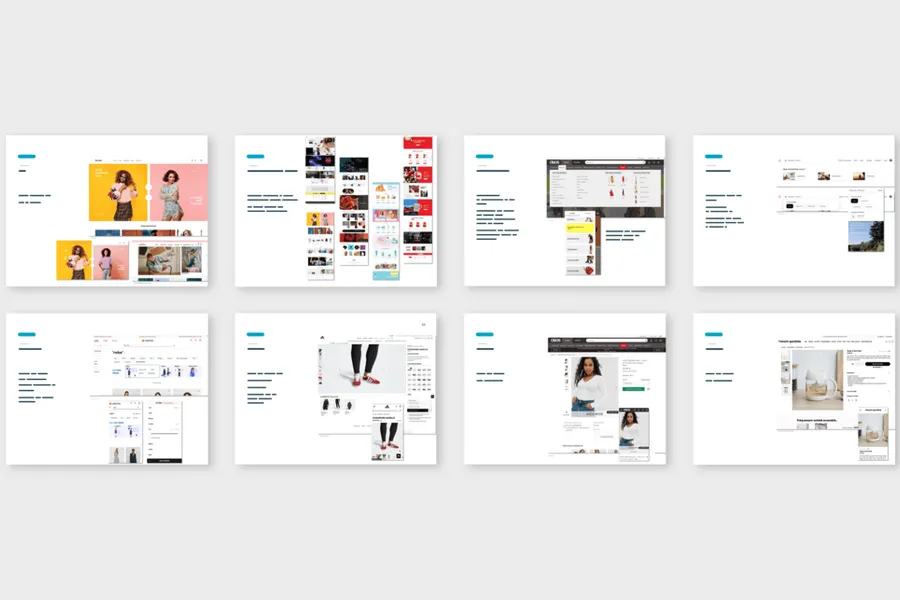
Present relevant examples sorted by category
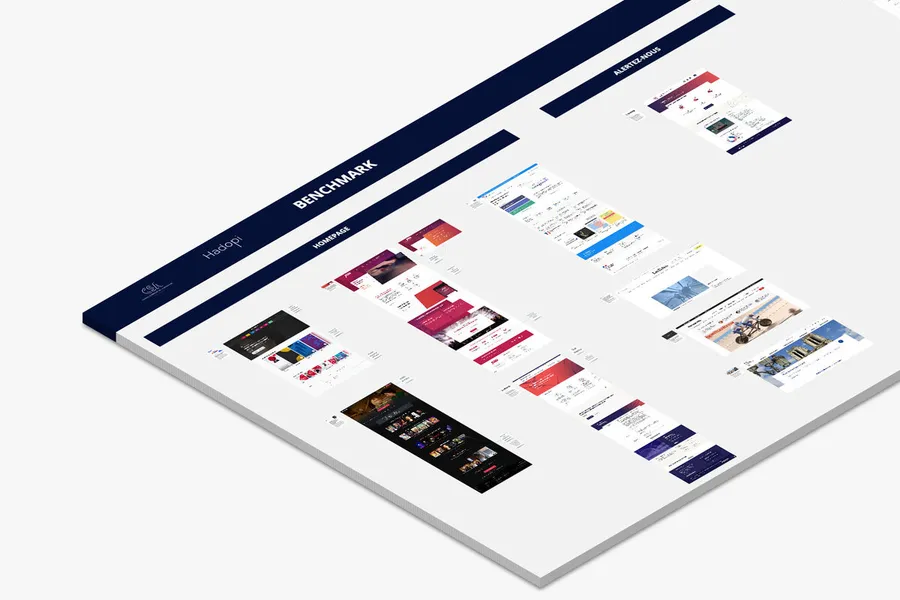
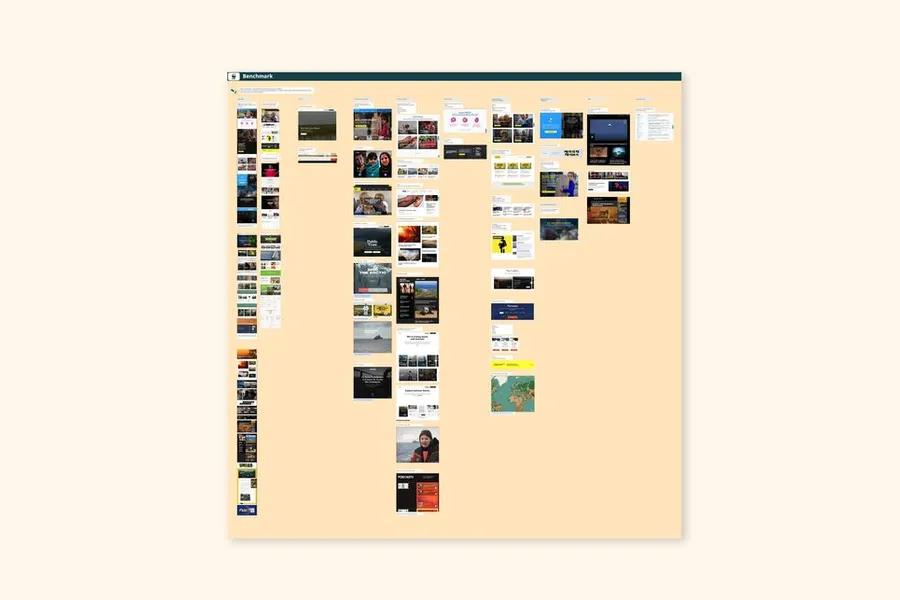
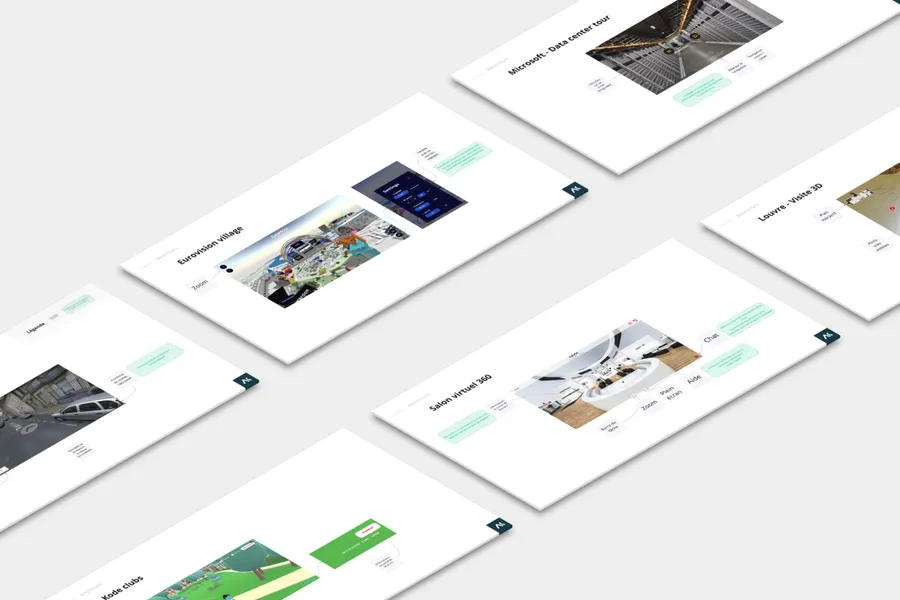
A benchmark is a snapshot at a given moment. It's worth feeding it into a continuous-improvement approach. How you present the benchmark therefore matters as much as its content. A tool like Miro lets you build the comparison base quickly and come back to it easily during design.
A benchmark is a snapshot at a given moment. It’s worth feeding it into a continuous-improvement approach. How you present the benchmark matters as much as its content. A tool like Miro lets you build the comparison base quickly and come back to it easily during design.
Sticking to competitors in the sector is a common mistake. It shows how you position yourself, but users, for their part, use plenty of other services every day. So we target both players in the field (direct and indirect competitors) and services from other sectors that handle certain features we are interested in.
Benchmarks are classically split into four types: internal (between entities of the same organisation), competitive (against direct competitors), functional (on a comparable function, whatever the sector) and generic (on universal processes). In UX, two readings matter most: functional or inspirational depending on the objective, direct or indirect competitors depending on the scope. Whatever the category, what counts is what you are trying to observe.
The ergonomic audit is an expert analysis that draws on established criteria and frameworks. It is systematic and details every critical element of a website or a mobile app. The benchmark, for its part, compares the way one part or another of your service is handled by others. It is therefore more a point of reference against standards than a validation based on ergonomic criteria. One does not replace the other.
The benchmark is most useful in a discovery or ideation phase, when a concept is being defined. It also informs the preparation and the interpretation of a user test or an audit, both ahead of them and afterwards. Finally, it comes into its own in continuous monitoring of usage and design trends.
A benchmark shows what exists, not what actually works for your users. It does not replace testing or observation. In professional environments, access to the interfaces can be limited (secure areas, licensed tools). Several options exist. Ask the client for the access they have, sign up for the demos and trial periods of the platforms, draw on publicly available screenshots and videos, or refocus the analysis on the accessible parts of the journey.




Based on collaboration, between project stakeholders or users, to design a website or app. These workshops surface solutions to improve the service or the platform, and bring up several ideas.
Read more about Co-designUsing domain criteria grids and our digital expertise, we systematically analyse the existing (digital) platform to surface its strengths and areas for improvement.
Read more about UX auditUsability measures whether a product lets its users reach their goals with effectiveness, efficiency and satisfaction, as defined by the ISO 9241-11 standard. An essential component of UX.
Read more about UsabilityA design pattern is a proven solution to a recurring problem: breadcrumb, modal, accordion. These conventions exist because they work for users.
Read more about Design patternExperience design (UX design) shapes what the user encounters beyond the interface: journeys, emotions, contexts.
Read more about Experience designInteraction design defines what a user can do and how a product responds to actions: flows, states, transitions, feedback.
Read more about Interaction designUI design shapes the visual layer of a product: layout, colours, typography, components. It turns the experience into tangible elements.
Read more about Interface designMicro-interactions turn a functional product into an enjoyable one: a like animation, real-time form validation, a loading indicator.
Read more about Micro-interactionsA moodboard is a kind of overview of inspiration material, meant to support the artistic choices for the next stages of your project.
Read more about MoodboardThe user flow is a visual representation that models the paths a user can take when going through a site or an app.
Read more about User flowEveryone talks about user experience, service design, ergonomics...
It's not always clear, and you'd like to find out, or sharpen what you already know.