Chapter 5: the Bobsleigh (or Bobsled)
Having broken down alpine skiing, curling (yes, really!), figure skating and boardercross for you, we’re closing out our Winter Games series in style with the Bobsleigh!
A shout-out, too, to the solid performance of our French four-man crew in their final run this Sunday. No easy task against the Germans and their very, very (very) fast crews!
A projectile sliding through an ice tube!
Yes, it’s a bit reductive, we’ll admit, but you have to grant that the idea is pretty wild. Hurtling down a slope on a sled or a bike, we’ve all done it. But when the thing is sitting on blades, and the slope is icy, narrow and lined with 19 banked turns that would make Valentino Rossi go pale, it tips over into outright madness. To complete the picture, add two bits of string for steering. Throw in the comfort of an old Lada, and there you have it: the Bobsleigh. No wonder you can hear them yelling before they push off!
A fixture of the Winter Games since 1924, the sport is run two to a sled (women’s or men’s crews), but it can also be done four to a sled (men’s crews only). Each qualified country can enter several crews, each named after the pilot on board.
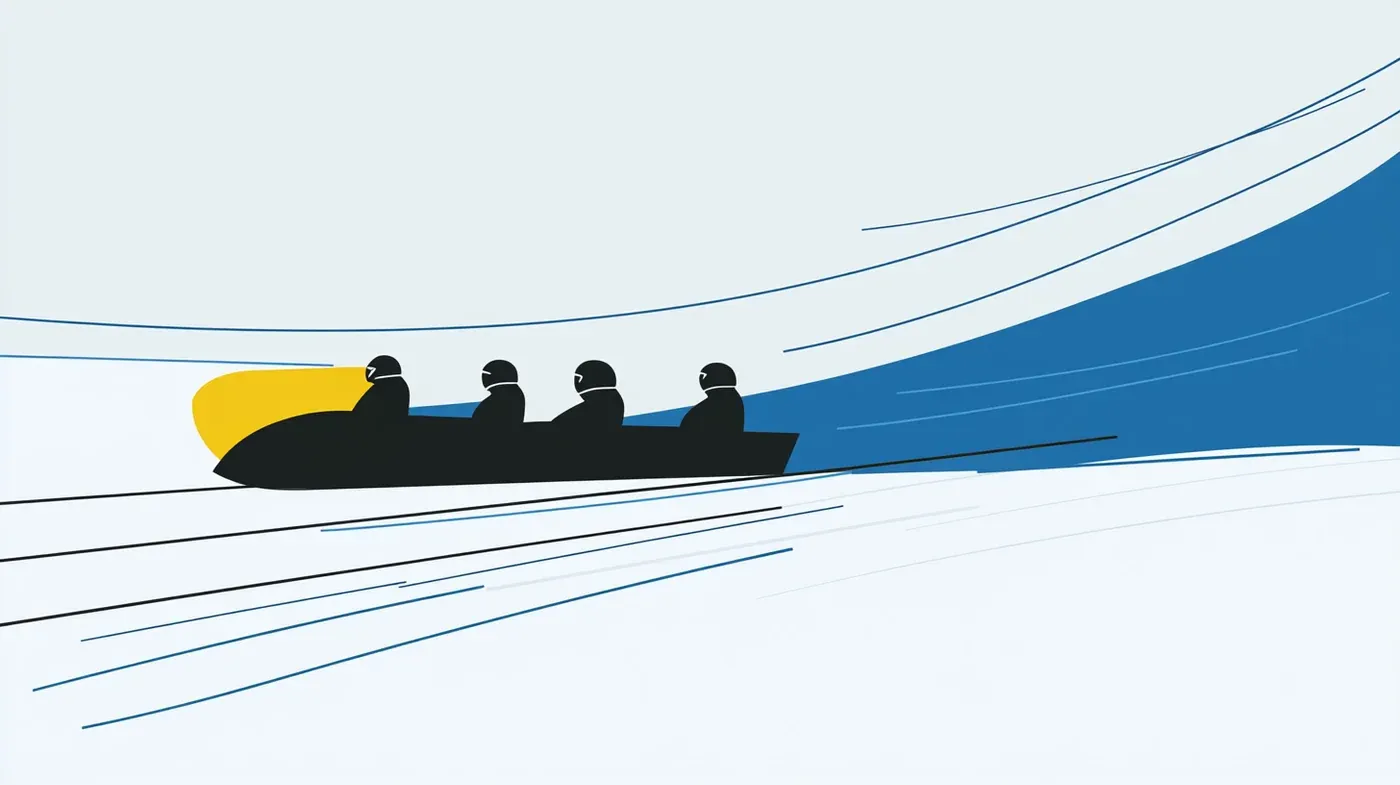
Shall we talk about the peaks at 140 km/h in Bobsleigh?
First, the aim of the game is simple: cross the finish line in the shortest possible time. Top speeds can hit 140 km/h in the fastest section (an 8 to 15% gradient) on tracks running from 1.5 to nearly 2 km. A full competition lasts around 4 minutes spread over 4 runs (Rempfler, 2016).
At the start, the pilot stands next to the sled, hands a few centimeters from the push bar. Their teammates, meanwhile, line up on a starting board that doubles as a starting block.
For at least the first fifteen meters, the sled’s front steering runners stay locked in guides carved into the ice. So this first phase is all about the sprint: pushing the sled (170 kg minimum for a two-man bob…) and jumping aboard before the rail runs out. After that, the slightest stray move could knock the bobsleigh off line and ruin the trajectory it set out on.
One for the sharpest tacticians among you: a bob can cross the line on its side, or even upside down. It still counts, as long as every crew member is still on board.
A matter of team, at the right tempo
Beyond raw athleticism, then, the crew has to move in perfect sync. Take the pilot, whose hands aren’t on the push bar: they have to react precisely to the cue of their teammates’ push, or risk watching the rocket leave without them. And when you remember that in a four-man bob the sled and crew together weigh close to 400 kg, a sharp reaction time is no luxury!
The standard is so high that bobsleigh is one of the sports with the tightest finishing margins (Dabnichki et al. 2004). If you’ve ever watched an event, you’ll have seen that every move is timed to the millimeter. The boarding phase is the most striking of all. Each teammate knows their part like a musician, executing precise movements perfectly in step with the others. The slightest wrong note, the slightest delay by one teammate on one of the moves that falls to them, and precious tenths of a second are gone.
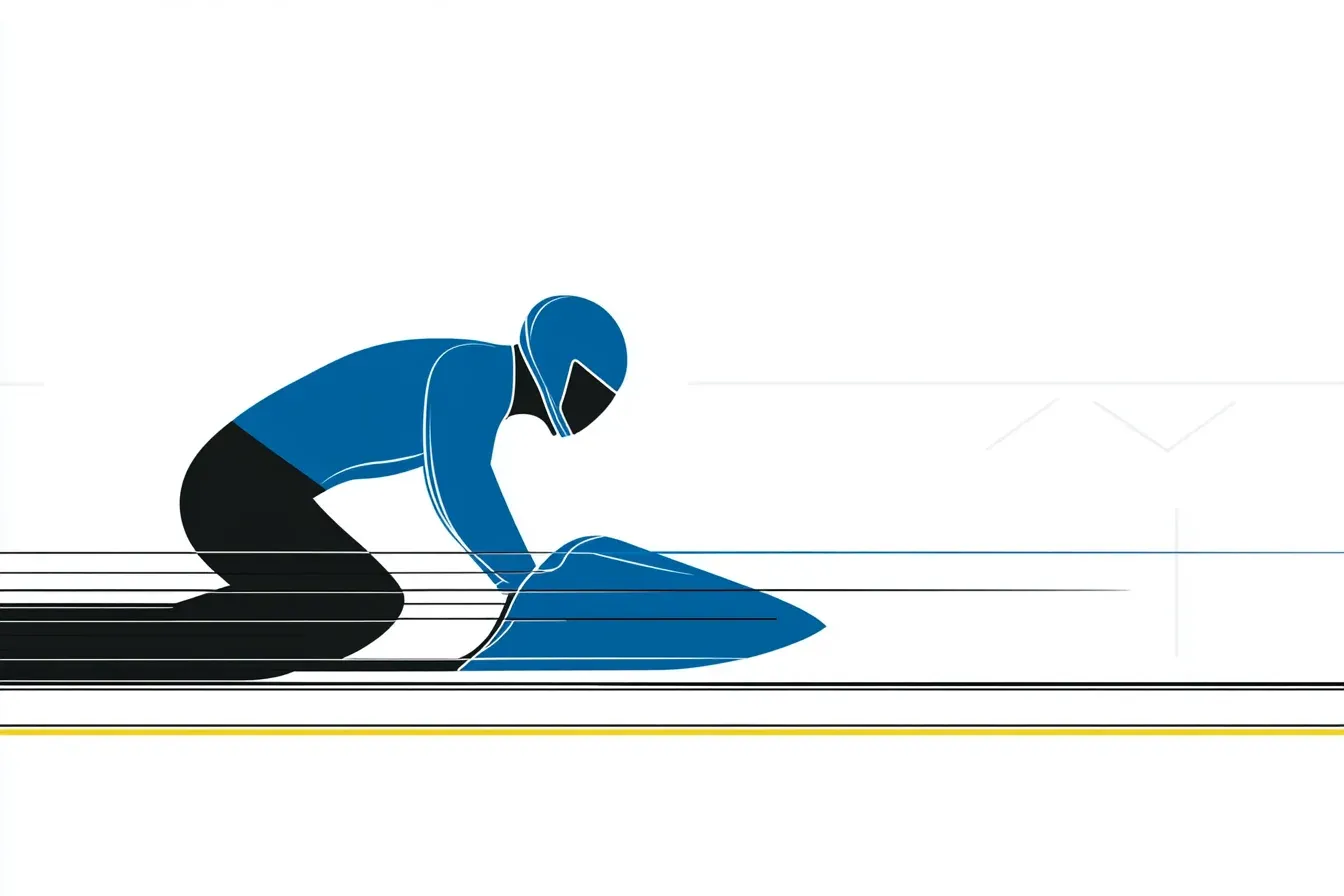
Position of the team members
Yes, we couldn’t help but give a nod to the film Cool Runnings, which, for a time at least, brought this sport into the public eye.
One important point, by the way: as with the skeleton, every tenth lost at the top of the track costs you double or triple at the bottom. Hence how vital it is to nail every detail during this launch-and-boarding phase (which lasts under 5 seconds for the best crews!).
To keep the equipment from deciding the outcome, the rules set design constraints on the sleds: the same alloy for the blades, standardized dimensions, and so on. Which means good teamwork across the whole crew becomes the real key to a fast run.
Once on the track, you might think the rest of the crew are just twiddling their thumbs… Far from it!
Plenty of studies have shown how much the crew members’ positions affect aerodynamic efficiency (Dachnichki et al. 2006). Fans will have spotted, for instance, the stance of the fourth crew member in the German bob (the gold medalists). He lies flat over the front to create a pocket of low pressure at the rear of the sled, boosting downforce and, with it, the speed carried through the banked turns.
Inside the head of the Bobsleigh pilot
Once the whole crew is aboard, it falls to the pilot to bring everyone safely to the bottom of the track. To do that, they work a steering wheel linked to the front runners, aiming to hold the ideal line they mapped out before the start.
A pilot’s inputs are tiny, constant corrections meant to limit the swaying generated by negotiating the banked turns. On top of knowing the track inside out, the pilot has to read ahead and feel how the bob is behaving on the ice. They rely on what’s known as a mental model (Bellenkes et al. 1997), built up by learning the layout. In training, they flesh it out with visual cues that serve as decision points. By race day, the pilot can run the whole descent in their head, like rehearsing a score where the notes are the moves on the wheel. That’s what lets them tear down such a technical track, playing out their plan according to their line as they enter each turn. Pretty impressive, no?
References
Website of the International Bobsleigh Federation
(opens in new window)
Larousse online (opens in new window) - Bobsleigh article
Rempfler, G. S., & Glocker, C. (2016). A bobsleigh simulator software. Multibody System Dynamics, 36(3), 257-278.
Dabnichki, P., Motallebi, F., & Avital, E. (2004). Advanced bobsleigh design. Part 1: body protection, injury prevention and performance improvement. Proceedings of the Institution of Mechanical Engineers, Part L: Journal of Materials: Design and Applications, 218(2), 129-137.
Dabnichki, P., & Avital, E. (2006). Influence of the position of crew members on aerodynamics performance of two-man bobsleigh. Journal of Biomechanics, 39(15), 2733-2742.
Bellenkes, A. H., Wickens, C. D., & Kramer, A. F. (1997). Visual scanning and pilot expertise: the role of attentional flexibility and mental model development. Aviation, Space, and Environmental Medicine.
The illustrations in this article were generated by AI (see our AI use statement).