





User research aims to create new knowledge about the uses and behaviours of the users of your services. To help translate field observations into shareable findings, several authors have proposed interesting conceptual frameworks. Among these approaches to processing the results of user studies, the atomic approach that exists in design also appears in user research.
Atomic research is a framework that breaks each user study down into independent facts, insights and recommendations. Proposed in 2017 by two professionals (Tomer Sharon and Daniel Pidcock), the idea is to treat the knowledge generated by a UX study as independent units, reusable from one project to the next. The goal is therefore to build capital in order to make better use of the results of user studies.
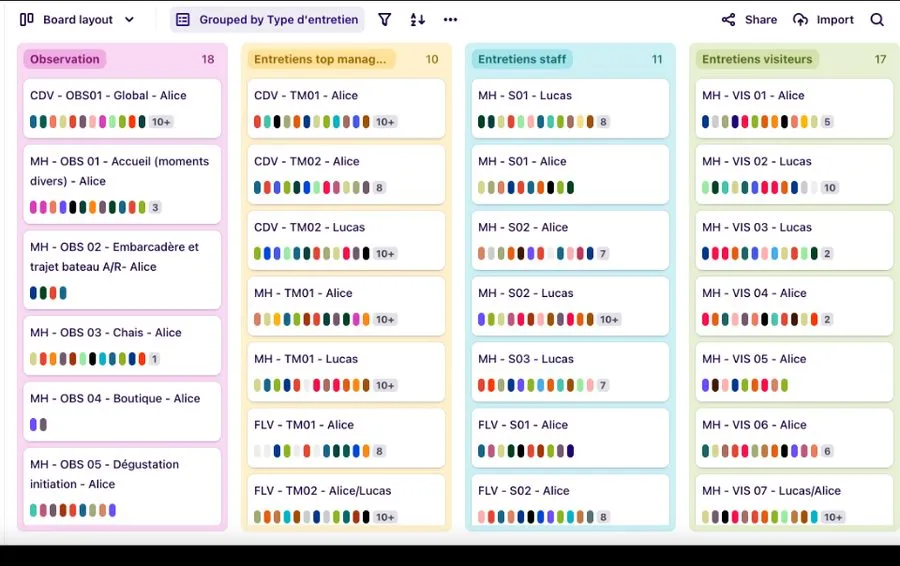
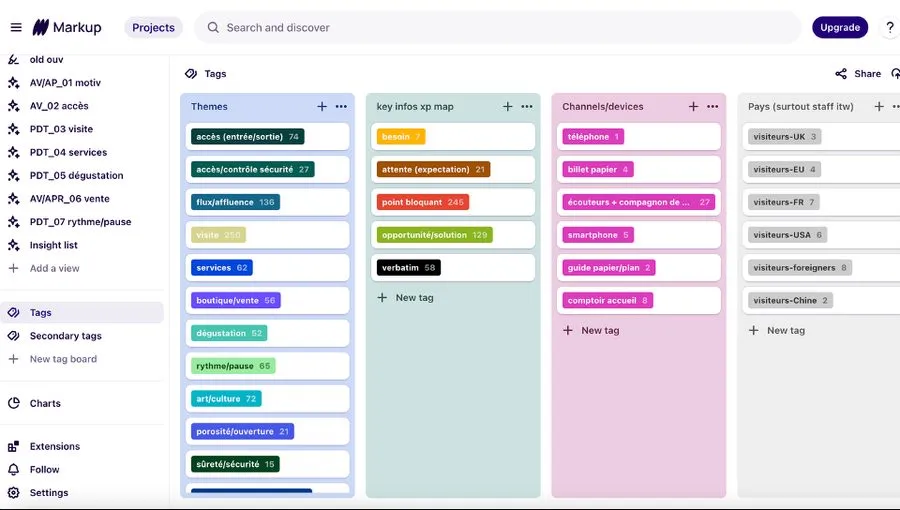
For each fact put forward, atomic research maintains the link with a piece of evidence (a quote, a screenshot, a video clip). These units can be cross-referenced between projects, retrieved by keyword, and remain consultable years after the session that produced them.
01
Experiments
these are your data sources, the field sessions carried out, of every kind (user tests, interviews, observations).
02
Facts
what was genuinely observed, without interpretation. To each fact, an attached piece of evidence: a quote, a screenshot, a video clip.
03
Insights
what several converging facts allow you to formulate. It's the key step, the one that separates observation from recommendation. Contradictory facts can also produce an insight, a more nuanced one.
04
Recommendations
they follow from the insights, and from them alone. Without an insight to support it, a recommendation is only an opinion.
The atomic research approach offers a working framework, not a magic recipe. The principles it describes are meant to support a change of posture towards user research. It is common for analysis reports from a study to be only partially used. By breaking down the elements of each study and indexing them, atomic research makes it easier to search through the knowledge already produced. If it is easy to share, and can be browsed according to one’s own needs (e.g. by journey stage or type of difficulty), then teams will take an interest in user knowledge.
Setting up an atomic research practice in-house happens through successive steps. As with atomic design, it means thinking about governance, forums, procedures, and so on. We recommend starting small with a limited group. Once the foundations are in place, you present the directions to the future users. The goal is to make sure you're heading in the right direction. And you build up incrementally.
Atomic research describes an approach to analysis for generating user knowledge. Where there's knowledge management, there's a knowledge base. The research repository is the knowledge base that is fed by an atomic research practice.
To get started without a dedicated tool, a table in a tool like Notion or Airtable is enough. It's methodological rigour that will make the difference, not the tool. Atomic research serves as a guide for that.
Atomic research is particularly useful for product teams doing continuous research on their solutions. In that case, applying the principles of atomic research changes the status of user research and its results. It's no longer a one-off activity that produces static material. It's an infrastructure for accumulating knowledge and making use of it dynamically.




The research protocol describes the conditions, the resources and how an experiment or test runs, along with the questions it sets out to answer.
Read more about Research protocolA benchmark explores current trends in usage, features and design: the good ideas, and the ones to avoid.
Read more about UX benchmarkThe research repository centralises the findings from UX studies. Its value lies in retrieval, not in storage: an unused repository is nothing but an archive.
Read more about Research RepositoryResearch Ops organises the practice of UX research within an organisation: methods, tools, recruitment, sharing user knowledge.
Read more about Research OpsDesign Ops optimises the practice of design: tools, processes, handoff, documentation. It lets designers focus on designing rather than on managing.
Read more about Design OpsQualitative research explores users' motivations and barriers. It answers the why where quantitative metrics stop at the what.
Read more about Qualitative researchEveryone talks about user experience, service design, ergonomics...
It's not always clear, and you'd like to find out, or sharpen what you already know.