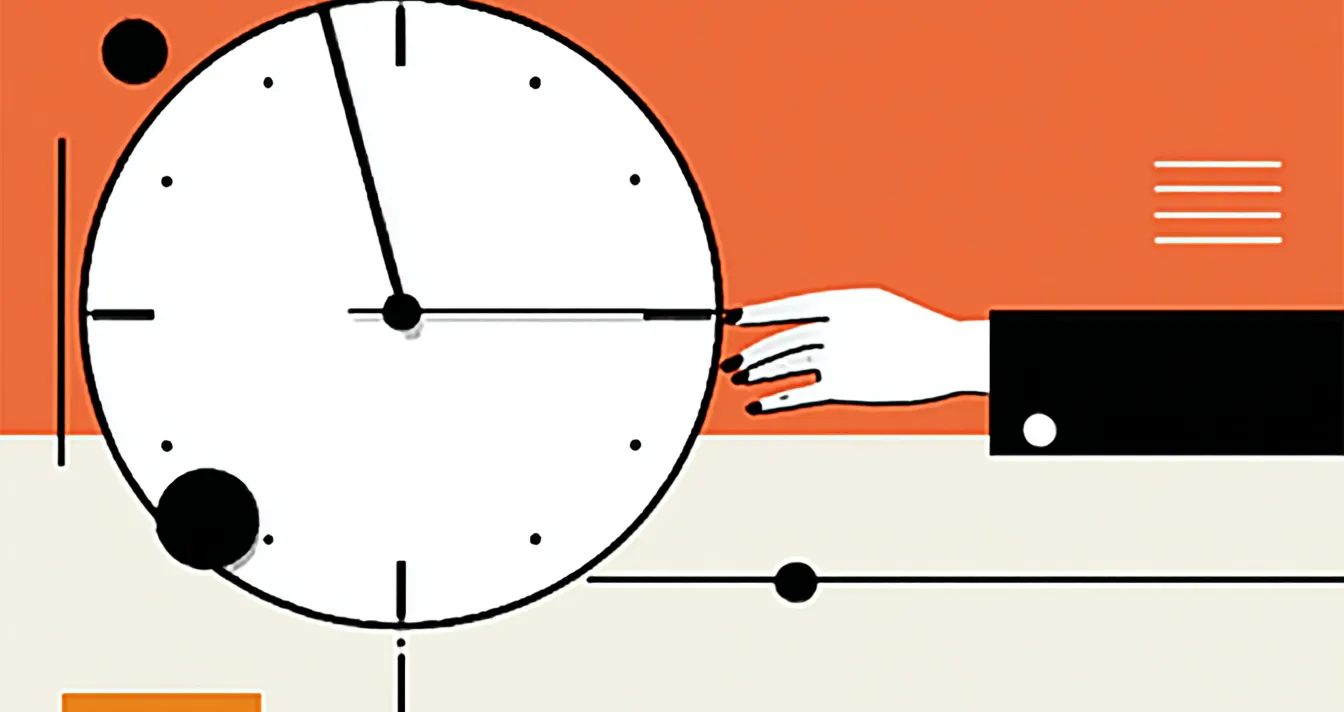
The role of time in user experience
At first glance, when we think about time in interface design, we tend to think about the time that sits outside the user: making applications run faster, cutting loading times. That fits the world we live in, a society in a hurry that asks us to be productive, but also responsive and quicker and quicker to adapt.
The trouble with this kind of solution is that it stays focused on the technology. Sooner or later, it always hits a technical limit. In this article, we want to flip the perspective and take the user’s point of view. For them, perception is reality. And nothing is more relative than time as we feel it. A minute with your hand stuck to a hotplate feels far longer than a minute on the phone with someone you’ve been missing. For the very same objective duration, you get wildly different experiences of how long it lasted. That’s why our user tests pay as much attention to what people do as to how they feel.

Where does the sense of passing time come from?
For the classic senses such as sight and hearing, each sense has its own dedicated receptors and its own interpretation system. The sense of time is a bit of an odd one out, because there are no receptors dedicated to time as such. To build a percept of time, the brain pieces it together from all the information available, whether visual, auditory, proprioceptive and so on.
Subjective time is therefore malleable, elastic, never constant, and prone to all sorts of illusions. Merging information of different kinds can throw up discrepancies. For example, for the same objective duration, an auditory stimulus is perceived as longer than a visual one. So perceived time depends on the nature of the stimulus. Since real-world events are far more often multisensory, the brain manages to build a single, coherent percept by weighting its inputs. This is why our ergonomic audits take these perceptual factors into account.
Several studies also show that our perception of time is strongly shaped by the emotional and, above all, attentional sides of cognition. According to what is known as “coding efficiency theory,” the perception of time rests on the size of the neural response. Events we pay attention to, whether we mean to or not, trigger a stronger response, so we perceive them as lasting longer. A dynamic stimulus that grabs attention (because it blinks, changes size, and so on) will therefore tend to feel longer than an equivalent static one. To really understand the range of user profiles, we build personas that factor in these perceptual aspects.
Conclusion on time perception
To wrap up, we hope we’ve shown that, when it comes to UX, measuring objective things (absolute loading time, say) isn’t always the most useful approach, and certainly isn’t enough to capture how rich a user’s experience really is.
Don’t get us wrong: we’re not saying a technical approach has no place. We’re saying you should round it out with a change of perspective, one that lets you look at the product or service differently, instead of betting on purely technical fixes that risk missing the mark. It’s also part of our eco-design practice, where the goal is lighter, more efficient interfaces.
We can only encourage you to dig into the vast literature on the subject, and we’ll see you in a future article on real-world examples of how these ideas can improve user experience in practice.
References:
- Eagleman, D. M., & Pariyadath, V. (2009). Is subjective duration a signature of coding efficiency? Philosophical Transactions of the Royal Society B: Biological Sciences, 364(1525), 1841-1851. doi:10.1098/rstb.2009.0026
- Hartcher-O’Brien, J., Di Luca, M., & Ernst, M. O. (2014). The duration of uncertain times: audiovisual information about intervals is integrated in a statistically optimal fashion. PloS one, 9(3), e89339. http://journals.plos.org/plosone/article?id=10.1371/journal.pone.0089339 (opens in new window)
- Grondin, S. (1993). Duration discrimination of empty and filled intervals marked by auditory and visual signals. Perception & psychophysics, 54(3), 383-94. Retrieved from http://www.ncbi.nlm.nih.gov/pubmed/8414897 (opens in new window)
The illustrations in this article were generated by AI (see our AI use statement).