Game vs. gamification
The Larousse dictionary says:
Game, noun
(from the Latin jocus, joke)
A physical or mental activity, not imposed, with no utilitarian aim, taken up to entertain oneself and to derive pleasure from it.
A game would therefore not be much use other than for fun. But the game still plays an important role. The earliest games found date back to 3,000 BC, around the time writing was emerging, when people played with spinning tops and dice made of bone. Beyond its entertaining virtues, the game had a strong social component.
Gamification (or ludification for those who aren’t bilingual) is the use of game mechanics in other fields. Ludification comes from the Latin facere, which carries the idea that it is possible to “make the game”. The idea is more about using game techniques than about creating a game. Game mechanics cover the following aspects:
- putting participants in competition
- immersion in a story
- levels of achievement
- levels of complexity
- step-by-step progression
- the presence of rewards (feedback)
Note that gamification is used in many fields such as health, human resources or even marketing. For example, recently on this site (opens in new window), which offers to teach first-aid actions in a playful way.
Learning
Memory and learning are so closely linked that they are often confused. What is certain is that learning (which changes our later behaviour) is based on memory processes (memory being the ability to recall information). To put it simply:
- New knowledge reaches us through our sensory system (we read something or hear it)
- This information is temporarily stored in our working memory, from which a memory trace can form: this is the encoding stage
- Through certain mechanisms (repetition or associations, for example), it will be consolidated and stored in long-term memory: this is the storage stage
- This memory trace is retrieved at the moment of recall or recognition: this is retrieval
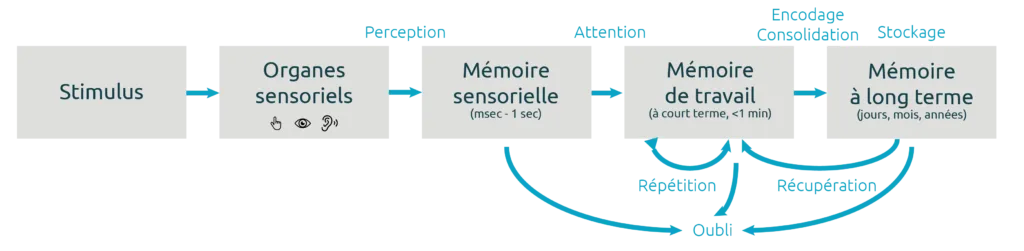
This ability to learn new information has no limit, but is naturally subject to forgetting. The ability to memorise information is shaped by several factors (opens in new window):
- the level of alertness or attention
- motivation or need
- the learner’s emotional state, or the affective value of the information
- the context
Teaching methods
First, in teaching, the idea is to make the memorisation of new knowledge easier. We distinguish several teaching methods. For example, the lecture method consists of the teacher presenting their knowledge to the learner.

The active method, by contrast, calls for the learner to be engaged. The teacher proposes a specific situation that lets the learner, by solving it, acquire knowledge they can later generalise.
It is the most fashionable method at present, supported by principles that are as questionable as they are interesting, such as this one:
“We retain 10% of what we read, 20% of what we hear, 30% of what we see, 50% of what we see and hear, 80% of what we say, 90% of what we say and do.” (Mucchielli, 2016)
Or the slightly classier version, by Confucius:
“I hear and I forget. I see and I remember. I do and I understand.”
Learning while playing (and vice versa): it works!
Since the learner is active during play, we can put forward the hypothesis that learning while playing will be more effective than a lecture method. And indeed, several studies agree that educational games are effective. In an analysis comparing 39 existing studies on the topic, the authors report that serious games improve learning and the retention of knowledge (Wouters, Van Nimwegen, Van Oostendorp, & Van Der Spek, 2013). What’s more, these gains appear to persist over the long term.

At the educational level, the possibilities are many:
- Adapt learning to the pupil: differentiated teaching, getting personalised feedback
- Strengthen the social aspects: solving problems collaboratively, building identity by playing other roles
- Staged and controlled learning: visualising your learning path with tasks and sub-tasks, the freedom to fail without negative consequences (getting it wrong has no real impact and doesn’t carry the same weight, since the player is physically in control of the game environment), learning by doing
- Increase the learners’ level of motivation: through “extrinsic” motivation
Educational games and the brain
But why does it work? During play, feedback (for example receiving points or badges) appears to activate the reward circuit. The reward circuit is made up of nerve connections that link particular groups of neurons in the brain. Initially, it is designed to reinforce our survival behaviours (eating, drinking, reproducing or showing maternal behaviour). Dopamine, the hormone released when it is activated, lets us associate the situation with something pleasant (and therefore want to repeat it). To learn more about the cognitive mechanisms involved, you can check out our training Introduction to neuroergonomics.
During play, activating this circuit appears to generate a positive emotional state in the player. Now, researchers have shown that the emotional connection between the subject and a task changes the attention span given to the task, and therefore memorisation. In short, rewards involve a positive emotional state which, in turn, appears to improve memorisation.
What’s more, play also appears to reduce stress (Ferguson & Rueda, 2010). Now, we know that in a learning situation, a high level of cortisol (the hormone released under stress) negatively impacts the quality of memorisation.
Wrap-up on gamification in learning
But be careful, before playing, there are a few precautions to take into account when designing an educational game:
- It isn’t enough to introduce a system of points, badges or leaderboards to increase motivation. You need to ensure differentiated progression, because rewards can motivate the best players but can also negatively affect the weaker ones.
- Another challenge is to define progressive mechanisms and to spread out the most boring or difficult tasks, so as not to undermine players’ engagement. What’s more, in a previous article, we showed that the level of complexity of the game’s instructions has an effect on the player’s physiological state and on how they process information. Narrative is an important factor to consider when designing.
- Finally, gamification is an excellent mechanism for increasing motivation or the effectiveness of learning on a given topic. However, it isn’t a key to the adoption of initiatives that participants find useless or unacceptable.
And as in any human-centred design, the design has to be iterative. It has to be based on knowledge of the learners, of what motivates them and of what can discourage them. For this approach, don’t hesitate to check out our page on design thinking. Of course, an evaluation phase with users will let you come out a winner from this round of fun! On that note, discover our user testing methodologies to get valuable feedback.
So, fancy coming to play to learn UX? Discover our approach to UX/UI design and how we bring it into our educational solutions.
References
Ferguson, C. J., & Rueda, S. M. (2010). The hitman study. European Psychologist.
Mucchielli, R. (2016). Les méthodes actives ; dans la pédagogie des adultes. Paris: E.S.F.
Wouters, P., Van Nimwegen, C., Van Oostendorp, H., & Van Der Spek, E. D. (2013). A meta-analysis of the cognitive and motivational effects of serious games. Journal of educational psychology, 105(2), 249.