


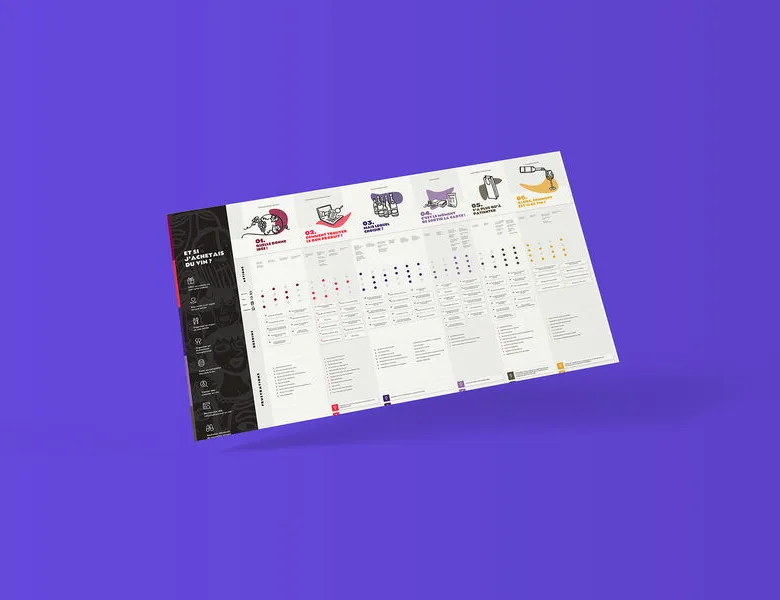


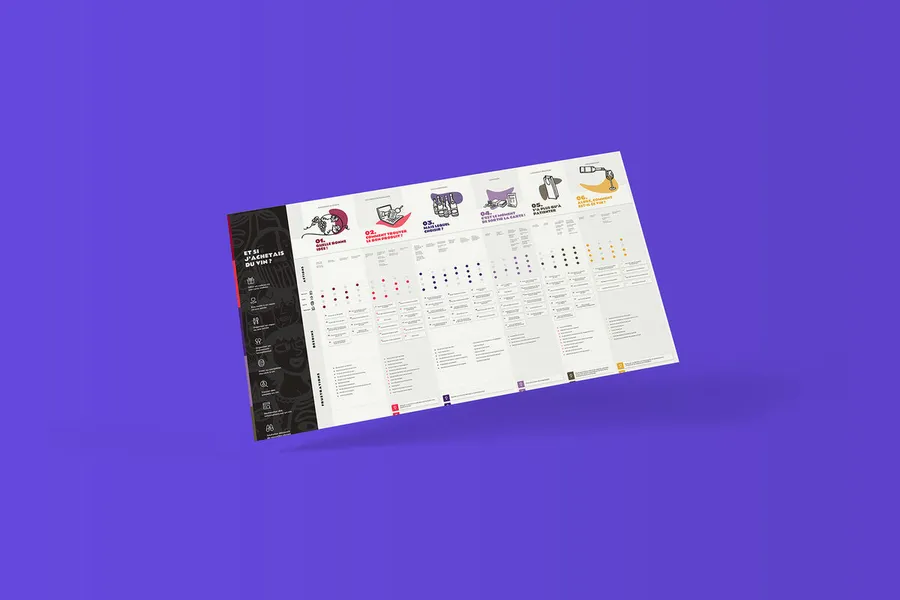
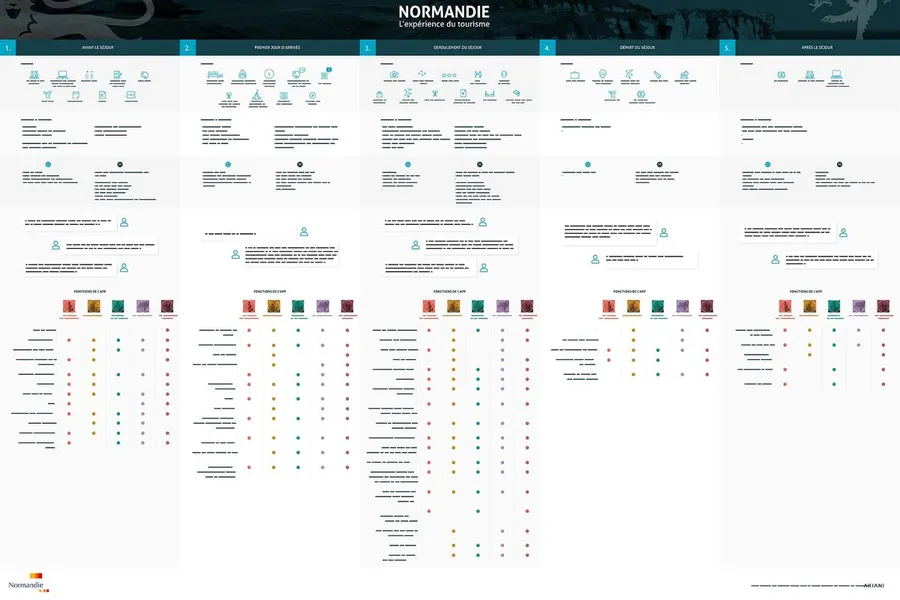
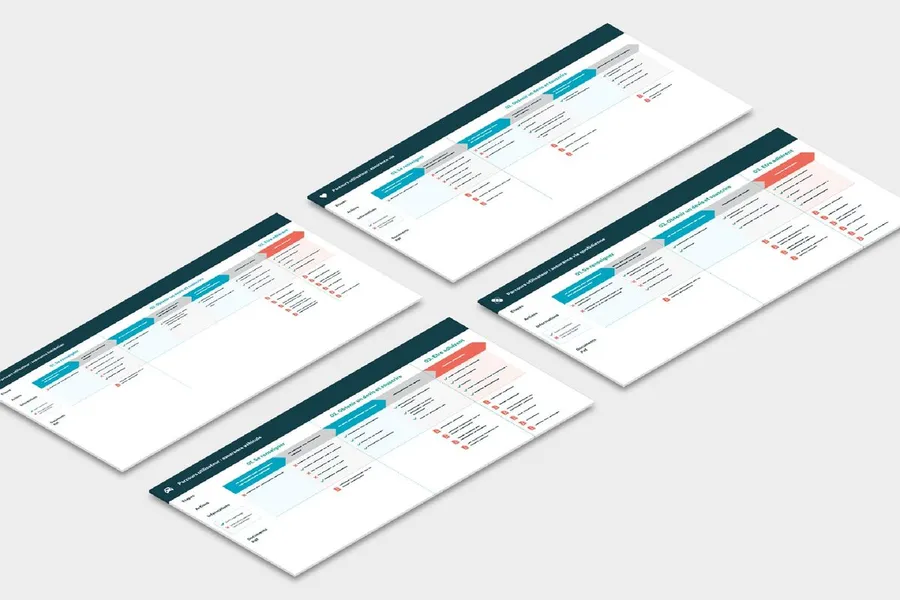
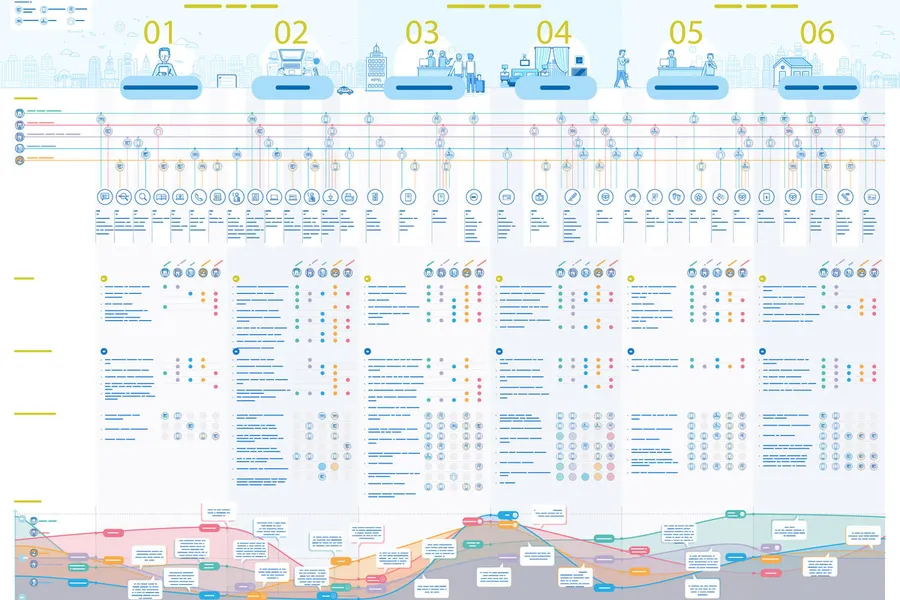
The user journey, also called customer journey or journey map, is a very common tool in UX. The term refers to a generic principle of visualising the process a user follows to reach a goal. This formalisation focuses on the steps of the user journey for a given scenario. The user journey presents a chronological breakdown of this scenario into steps. For each step, you record, at the very least, the actions taken by the user following the path. In more detailed forms, the users' needs, expectations and frustrations are also captured. You can represent variations for the different user types (mainly personas) on a specific journey. A user journey can be produced based on expert analysis, business data, or even directly on user data. Depending on the project, the user journey can take many shapes, more or less detailed. When the part lived by the user is very detailed, you'll lean towards an experience map. When you focus on the internal organisation of the various touchpoints and how they work, you'll lean towards a service blueprint.
01
Goals and needs
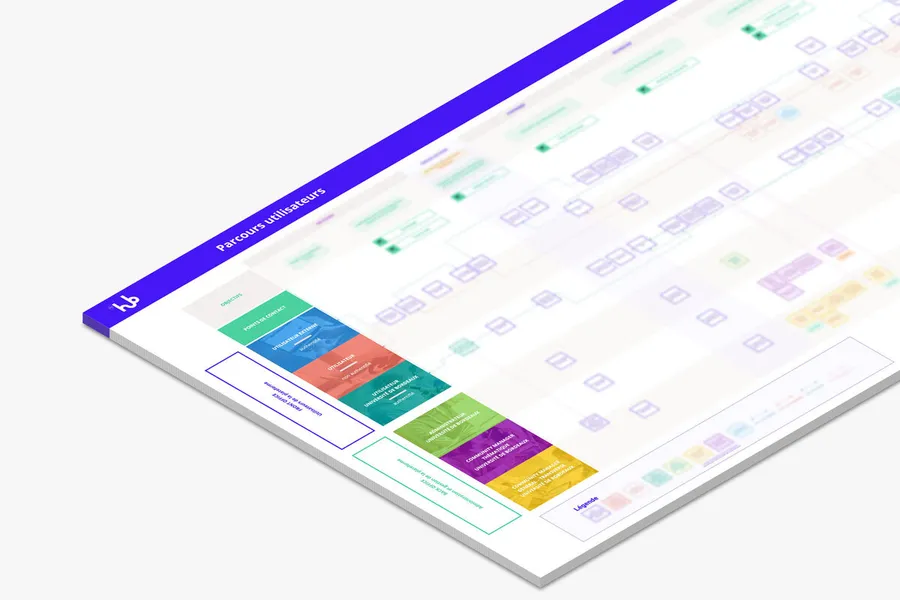
The goals the user wants to reach (note-N-map, jobs to be done) and the path taken to navigate the information architecture (user flow).
02
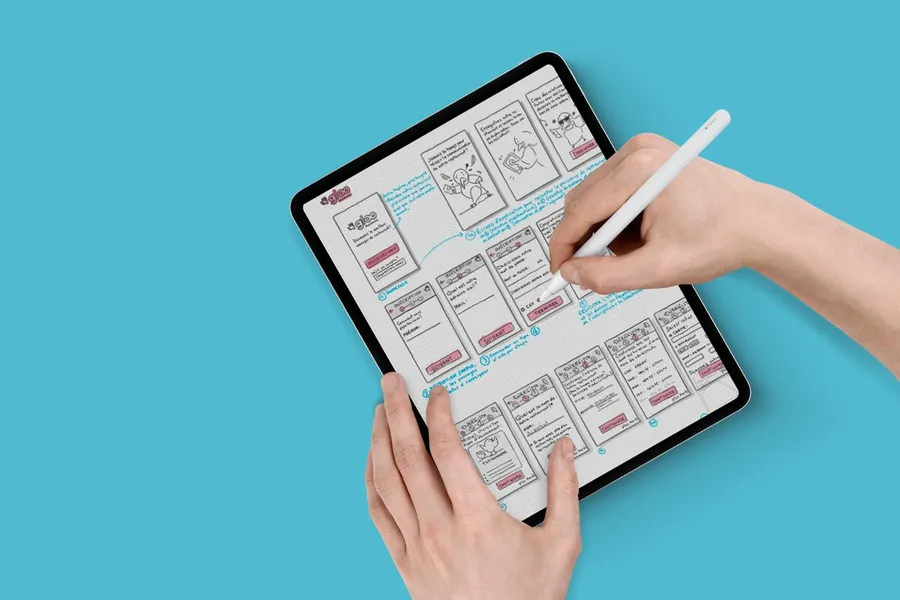
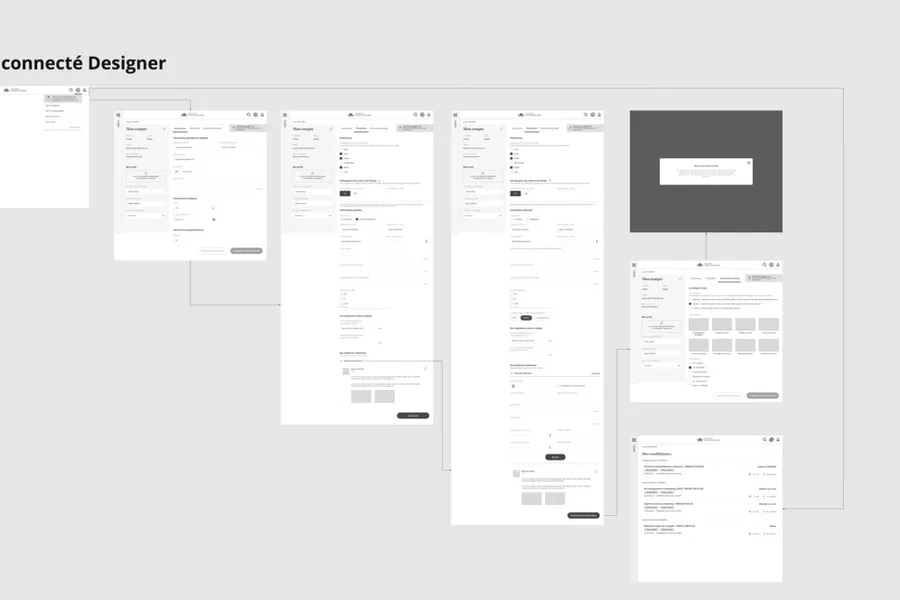
Screens and interactions
The sequence of screens the user goes through (screen flow) and how an interface behaves in a given scenario (prototype).
03
Concepts and experience
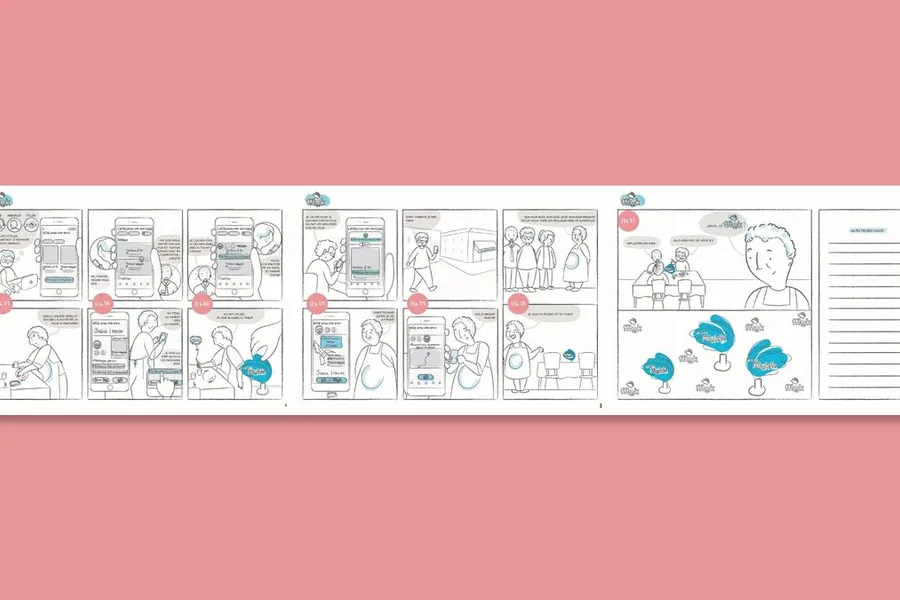
Demonstrating the concepts tied to a step of the journey (storyboard) and the characteristics of the lived experience (experience map).
04
Internal system
How the system works internally at the various steps (service blueprint).
We’ve taken part in several ergonomics and design conferences to share our expert approach, which rests on building user journeys. You can find an example presented at UX days in 2021 in a dedicated blog article on UX design from user journeys.
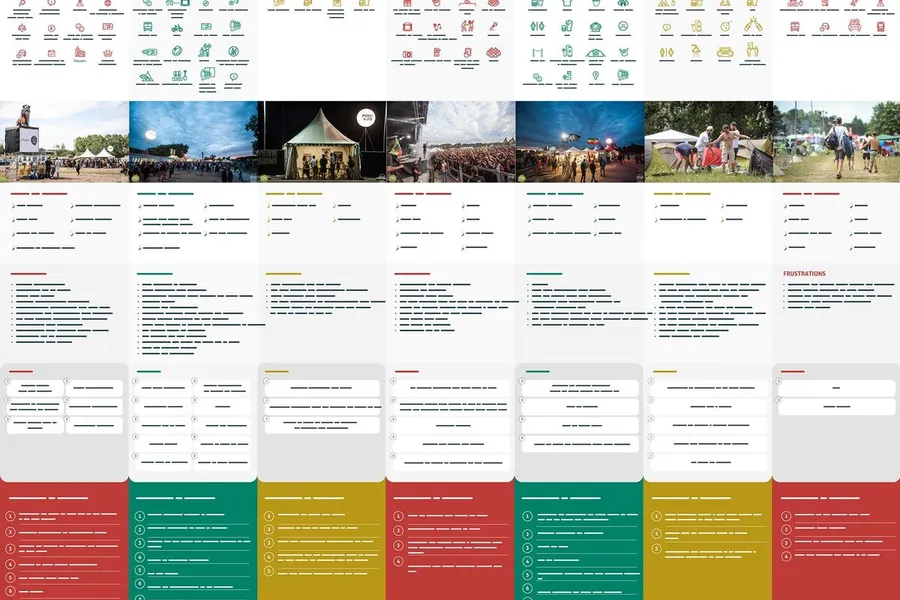
A user journey (user journey map) is a visual representation of the steps a user goes through to reach an objective, integrating their actions, their emotions, their touchpoints with the service and their friction points. It does not describe what should ideally happen, but what the user actually experiences, reconstructed from research data. It is as much a communication tool as an analysis tool.
The persona describes who the user is: their profile, their objectives, their habits. The user journey describes what they experience in a specific situation. The two are complementary: a journey is generally anchored in a persona (« here is what Marie experiences when she renews her subscription »). A persona without a journey stays abstract; a journey without a persona is disconnected from the user's real motivations.
You start from research data (interviews, observations, analytics) to reconstruct the real steps of the journey. You structure each step with: the user's action, their thoughts and emotions, the touchpoints with the service, the tools or channels involved, and the friction points identified. Emotions are often represented as a curve (the overall feeling rises or falls at each step). The journey is validated with users before being used as a decision-making tool.
In the discovery phase, to synthesise the lessons of the research and share them with teams that did not take part in the studies. In the design phase, to identify the steps to prioritise in the redesign. And in the evaluation phase, to check that the improvements made have effectively reduced the friction identified. It is also very effective in a framing workshop to align stakeholders who have diverging views of the current journey.
The user journey focuses on the experience lived by the user. The service blueprint adds the organisational dimension: the provider's visible actions, the behind-the-scenes processes and the systems that make the service possible. You generally start with a user journey, then build the service blueprint from it to understand how the organisation must evolve to improve the experience.


Personas come out of work on user-profile modelling. They highlight behavioural archetypes that prove useful when designing.
Read more about PersonasEveryone talks about user experience, service design, ergonomics...
It's not always clear, and you'd like to find out, or sharpen what you already know.