


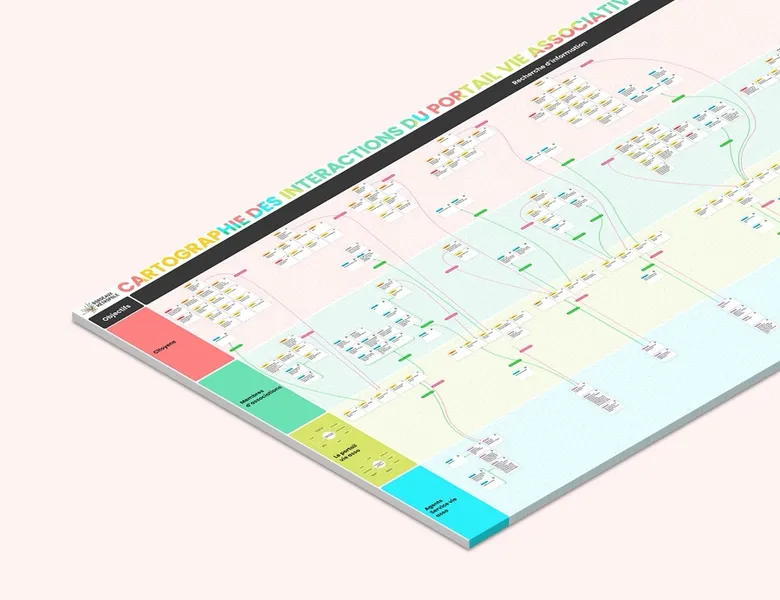


The service blueprint sets out to describe a "view" on the company side, in order to list all the touchpoints with the user step by step and how they are organised. It literally translates the imprint, blueprint in English, of the experience offered, from the point of view of the organisation and its actors.
Unlike the other maps, the service blueprint isn't concerned solely with the part of the experience visible to the user. This visualisation also describes the internal workings and interactions that make it possible to deliver the service.
Defining a service blueprint means, on the one hand, making sure to properly account for what happens below the user's line of visibility. On the other hand, the other formalisms consider only the end users, whereas the service blueprint includes internal users in order to design with an overall approach.
A service blueprint takes up the logic of breaking a process down into steps. For each of the steps, you generally document, in the form of layers:
01
The service evidence
A translation of the English term « evidencing ». It covers all the elements or places the user interacts with at a given moment. A confirmation email is one example of service evidence.
02
Touchpoints
For each step of the journey, the touchpoints the user can interact with are identified. This will notably help highlight any experiential breaks and describe the different actions, visible or not visible to the user, that are linked.
03
The « frontstage actions »
They comprise all the actions visible to the user in their interaction with the service.
04
The « backstage actions » and processes
All the activities that happen in the background without the user necessarily being aware of them. The processes are all the intermediate steps and internal interactions whose purpose is to help employees in their tasks
In these lines of a service blueprint, you’ll generally materialise three separations: the line of interaction, the line of visibility and the line of internal interaction.
Since the service blueprint consists of looking beyond the line of visibility, it’s essential to speak with and involve the internal actors who keep the service running. You can for instance carry out in-situ observations, run interviews with business representatives and organise workshops to build the model collaboratively.
Like the other maps, it’s also possible to add other information to the service blueprint, such as feelings (emotions), the links between actions, opportunities, and so on.
The service blueprint is built by taking into account all the stakeholders who contribute to delivering the service to a user. This corresponds to everything that happens behind the scenes and at the level of the touchpoints between the service and the user.
Everyone in charge of a piece of the overall system is potentially concerned. You arrange at least to have different disciplines, and representatives who handle different touchpoints. The service blueprint brings together the strategic vision, the tactical plan and the operational actions. Those who shape it must feed these different levels.
It's the exploded view of all the cogs of the organisation that keep running a system delivering services to its users. A centralised view of the flows, the links, the dependencies, the resources to mobilise, the processes. In short, it's a tool for planning and steering your projects.
The service blueprint is a modelling and decision-support tool. It's more regularly used in service design projects. Despite that, it's also associated with the design approach and therefore with design thinking.


UX mapping is the creation of a simplified representation of a concept or a problem to make it easier to understand and take ownership of.
Read more about UX mappingThe experience map focuses on the visible part of the experience. It represents a user's overall experience with a service or product: before, during and after.
Read more about Experience mapPersonas come out of work on user-profile modelling. They highlight behavioural archetypes that prove useful when designing.
Read more about PersonaService design shapes the whole experience of a service, online and at the counter, beyond its screens. Definition, public sector and examples.
Read more about Service designEveryone talks about user experience, service design, ergonomics...
It's not always clear, and you'd like to find out, or sharpen what you already know.