


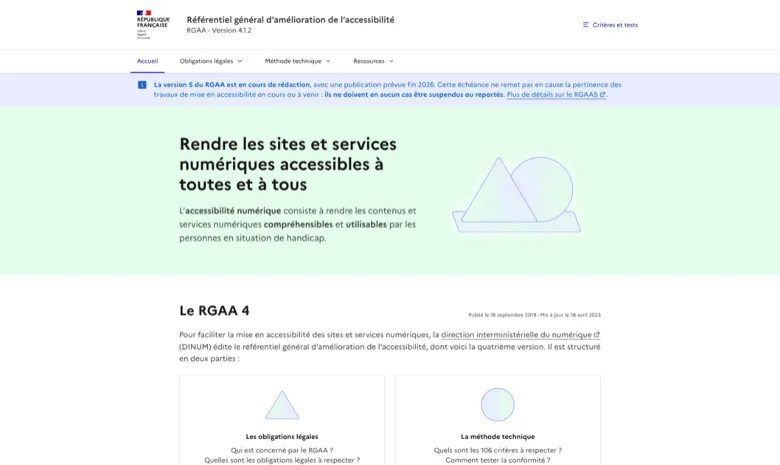


The Référentiel Général d’Amélioration de l’Accessibilité (RGAA), the French general accessibility improvement framework, gathers the criteria that digital services must meet to satisfy accessibility requirements. We are on version 4 of the RGAA, and the updated version (RGAA 5) is planned for the end of 2026. Numbering 106 and spanning 13 themes, the criteria are testable through a dedicated protocol, and their WCAG equivalents are identified.
01
During an ergonomic audit
The RGAA criteria are checked to make sure at least the AA standard is reached. If that is not the case, precise fixes are set out
02
During UX design
Integrated in the same way as the Bastien & Scapin and Nielsen heuristics, the RGAA criteria must be taken into account as early as possible in design, since their scope is wide: navigation, appearance, and so on.
03
During UI design
Applying the RGAA criteria is important at the high-fidelity mockup stage, since several criteria flow directly from the chosen art direction: line spacing, colours used, and so on.
The Référentiel Général d'Amélioration de l'Accessibilité (RGAA, the general framework for improving accessibility) is the French regulatory framework that defines the accessibility criteria that public digital services must comply with. It transposes the WCAG (Web Content Accessibility Guidelines from the W3C) into a French legal context, with precise test criteria and an audit methodology. The current version is RGAA 4.1.
Central government administrations, local authorities, public bodies and companies operating a public service under delegation are legally required to comply with the RGAA since the law of 11 February 2005. Since 2019, private companies with revenue above 250 million euros are also affected. The obligations include publishing an accessibility statement and a multi-year compliance plan.
The WCAG are the international accessibility standards published by the W3C, with no legal force of their own. The RGAA is the French transposition of the WCAG into a legal framework: it adds precise test criteria for each conformance level, a structured audit methodology and regulatory obligations for public entities. Complying with the RGAA implies complying with the WCAG, but the audit and compliance process is more formalised.
It is a mandatory document that organisations subject to the RGAA must publish on their digital service. It indicates the level of conformity reached (compliant, partially compliant, non-compliant), the list of identified non-conformities and the alternatives offered to users for content that is not accessible. It must also indicate a contact procedure for people who encounter accessibility problems.
The RGAA audit takes place in several stages: defining a representative sample of pages, evaluating each criterion on that sample, calculating the overall and per-page conformity rate, and writing the report with the non-conformities and recommendations. The audit can be carried out in-house by a trained team or entrusted to a specialised provider. The RGAA framework is available free of charge on the French government website, with the full methodology.


Digital accessibility makes products usable by everyone. In the digital field, the RGAA is the reference on the matter.
Read more about Digital accessibilityThe WCAG are the W3C's recommendations for web accessibility. Organised into 4 POUR principles and 3 levels (A, AA, AAA), they serve as the basis for the French RGAA.
Read more about WCAGOpquast gathers 240 web quality rules covering accessibility, SEO, performance and security. Its standard and its certification structure web quality practices.
Read more about OpquastThe RGESN sets out eco-design criteria for digital services and serves as a reference for players in the sector.
Read more about RGESNEthical design factors in the impact on users from the design stage. It stands against dark patterns and raises the question of the designer's responsibility for their choices
Read more about Ethical designSystematic, detailed analysis of an interface (web, mobile, business tool) against a set of criteria, used to surface friction points and produce illustrated recommendations.
Read more about UX auditEveryone talks about user experience, service design, ergonomics...
It's not always clear, and you'd like to find out, or sharpen what you already know.