




A format created by Alan Cooper in 1979, personas (or "personae") now hold a major place in UX. They're especially used to support decision-making and to pick which new ideas to pursue. A persona is a stereotyped representation of the target user group, used as a reference when expressing needs and understanding users. In marketing, personas are usually built around traits tied to buying behaviour. UX personas focus on behaviours around usage. From the data gathered from end users, you'll work to identify the behavioural variables that segment your target users. Four or five major dimensions will emerge, and they'll allow the definition of 4 to 6 main personas. These personas will stand as stereotypes of the users of your products or services. You'll accept the idea that personas are stereotypical profiles and, as such, can only represent a marginal slice of the user base. But the way their traits combine, having come out of rigorous behavioural research, gives designers the means to think through the user journey while constantly keeping the specifics that stand out in mind.
01
User data
To build personas, you first need to gather behavioural data. Ideally, that data comes directly from real users. It can come through observations, individual interviews, focus groups or diary studies.
02
Behavioural variables
The data analysis should bring out behavioural variables. You can also talk about axes or dimensions along which the users you met seem to distribute. Generally, 4 to 6 dimensions are enough.
03
Behavioural archetypes (patterns)
Once users are placed on those axes, certain patterns start to take shape. That's what we call the behavioural archetypes. You then pick the most telling ones, and crucially validate them with subject-matter experts. This iteration helps target the most interesting ones to work on, and also adjust or even drop some archetypes.
04
Generating the user profiles
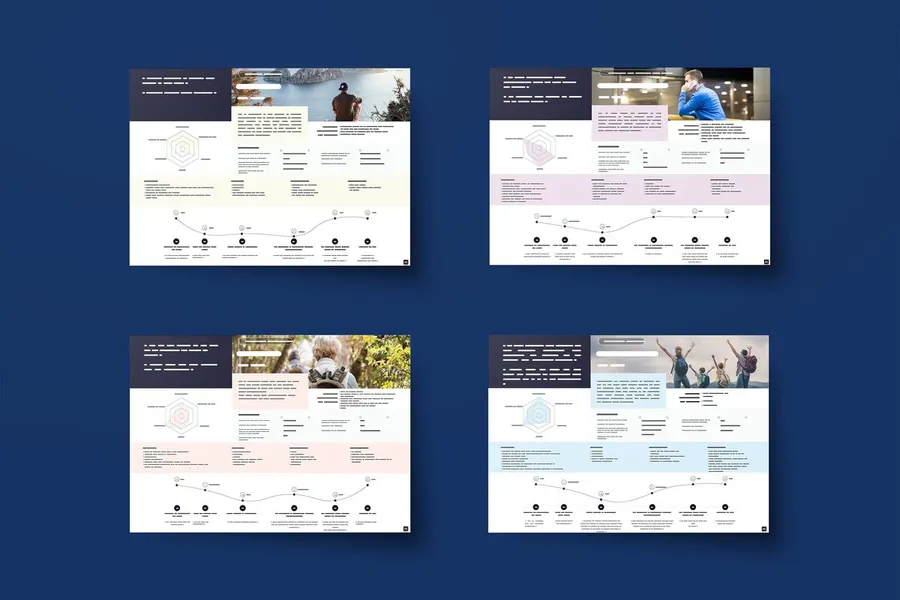
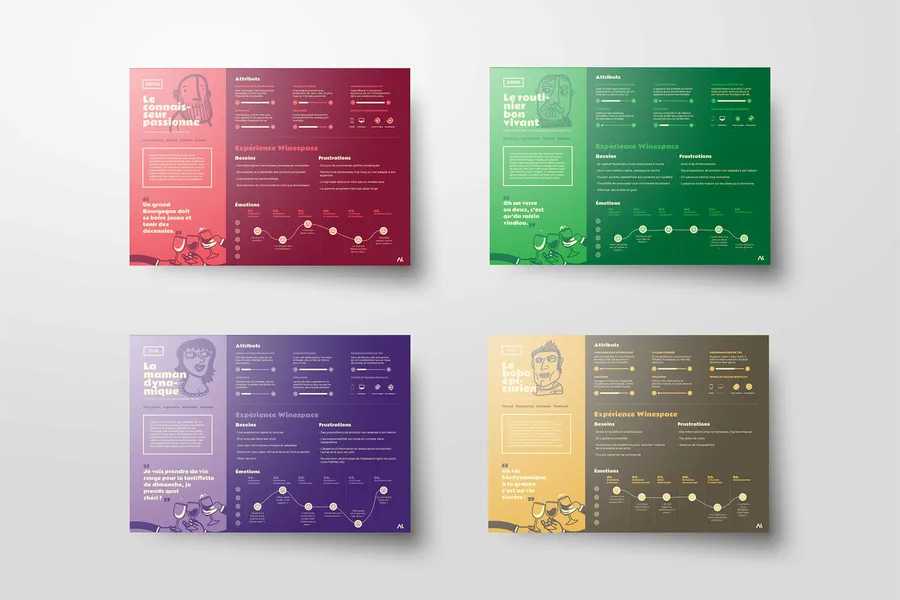
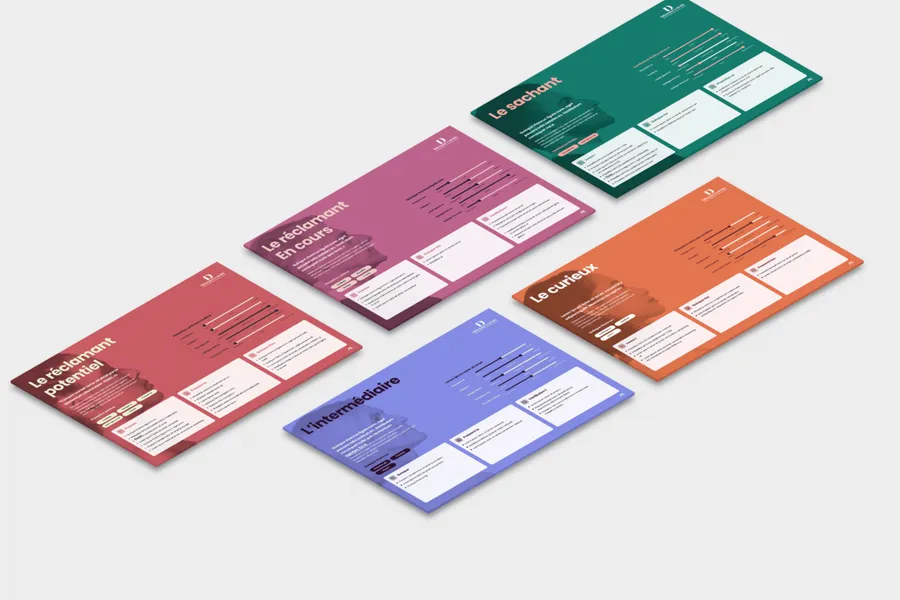
Once the archetypes are defined, all that's left is to enrich them with other information that fleshes out the profiles. You usually include expectations and frustrations, along with any other piece of information relevant to the product or service at hand.
The usability and design of the final output are key characteristics of its quality. Far from being an expert’s flourish, these materials need to be usable in workshops, with profiles that don’t necessarily share the same sensitivity to usage as the user researchers.
The document needs to convey the most important information quickly and simply, and make it easy to remember. It also needs to support creativity. Its visual character should energise the teams gathering around it, make them want to consult it, even enjoy it.
This modelling work can also be carried out without the user-needs collection step. That situation comes up when resources (time and budget) are constrained, but the stakes around accounting for users justify the stereotypes being designed to reflect the (necessarily slightly biased) view of the business and the experts supporting the work. To set them apart from materials built on actual user data, these deliverables are called proto-personas.
A persona is a fictional profile representative of a group of real users, built from research data. It describes a user archetype with their objectives, their habits, their frustrations and their usage context. Formalised by Alan Cooper in 1999, it serves to keep teams focused on real users during design, rather than on internal assumptions.
From qualitative and quantitative data drawn from user research: interviews, field observations, questionnaires, analytics. You identify recurring behaviour and motivation patterns across participants, and you group similar profiles into archetypes. Each persona is then described with its objectives, its behaviours, its tools, its frustrations and its needs. A persona not anchored in real data is not a persona: it is an assumption in disguise.
As few as possible while covering the genuinely distinct user segments. One to three personas cover most products. Beyond five, personas become hard to maintain and to use in design meetings. If the profiles are too numerous, it is often a sign that the segmentation is too fine or that the personas are based not on behaviours but on demographic data.
A persona is built from real user research. A proto-persona (or hypothesis persona) is built from the team's assumptions about users, without field data. The proto-persona is useful to launch a project quickly when you have not yet done research, but it must be explicitly marked as provisional and updated as soon as real data is available. Confusing the two is a frequent source of confirmation bias.
By making them visible (displayed in the workspace, accessible in Notion or Figma) and by integrating them into the team's rituals: « For this persona, does this feature make sense? ». A persona that no one consults has no value. You can also structure user stories and test scenarios around the personas so that they concretely guide design decisions and product prioritisation.


The user journey breaks a process down into steps to surface user needs and expectations, either for a given goal or when interacting with a specific product or service.
Read more about User journeyEveryone talks about user experience, service design, ergonomics...
It's not always clear, and you'd like to find out, or sharpen what you already know.