


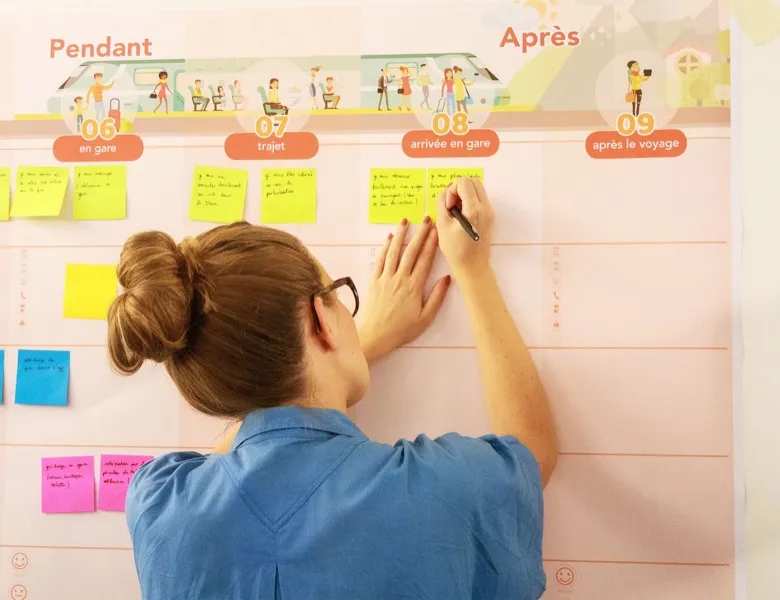


The experience map is an augmented version of the user journey, from which it takes up the logic of breaking things down into steps.
In an experience map, you set out to describe end to end the actions carried out by a user on a given theme. This classically includes the upstream and downstream steps around the use of a service. It's therefore important to understand that an experience map isn't limited to the sole moments during which a user interacts with your product or service.
Modelling an experience map, or experience mapping, therefore means retracing the different steps that all or part of your users go through to reach a goal. Experience mapping thus defines a panoramic view of the pathways, dwelling on the real needs, the actions carried out and the difficulties encountered.
In a user research project, the experience map is a deliverable that requires collecting usage data to cross-reference with business experts, in order to co-build a shared and usable view.
01
Behavioural archetypes
On the basis of the research carried out, you identify different behavioural typologies of user in relation to the service and/or the product concerned (see « personas »).
02
Defining a journey skeleton
For the before, during and after phases of the interaction with the service, you break down the different steps of the users' experience that will serve as a frame of reference for the model. Like any model, it's necessarily partial and incomplete; the essential thing is to include all the moments that are relevant to document. It could be a very short step but a very strategic one for the company, or one for which you have a lot of interesting feedback, for example.
03
Building the experience map
Depending on what you're studying and the purpose of the exercise, the lines will evolve, with the needs and blocking points generally set against opportunities. As far as possible, you incorporate leads for solutions and/or features spotted in contact with users. It's also possible to list emotions and annotate quotes. This work is very frequently carried out with the project teams to ensure a cross-check between the business vision and the findings from the study.
04
Making use of the experience map
This step comes after delivery, once the experience map is in the hands of the client teams. A snapshot of an existing situation or a target project, the experience map is meant to evolve through an update of its content. This type of deliverable isn't an end in itself but a genuine decision-support tool for the company's projects.
An experience map built on the basis of real data is a fairly dense document that holds a great deal of usable information.
As with personas, particular care is given to the graphic quality of the final document. Meant to be shared and used by the business teams, it’s important that an experience map makes you want to read it and offers the best possible readability.
An experience map is a visual representation of a user's overall experience in a given domain, independently of a specific product or service. It maps the steps, behaviours, thoughts and emotions of a user across a complete journey, often broader than what a single product covers. It serves to understand the experience before designing the solution.
The user journey (user journey map) is anchored in a specific product or service: it describes a user's steps with that particular product. The experience map is more generic: it describes the experience in a domain or a life context, even before a product exists. The experience map is a discovery tool; the user journey is a tool for design and alignment on an existing or target service.
The experience map focuses on the user's perspective: their steps, thoughts and emotions. The service blueprint adds the organisational perspective: the visible actions of the provider, the behind-the-scenes processes and the support systems. The experience map answers « what does the user live? »; the service blueprint additionally answers « how does the organisation produce this experience? »
From qualitative research data (interviews, field observations, diary studies). You identify the phases of the experience, the typical behaviours at each phase, the associated thoughts and emotions, and the standout points of friction or satisfaction. Emotions are often represented as a curve (the feeling rises or falls at each step). The experience map is then validated with users to check that it reflects their real lived experience.
It aligns teams on a shared understanding of the experience before designing anything. It reveals improvement opportunities that wouldn't be visible when looking at a single touchpoint only. It helps prioritise design efforts on the phases of the experience where the impact will be greatest. It's also a communication tool with non-design stakeholders, who concretely see where their users' experience stands.


UX mapping is the creation of a simplified representation of a concept or a problem to make it easier to understand and take ownership of.
Read more about UX mappingThe service blueprint represents the back-office side of the experience. It describes the organisation of the touchpoints the user crosses to use a given service.
Read more about Service blueprintPersonas come out of work on user-profile modelling. They highlight behavioural archetypes that prove useful when designing.
Read more about PersonaEveryone talks about user experience, service design, ergonomics...
It's not always clear, and you'd like to find out, or sharpen what you already know.