




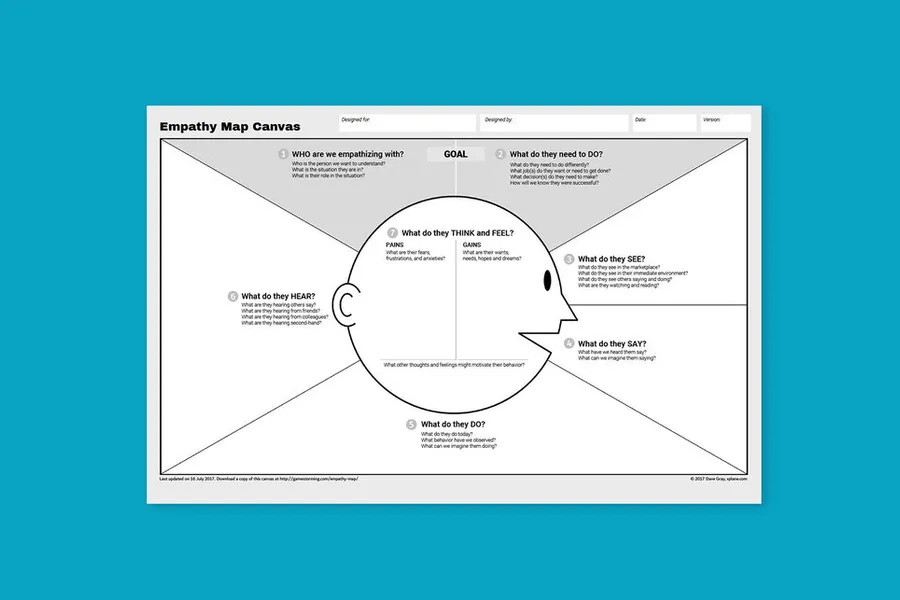
An empathy map is a technique for compactly representing the various elements that make up the experience a user lives through in a given situation.
The empathy map is a very simple way to sketch out what happens in reality. To build an empathy map, you can use information reported by subject-matter experts or gathered through field observations. Because the user's thoughts and feelings aren't directly observable, this calls for either making assumptions (we'll talk about inferences) or asking users directly to verify them.
01
The upper part: the user's perceptions
The upper part of an empathy map describes the user's perceptions: their behaviour (what the user does, what they say), the environment they're in (what the user sees and hears) and the matching cognitive and emotional dimensions (what the user thinks, what they feel).
02
The inner part: problems and needs
The inner part is used to list the problems encountered and the related needs, expectations and opportunities.
An empathy map can be filled in on your own or as a group.
It can be fed by information reported by subject-matter experts or by field observations. Because the user’s thoughts and feelings aren’t directly observable, this calls for either making assumptions (we’ll talk about inferences) or asking users directly.
An empathy map can be used at different stages of user research. It’s useful upfront, to lay out what’s already known about a situation. It’s also a handy note-taking format in the field. During a workshop with the project teams, it makes for a good exercise to gather complementary feedback from the various roles. Lastly, the empathy map can serve as a summary of the data coming out of the preliminary research.
An empathy map is a visual synthesis tool that represents what a user says, thinks, feels and does in a given context. It is used to quickly share a common understanding of a user profile within a team, based on data gathered in research (interviews, observations, questionnaires).
The persona is a synthetic fictional profile that represents a user archetype over time. The empathy map is a more immediate analysis tool, often built on the spot from a specific research session. You can use several empathy maps to feed the construction of a persona.
Both are possible, but the collective workshop is often richer. Bringing designers, product managers and developers around the same map forces everyone to confront their assumptions with the real data. That is often where preconceived ideas about users fall away the fastest.
Mainly in the discovery phase, after conducting interviews or field observations. You can also use it to prepare an ideation session or to refocus a team that has drifted away from real needs. It is particularly useful when the client and the team do not have the same level of knowledge about users.
You rely on qualitative data from research: interview verbatims, field observation notes, open-ended answers to questionnaires. The aim is to stay as close as possible to what users actually said or showed, not to what you assume they feel.


Personas come out of work on user-profile modelling. They highlight behavioural archetypes that prove useful when designing.
Read more about PersonasBreaking a process down into steps to bring out user needs and expectations, either for a given goal or when interacting with a specific product or service.
Read more about User journeyEveryone talks about user experience, service design, ergonomics...
It's not always clear, and you'd like to find out, or sharpen what you already know.