
The oldest enigma of Humankind
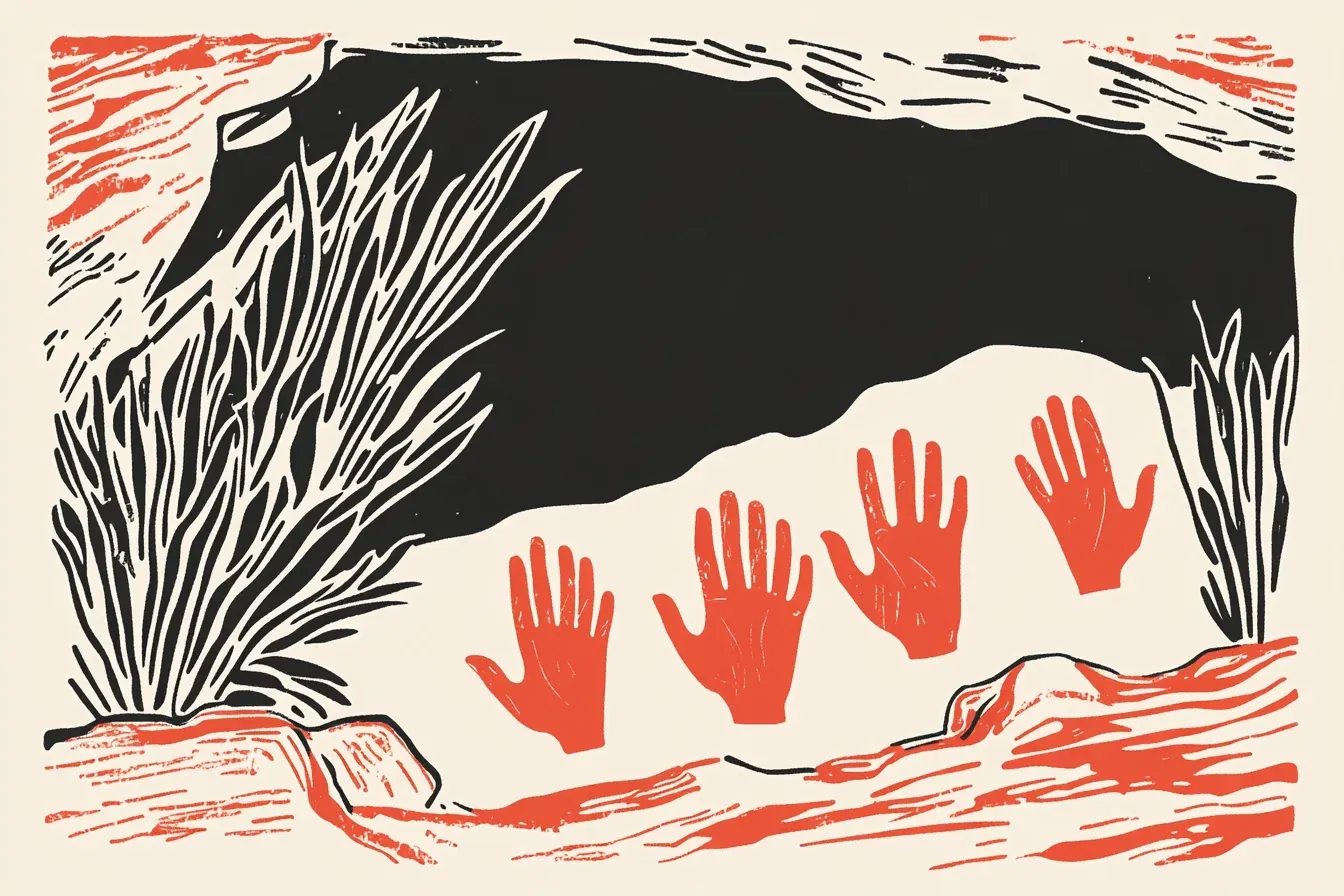
You may have heard of Bertrand David. His book The oldest enigma of Humankind caused quite a stir last year. In it, he sets out a theory about the cave paintings of Prehistory, including the very famous ones at Lascaux. Of all the theories explaining how they were made, the most widely accepted simply assumed a freehand charcoal drawing.
Yet several details kept puzzling the experts. First, the almost perfect repetition of certain models. But also the fact that some paintings began on one wall and finished on another. Or drawings that were sometimes caricatural, distorted, or layered on top of each other with no real logic.
One evening, as he was putting his son to bed, Bertrand David was struck by the shadow cast onto one of the bedroom walls by a figurine sitting near the bedside lamp. He knew that many animal figurines dating from prehistoric times had been found. So he ran an experiment, placing them between a cave wall and a simple oil lamp. He then traced the outline of the cast shadow in charcoal, and the result was conclusive (opens in new window)!
Move the figurine and the shadow stretches across several walls; change its distance from the candle and you change the scale. Turn the object and part of the limbs vanish into the shadow, or the shadow itself warps. Every detail that had puzzled the community for so long suddenly had an answer: the simple charcoal tracing, on the wall, of the shadow cast by a small statuette.
Prescribed activity and actual activity
Let’s come back to our question of activity. We usually distinguish between what is called prescribed activity and actual activity. Prescribed activity is the one set out by procedures, the one asked of the operators. It is the one that states, for example, that a checkout clerk’s job is to run purchases past a cash register, possibly arriving on a conveyor belt, then move them to a delivery area, and finally collect the amount due from the customer. Prescribed activity, in our allegory, is Bertrand David’s figurine: cleanly drawn and defined, the way a job description spells out a role. Just as a persona helps define a typical user.
The work environment is the set of constraints that bear on the activity: social, physical and environmental ones (lighting, temperature, and so on). It is what turns prescribed activity into actual activity. In our allegory, it is the cave walls and the oil lamp set behind the figurine. This transformation can be modelled and explored through user journeys, which make it possible to picture the experience.
Actual (or effective) activity is what the operators really do on the ground. It reflects the fact that a checkout clerk is assessed on performance targets, and that how warmly they greet customers is part of that. That on top of scanning purchases, they also have to wipe down the conveyor belt, for instance, just to keep it clean when a leaking package has soiled it. To really grasp this actual activity, user tests are essential, because they let you observe behavior first-hand.

Studying the paintings at a glance
In our allegory, this is the projection on the wall. It is distorted, a little lopsided. Some parts are bigger than others. It resembles the figurine, and yet, if you only look at the figurine, you get the wrong idea of what its shadow will look like. If you know where the lamp sits and what the cave looks like, you can begin to imagine it, but it is only by looking at the projected shadow that you will really know. And only then can you measure the gap with the cleanly drawn statuette you started from.
Analyzing activity in ergonomics means studying three things side by side. First, measuring the gap between prescribed and actual activity in light of the work environment. Then, weighing the impact of that gap and the effect of the environment. To think you can analyze the activity by looking only at the prescribed part is to think you can picture the projection on the walls. It is not impossible. It just takes knowing the cave walls and its volume perfectly. But also the slightest bump in the rock, the size of the candle, the way the flame moves in the draft, and how all of it sits relative to the figurine. Co-design workshops help here, by bringing different points of view together and deepening that understanding.
What can we draw from this allegory of the Lascaux paintings
Or you can go and study what the operators actually do, and cut the risk that the projection has badly warped the original silhouette, with everything that follows: performance dropping, safety taking a hit, costs creeping up. And speaking of painting, we may as well touch on the creative side of things. But where does a creative idea come from? Read our blog articles on the subject: the first and the second episode.
PS: the theory is used here for illustration. We should add that, when it came out, it was hotly debated and criticized. Many experts doubt it can really explain the Lascaux paintings, since no figurine has ever been found there. We would also like to warmly thank Pr. François Daniellou of the ENSC, who introduced us to the checkout clerk case in his wonderful course on activity.
The illustrations in this article were generated by AI (see our AI use statement).