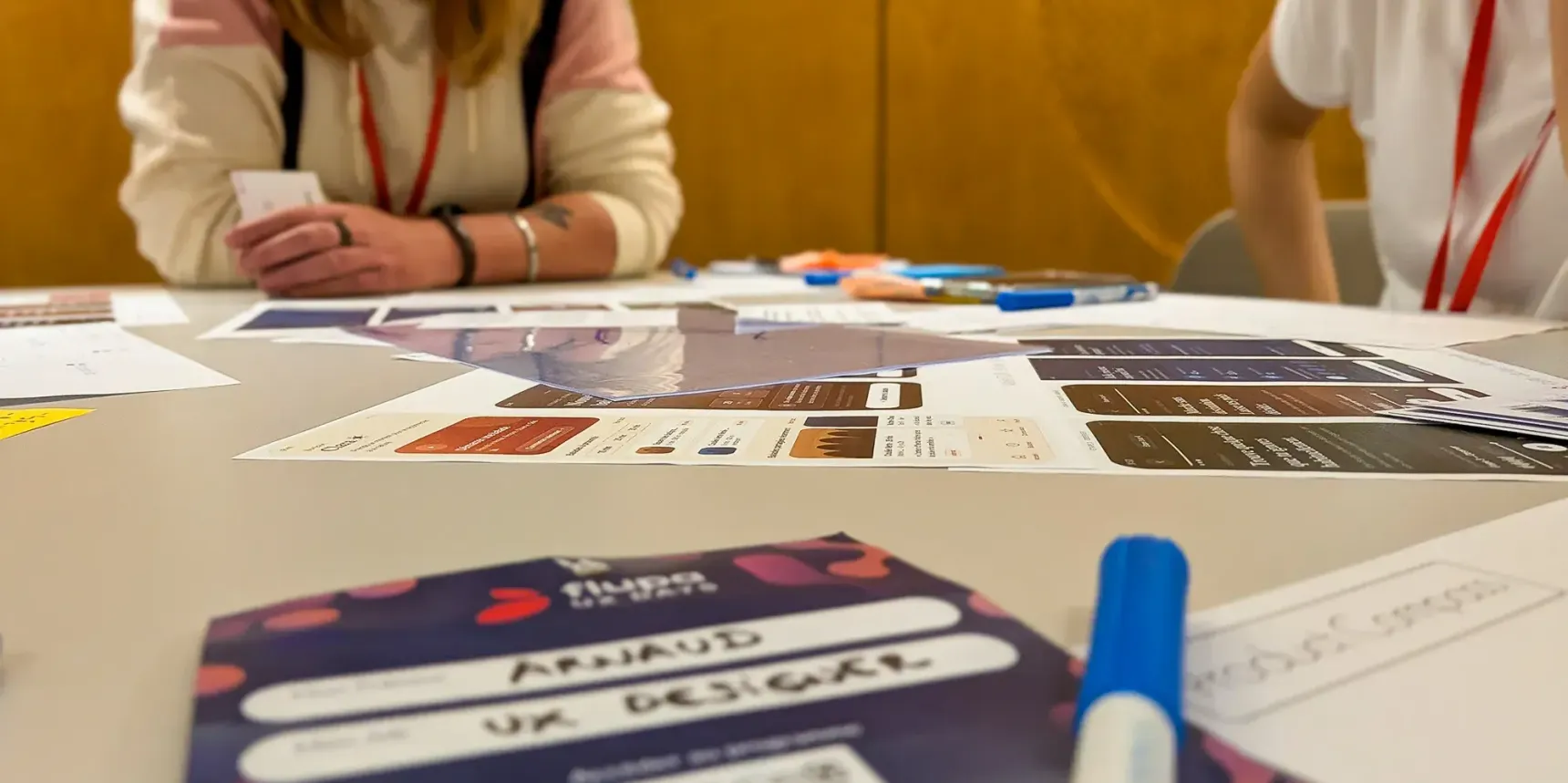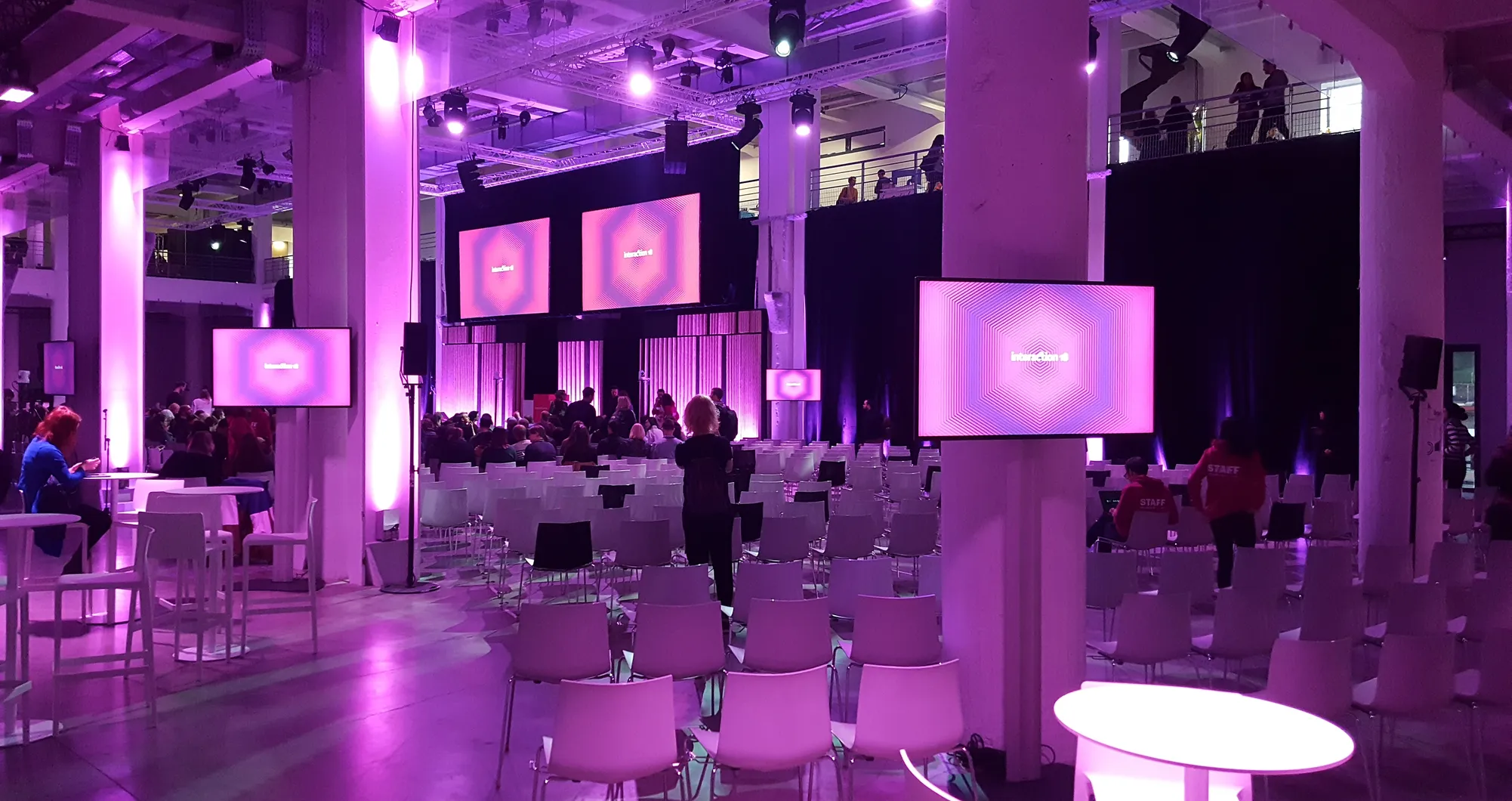
Interaction18 - The event (with a capital THE)
To set the scene a little:
- It’s the fourth time in 11 years that this conference has taken place in Europe. Our chance, the magnificent city of Lyon was chosen this year
- The theme of the edition: “Dissolving boundaries. Building connections.” (admit it, even just that sounds pretty good, doesn’t it?)
- Interaction means workshops, a design challenge, and 3 days of talks
- Alan Cooper opened the proceedings with the opening keynote (the inventor of personas, no less)
- As a setting to do this fine programme justice, La Sucrière (a place steeped in history, fitting for the event) (opens in new window)
First, what struck us was the beauty of the place and the arrangements made by the organisers. The attendee experience was carefully crafted: top-notch decor, all kinds of goodies, playlists, guidance from the volunteers on site, and so on. By bringing together designers from 46 different countries, the Interaction18 team managed to pull off something very hard: creating an atmosphere, for a memorable experience!
Shared moments
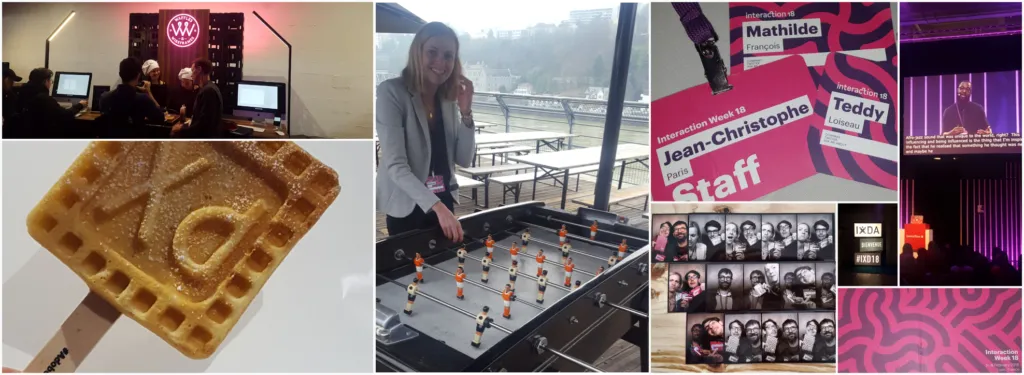
At Akiani, it was also the chance to enjoy nice moments between colleagues from the Lyon and Bordeaux agencies. You’ll see in what follows that everyone wanted to share their experience in this article. For example, we:
- played table football on the roof top
- took photos in a vintage booth
- ate vegan (and gluten-free, we don’t do things by halves)
- ate waffles bearing the likeness of a very well-known software company (with gluten)
But above all, we learned plenty of things, met passionate, very approachable pros to discuss everything that keeps us busy day to day. Right, we’re starting to make you sick of us, so let’s get into the heart of the matter!
Rather than tell you everything, we’ve chosen to give you our selection. Overall, we propose to sum it up in four words: responsibility, space, temporality and diversity.
1 - Design and responsibilities
Alan Cooper went all in with his keynote titled “The Oppenheimer moment” (opens in new window), telling us we were all potential Dr Frankensteins. Indeed, when you design a product, you can quickly find yourself creating a monster. This product can be used in a diverted or inappropriate way. Robert Oppenheimer, a physicist, may not have planned to kill 70,000 people in Hiroshima (shh, let us believe it). In these cases, no one is ever responsible, or rather everyone is (yes, you too, behind your little computer). He used the image of the Titanic without an iceberg: there isn’t one hole in the hull, but thousands of small holes.
If we want to create durable, ethical and responsible products, we have to consider these aspects throughout the design process, and everyone has to feel responsible.
“It’s not our fault, but it is our responsibility!” Alan Cooper - Interaction 18
Everyone can act at their own level. Doing nothing when you detect a potential side effect shouldn’t be an option. Even if we believe we don’t have the power, we have something better: agency. That is, the ability to act and step in at our own level to plug one of the Titanic’s little holes! It’s the sum of small actions that will straighten the bow. Nothing else.
In short, we were already a little in love on arriving, but it has to be said that Alan Cooper found the words to definitively sweep our little hearts away. He talked about his cat (shout-out to Monkey), about his ranch (which he named after his cat), but above all about ethics, sustainability and being a good ancestor.
2 - Design and spaces
Then, several people talked to us about design and physical space during the conference, including Molly Lafferty. In her presentation TV is dead, long live TV! (opens in new window), which we really enjoyed, Molly talks about the changes in how we organise our interiors.
She gives the example of the design of the Kinect and the Wii. Microsoft designed the Kinect in the United States, where living rooms are quite large. They need space in front of the TV so you don’t break mother-in-law’s photo while flailing about. By contrast, you can use Nintendo’s Wii in a more confined space (even sitting on the sofa), which fits the small living rooms of the Japanese.
So gone is the classic sofa / coffee table / TV arrangement and the family gathering in front of the screen at 7pm sharp. She talked to us about taking physical space into account, but also about the dynamics of experiences. Recalling the importance of taking into account Levin’s 3 Cs (2014): Coherence, Complementarity and Continuity in designing multi-device experiences. But there’s also the generational perspective, which is interesting! Right now, our (grand)parents have a very particular relationship with the TV because of their history. At the other end of the spectrum, today’s little ones — tomorrow’s users — will have a completely different relationship with screens and the TV. This transition from all-digital towards taking physical space into account inspired us: back to the real world.
In our top 5 talks, there are also those by Nicolas Nova (opens in new window) and Farai Madzima (opens in new window). They both talked, in their own way, about the importance of heritage — technological and cultural — in how we design; we’ll tell you more right now!
3 - Temporality / How design evolves
Nicolas Nova presented a history of the interfaces and interactions designed in France (opens in new window). He put their heritage into perspective with our current interactions. We loved going from the Canut weaving looms to IBM circuit boards, from the “Minitel rose” to the internet, or from the Nabaztag to today’s voice assistants. Nicolas Nova took us on a journey through time. He showed us the importance of knowing the past to design the future. This talk could be summed up in 5 words:
Step backward to step forward! - Nicolas Nova, Interaction18
But it wasn’t just a simple list, because you can take technical constraints from the past as prerequisites for new services. For example, a few years ago, limited connection speeds forced us to consider features that worked despite that constraint. This low-bandwidth paradigm remains very relevant to consider today. An example? Well, think of the last time you arrived at a hotel where you had no 4G and were looking for your booking code to check in!
4 - Design, diversity and personality
For his part, Farai Madzima talked to us about the designer as an individual in all their uniqueness (opens in new window). He works from the principle that the quality of a product would also come from the specificities of the designer who created it. Like that young trumpeter he used as an example, he encouraged us to play our own sound, drawn from the mix of our South African roots and the influences of American jazz players. Farai actually used the exact words Miles Davis said to that young trumpeter to put this across:
Take your sh*t from home Put that with the sh*t you learned here That’s gonna be a muthaf*cka - Miles Davis
It made us think about what we can each bring, in our individuality, to our design projects. His talk is really worth a look, for the inspiring content but also for the form.
And so many other fascinating talks during Interaction18
As we said, it’s a Redux, so by definition, we can’t be exhaustive. We can still recommend some very inspiring talks worth revisiting:
- Haiyan Zhang (opens in new window), who came to present projects initiated by Microsoft in the medical field. How do you turn a care experience into a playful one? Haiyan and her teams have answers!
- Anab Jain (opens in new window), founder of the Superflux studio, who came to talk about Speculative Design
- Belen Palacios (opens in new window) then Emile Hooge (opens in new window), who talked about co-design and co-creativity initiatives in cities
- Florent de Grissac (opens in new window), who came to share his expertise in gamification for public consultation
Drrrrriiiiiiinnnngg goes the bell: end of the 8 minutes granted. We hope to have shared our enthusiasm with you and to have made you want to do an Interaction binge watching weekend! Popcorn, maestro! All the videos are online on Ixda’s Vimeo channel (opens in new window) or via the conference programme page (opens in new window).
But before we let you get back to a normal activity, we haven’t forgotten what we promised you…
Want more on Interaction18?
Thanks to the speakers who answered our request to share their bedside books or really nice projects! A good extra source of inspiration:
Speaker
References
Format
Molly Lafferty (opens in new window)
Designing Multi-Device Experiences: an ecosystem approach - Michal Levin (opens in new window)
Book
Molly Lafferty (opens in new window)
Putting the Person Back Into Personalization - Elizabeth Churchill (opens in new window)
Article
Nicolas Nova (opens in new window)
Bootstrapping - Thierry Bardini (opens in new window)
Book
Nicolas Nova (opens in new window)
Book
Nicolas Nova (opens in new window)
Designing Programmes - Karl Gerstner (opens in new window)
Book
Nicolas Nova (opens in new window)
Grid systems in graphic design - Josef Müller-Brockmann (opens in new window)
Book
Nicolas Nova (opens in new window)
Papertronics, Chienpo (opens in new window)
Project/Initiative
Anab Jain (opens in new window)
Win > < win (opens in new window)
Project
Anab Jain (opens in new window)
Speculate This! Manifesto (opens in new window)
Manifesto
Anab Jain (opens in new window)
Mitigation of Shock (opens in new window)
Project
Sjors Timmers (opens in new window)
“Where the action is” - Paul Dourish (opens in new window)
Book
Thomas Wendt (opens in new window)
Strategy Without Design: The Silent Efficacy of Indirect Action (opens in new window) - Robert Chia and Robin Holt
Book
Thomas Wendt (opens in new window)
Drone shadows - James Bridle (opens in new window)
Project
Belen Palacios (opens in new window)
Project OrganiCity (opens in new window)
Project
Alan Cooper (opens in new window)
Book
And did we mention the community dinner?
As if everything we’ve just talked about wasn’t enough, one of us got a great bonus. To showcase the French art of the table and extend the discussions, dinners with some of the speakers were organised. And we got to share an excellent meal with a great man, Alan Cooper.
Thank you #ixd18 (opens in new window) #Prairial (opens in new window) restaurant and chef Gaëtan Gentil and our local leader Jean-Christophe Paris. 3/ pic.twitter.com/UxX39EHjq6 (opens in new window)
- Alan Cooper (@MrAlanCooper) 8 February 2018 (opens in new window)
It was my pleasure @MrAlanCooper (opens in new window) to share a little piece of France with Sue, you and all our guests! An amazing culinary experience thanks to Chef Gaëtan Gentil (@divaltido (opens in new window)) and its team, I’ll be back soon for sure. Hope to come and meet Monkey sometime 😇 #IxD18 (opens in new window) cc @akiani (opens in new window) https://t.co/EKoPDKfgLp (opens in new window)
- J-Christophe PARIS (@jisser) 9 February 2018 (opens in new window)
References for Interaction18
Levin, M. (2014). Designing Multi-device Experiences: An Ecosystem Approach to User Experiences Across Devices. O’Reilly Media, Inc.