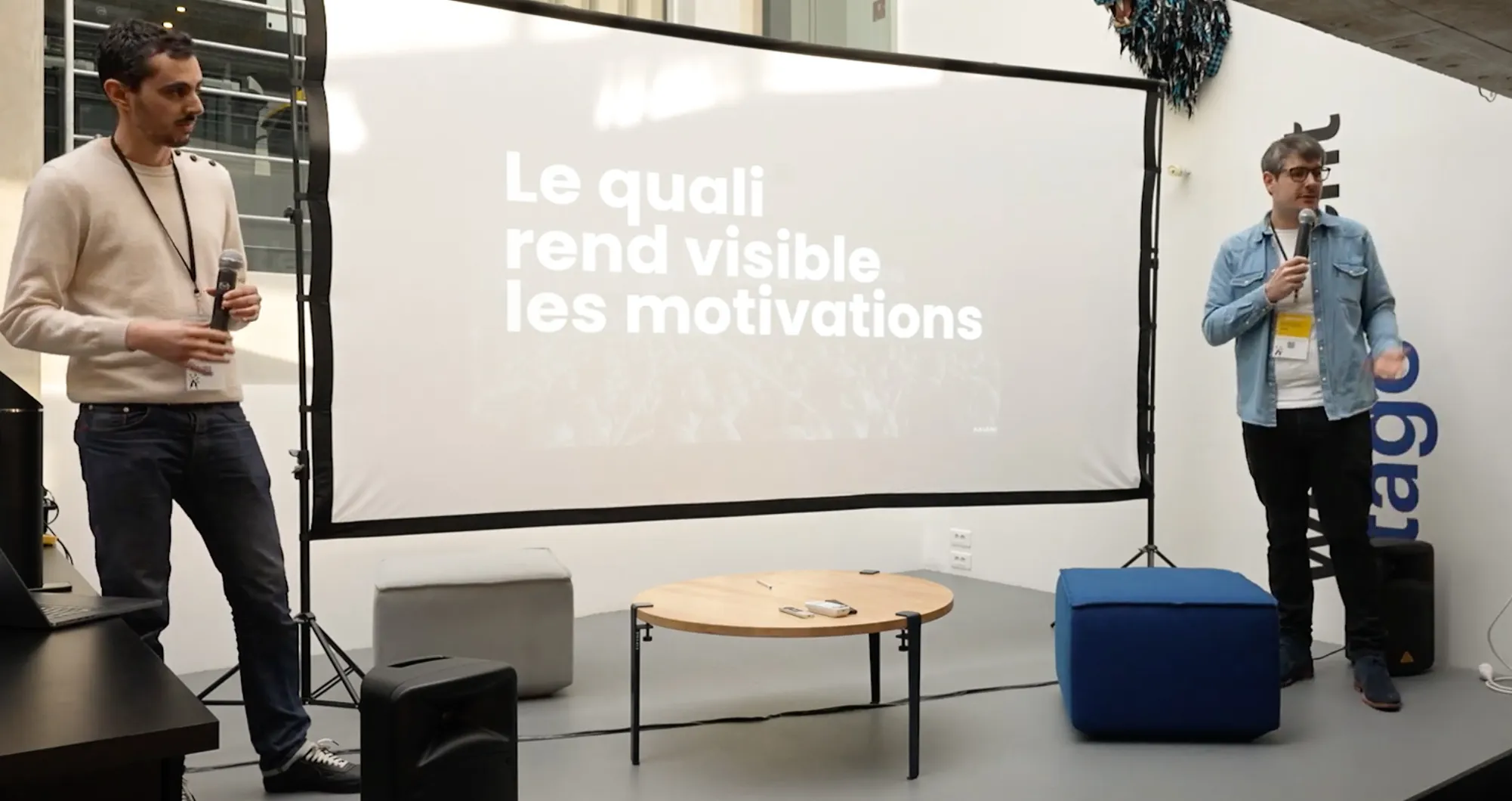
A few months ago, Weezevent invited us to Weezdays Festivals to talk about the festival-goer experience. We turned up with four festivals under our belt (Garorock, Les Francofolies, Reggae Sun Ska, Paléo Festival), about twenty years of cognitive science between the two of us, and eye-tracking glasses we’ve fitted on Air Force pilots as much as Garorock festival-goers. Day-to-day work took over after the event, and we never got round to writing about it. That’s a shame, because we made a few arguments we stand by.
If you’d rather have the short version, we summarised the key ideas below. The full talk (35 minutes) is available as a replay.
What we plan isn’t what happens
In ergonomics, we call this the gap between the prescribed and the real. A festival is planned by day, soberly, in calm conditions. It is lived at night, in the noise and the euphoria. We put eye-tracking glasses on Garorock festival-goers to measure how they actually find their way, and the result didn’t match what the exit surveys claimed: people often do the opposite of what they say they do. Whether it’s flying an A400M or finding the main stage at a festival, real usage always drifts away from the plan, because real conditions are never the ones we plan for.
That’s also why hard data on its own isn’t enough. It’s reassuring, it lets you make charts (and charts are great), but on its own it often says more about the person analysing it than the person living it. At a smart-home conference, someone is presenting a connected light switch. According to him, if your grandmother no longer turns the light on in the evening, she must have had an accident. Except she may simply have discovered Game of Thrones and be binge-watching in the dark. Data without context can be made to say almost anything you want, and that’s why we do ethnography (observation in real situations) rather than settling for numbers alone.
On the Paradiski project at Les Arcs, we spent 17 days in a row at the resort to observe what was actually going on. Marketing said “mobile connections mostly come from people at home”. Surveys said “I never take my phone out on the slopes”. And on the slopes, people had their phone in their hand.
The festival doesn’t stop at the gate
At Paradiski, a skier arrives by car. The road has been cleared. He walks through the resort gate: 15 cm of snow. He complains. We tell him “yes but the road is cleared by the local council, we have the resort’s snowplough”. He doesn’t care. To him, it’s the same resort from the moment he left home. And if the last kilometre between the train station and the site is chaotic, the whole event takes the hit.
What’s interesting is that by bringing together teams who don’t talk to each other, you uncover useful things. At Les Arcs, we asked to observe the safety control room. We were told “what are you doing here, this is for people who’ve broken an ankle”. In fact, the operator who handles calls reassures people within 4 seconds, locates the accident on a grid map (B4, C6), and sends a ski patroller who arrives in about 7 minutes anywhere in the ski area. We went to see marketing and told them: that’s a selling point. From there came the geolocated SOS feature in the app. Originally, we were just meant to add the resort’s phone number.
What staff do with your innovation
At Les Arcs, year one of the Huge app. Marketing reckons that ski-pass desks are an unavoidable point of passage, so let’s ask staff to push the app there. One Black Saturday, the queues are hours long. A staff member steps out of the booth, hands cards to people and tells them “go home, download the app, load your pass on it”. Except the one feature that didn’t exist in v1 was loading a new pass. 500 people sent home, and the backlash was harsh.
What isn’t handed to the people producing and running the service can’t show up in the experience. That’s what this story shows: staff didn’t have what they needed to stand behind the innovation they were being asked to sell. At Paléo, for the ticketing going digital, we did the opposite. 50 full-time equivalents, 230,000 festival-goers, and internally a whole crowd of people issuing access passes (accreditations, guests, VIPs, sponsors, volunteers, partners, exhibitors and their staff). We started by mapping it all out with the teams. First win: colleagues who see each other every day discovered they were doing the same thing without realising it. Then frugal, low-fidelity prototyping, on site, in front of the future venue (because a 2D plan doesn’t show elevation). The teams were trained both on what the tool let them do and on what it didn’t.
What if we imagined the worst to identify what really matters to festival-goers?
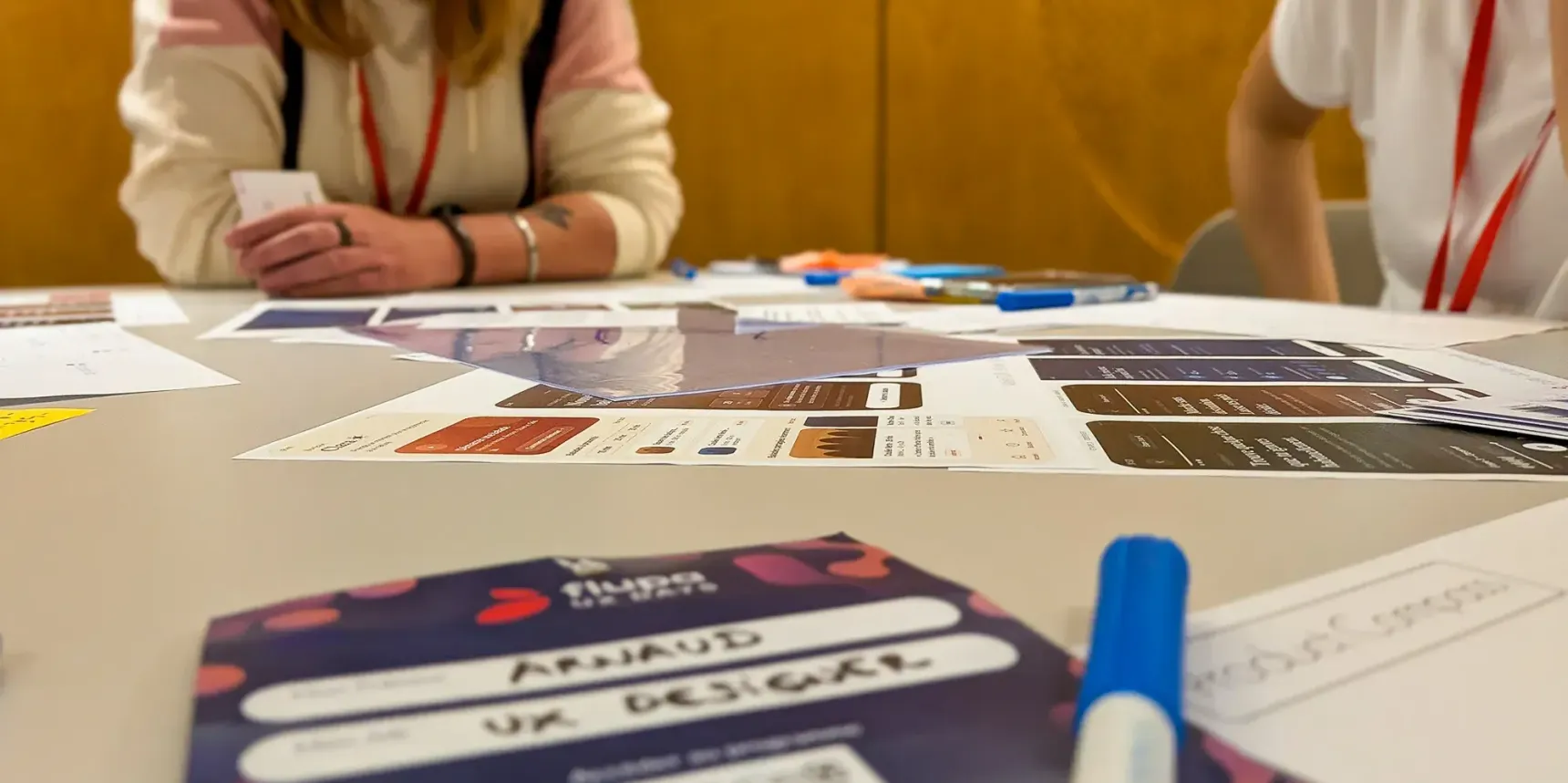
In the afternoon, we ran two UX Devil sessions, our method that starts from worst-case scenarios to work back to what really matters. In groups of five or six, representatives from more than fifty festivals shared the worst stories from their events. More on this another time.
The full talk (35 minutes) is available as a replay: