


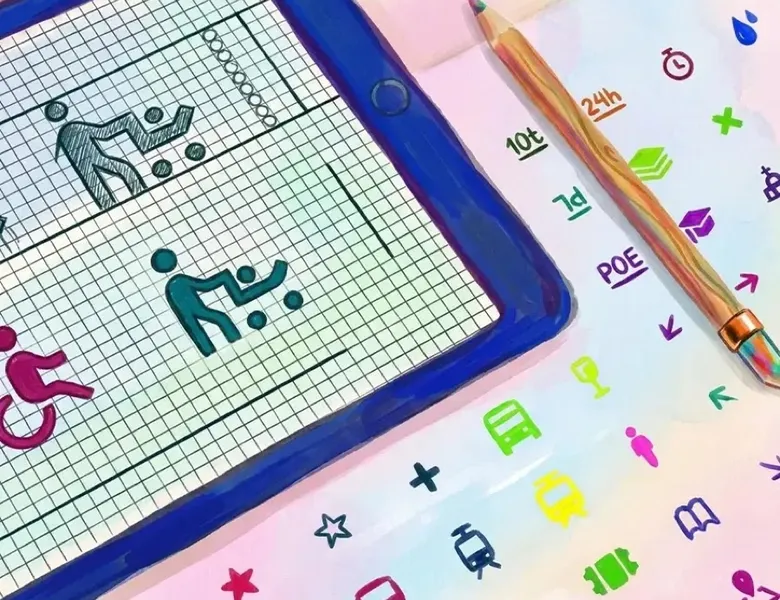


Iconography refers to the set of icons found in a product's visual identity: their consistency, their style and their usage logic. Well managed, an icon library helps guide the user more easily and gets actions understood quickly.
In an interface, icons play an essential role. They convey information quickly without relying on text, which, for icons that are now universally recognised, lets the interface gain breathing room and spacing. Choosing your interface’s iconography well means gaining overall readability. This matters even more on mobile, where space is limited.
And above all, always pay attention to the consistency of your icons. Filled, outlined, rounded, angular… mixing styles will only confuse the user.
It all depends on your needs. Today, public libraries will cover the majority of your needs in terms of icons and style. They suit most projects. That said, custom icons will be relevant if your brand identity is very strong and you want that to come through in the icons. It will also be useful for professions that use specific icons not usually found in libraries.
Very simply, by keeping only one specific style. You can choose between outline or solid, then choose the thickness of your stroke and stick to it. You can also choose between rounded or angular, coloured or not. These small details will let you keep optimal consistency.
Decorative icons don't need to be accessible, so they won't need a text alternative. Functional icons, on the other hand, must indeed have a text alternative to describe their functions. For example, a cross to close a modal must be readable by screen readers. You also avoid conveying information solely through the icon without textual support, for users who wouldn't recognise the symbol.
The standard size for inline icons (in text or next to labels) is 16px or 20px. For navigation icons or icon buttons, it will be 24px. As for the clickable area around the icon, it must be at least 44x44px even if the icon inside is smaller. This guarantees a touch target large enough to avoid errors.


A digital product's colour palette encodes statuses, hierarchy and accessibility. A well-defined palette is a coherent system, not just a collection of shades.
Read more about Colour paletteTypography defines fonts, scales, weights and spacing. It drives readability and visual identity. It's an impactful element that is often underestimated.
Read more about TypographyUI design shapes the visual layer of a product: layout, colours, typography, components. It turns the experience into tangible, interactive elements.
Read more about Interface designUX writing composes an interface's texts: buttons, errors, empty states. Done well, it guides without you noticing. Done badly, it's the first source of friction.
Read more about UX writingEveryone talks about user experience, service design, ergonomics...
It's not always clear, and you'd like to find out, or sharpen what you already know.