Gestalt theory

Concept

How the eye groups and structures what it sees

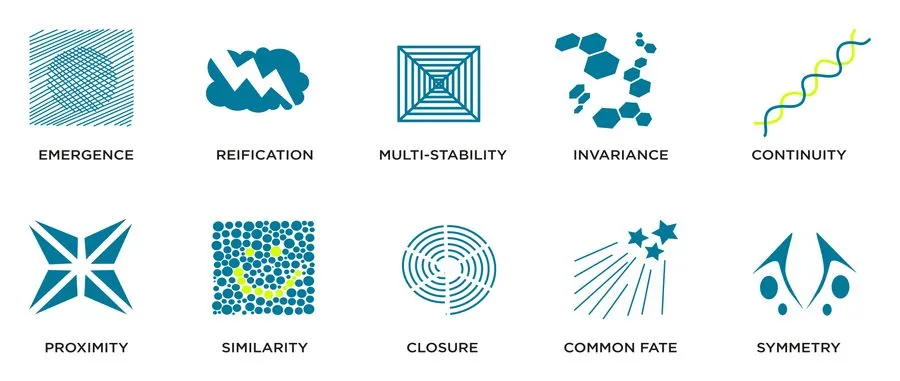
Gestalt theory is a set of perceptual principles that came out of German psychology in the 1920s. The term "Gestalt" means "form" in German; the theory is often summed up in a single sentence: the whole is more than the sum of its parts. In interface design, these principles explain how the eye groups elements. The theory distinguishes several laws: proximity, similarity, closure, continuity, figure/ground. Understanding Gestalt means understanding how perception structures an interface.

What is it for?

  • Organising interface elements into coherent perceptual groups, without resorting to borders or headings.
  • Creating a visual hierarchy that guides attention naturally.
  • Avoiding the perceptual ambiguities that create confusion in an interface.

What you need to know

  • The law of proximity.
  • The law of similarity.
  • The law of closure.
  • The law of continuity.

Frequently asked questions

Cognitive psychology

Cognitive psychology studies how the brain processes information. Memory, attention, perception: the scientific foundations of UX design.

Read more about Cognitive psychology

Cognitive ergonomics

Cognitive ergonomics turns the way the brain works into design principles. Perception, memory, mental load: the foundations of UX design.

Read more about Cognitive ergonomics

Affordance

Affordance is the ability of an interface element to suggest its use. Donald Norman popularised the concept: only perceived affordance counts.

Read more about Affordance

Colour palette

Brand palette or interface palette, the two are not to be confused. How to build a coherent, legible and accessible colour system.

Read more about Colour palette

Typography

Typography defines the fonts, the size scale, the weights and the spacing of an interface. How to choose it and guarantee its readability.

Read more about Typography

Curious to learn more about us?

Everyone talks about user experience, service design, ergonomics...
It's not always clear, and you'd like to find out, or sharpen what you already know.

Let's talk