Keynote: systemic design
Sylvie Daumal
The day opens with Sylvie Daumal’s opening keynote on systemic design. This talk highlights the critical importance of user-centred design in companies, as well as the systemic challenges designers face when it comes to environmental impact.
Sylvie Daumal stresses the need to adopt a collective, systemic approach to tackle these problems, by using specific tools and methodologies. Here is a recap of the key points of this talk and the recommendations for designing products more environmentally friendly.
The environmental impact of design
Over 80% of a product’s environmental impact is set during its design phase. The examples given, such as electric scooters cluttering up the pavements without being stackable (which adds trips for the operators who collect them all), highlight the need to rethink product design in order to minimise its negative impact on the environment.
Convincing stakeholders
Convincing stakeholders of the importance of environmental sustainability can be a real challenge.
Luckily, several tools exist to encourage companies and designers to become aware of these issues:
- Regulation, with the climate and resilience law
- Legal obligations, such as extra-financial reports and mandatory carbon assessments
On top of that, the increased legal and financial risks tied to a rising number of legal challenges and growing energy costs can also influence company decisions.
A systemic design approach
What about this systemic design approach for solving complex environmental problems?
Sylvie Daumal suggests three core mechanisms for designers:
- Engage the collective beyond the traditional stakeholders
- Decode the mechanisms through causal-layered analysis
- Go beyond the obvious
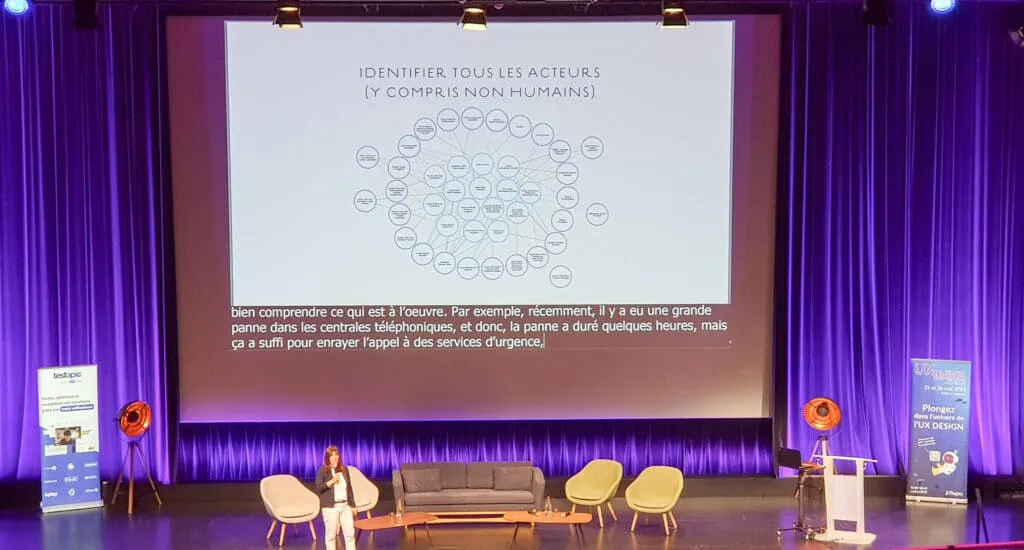
Sylvie also recommends identifying all the actors involved, including non-human ones (we’re talking about an ecosystem: fauna, flora, etc.), and using visualisation models such as the “futures wheel” to assess the consequences and benefits of a project.
Designing sustainable products and services
By stepping in early in the project and helping it evolve, the designer plays a key role in the transition towards products and services that are more environmentally friendly.
To do that, it’s essential to adopt a systemic approach, engage the collective and understand the underlying mechanisms and benefits of a project.
For that purpose, various frameworks, tools and books exist, such as:
- Design Journeys through complex systems
- Symbiosis in development
- Structured dialogic design
- Dispute System Design
Through these approaches and tools, the designer aims to play an active role in designing products and services that are more environmentally friendly, contributing to building a sustainable future.
Understanding the user from the inside and designing an experience that transforms them
Liv Danthon Lefebvre
Cognitive psychology research can be applied to the digital world through what Liv Danthon Lefebvre calls “digital psychology”.
How to transform this user experience in 3 main stages:
1. Offer an attractive design to highlight the usability of a product and guide the user’s gaze.
80% of the visual information we perceive is nothing more than interpretations of the world by our visual cortex. The experience on offer therefore has to be clear, readable and accessible to minimise the risk of misinterpretation.
2. Create an impact so the user remembers what they see and what they read.
The Stroop effect (opens in new window) and the various pieces of research on emotions carried out by Ekman and Hamann illustrate this impact. You can reduce a user’s cognitive load by playing on emotions, because they help to anchor memory. Emotions, scarcity and surprise should be brought into the design to create a memorable experience for the user.
3. Get the user on board by supporting them throughout their journey.
Guiding the user throughout their experience by providing clear information and the help they ask for is recommended. The goal is to avoid the feeling of tension and frustration that could lead them to abandon the product or service.
In short, Liv D. Lefevre invites us to better understand cognitive processes in order to create more impactful experiences.
Why and how to integrate digital accessibility
Sébastien Delorme
Sébastien has specialised in accessibility for over 15 years. He explains that digital accessibility needs vary depending on the disability situation. These needs have to be taken into account to improve the user experience.
He also insists on the fact that accessibility is a fundamental right that concerns everyday services (online ticketing, restaurant menus, transfer connections in the underground, and so on).
For example, every interface should provide alternatives to complex interactions and offer interfaces that work in both portrait and landscape. The best way to make sure the products we design are accessible is still to have them tested by people with disabilities. Bringing in these users helps raise teams’ awareness of the specifics of accessibility.
Despite the new legal obligations in France, accessibility is not very visible in projects. Sébastien hopes that the appointment of oversight bodies in France will help reverse this trend.
360-degree design of a hospital intensive care unit
Bastien Sennegon
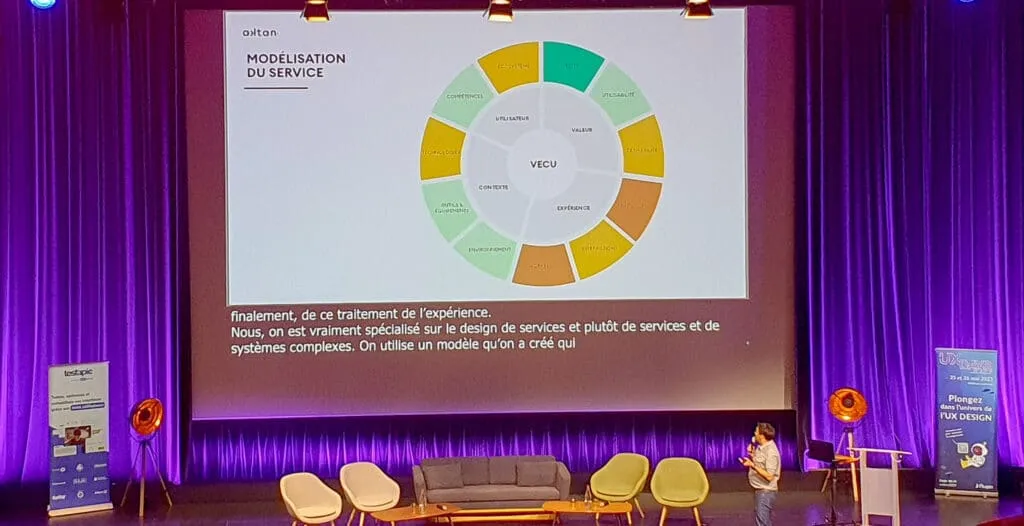
The project concerns a hospital unit under heavy strain during the Covid health crisis. The preliminary study carried out in this unit shows that the “user experience” dimension has significant room for improvement.
To carry out this project, the user research phase focuses on three different user types: healthcare staff, patients, but also the relatives.
The analysis of the needs and constraints identified for each of these types makes it possible to define different improvement hypotheses. Several service prototypes are designed and tested by users to put these different hypotheses to the test.
For example, the team in charge of the project notices that the people around patients very often ask healthcare staff for help finding their way around the unit. The goal is simple: anticipate the requests in order to limit the demands on healthcare staff. To meet this need, new welcoming features are tested with panels and signage.
Another example, communication between healthcare staff and patients, but also among the staff. To meet the need to smooth out this communication and save time (which is sorely lacking), attention turns to planning and how the healthcare staff’ work is organised. The various care spaces are reorganised, putting patient files more in the foreground. The schedule is also displayed at all times to make it easier for teams to communicate.
The team in charge of the project also does a lot of work on a topic that is extremely important in a hospital setting: morale. Starting from the observation that patients have a fluctuating morale curve, which can drop very quickly depending on the context, it’s important to make this progression tangible. This need takes the form of a timeline that lets people see the evolution of the patient’s morale. A solution that was particularly well received by the hospital teams.
A project of this size, run in a hospital setting, has to deal with many constraints. Constraints that are all the more heightened in a health-crisis context.
Gathering the needs of professionals such as healthcare staff proves difficult, since their mental load is high and their availability low. The pressure to deliver operational results very quickly is also strong.
The full set of solutions imagined brings a user point of view that helps improve certain processes, taking into account both the patients and the relatives and the healthcare staff.
Design Sprints beyond the product
Pauline Thomas
A designer understands the processes and the different roles within the company so they can work with the other departments to reach shared goals.
Indicators are very important within a company in order to align employees from every department towards the same direction.
Revenue, for example, is a critical topic in the company. This talk argues that the designer can solve “business” problems by asking hard questions in order to anticipate negative impacts.
Cross-interviews with stakeholders, or setting up a service blueprint, are quick methods that can lay good foundations for a product.
Evangelising user research: speed testing
Oriane Guineau
To illustrate the benefits of speed testing, Oriane takes the case of the Accor group as an example.
The hotel group, a leader in Augmented Hospitality, puts the customer at the heart of its organisation and decisions, commonly called “customer centricity”. The teams dedicated to user research are heavily in demand for running user tests.
In order to streamline and smooth out these test phases, an turnkey format was put in place. The idea is to provide a support journey that makes it easier to scope the work, design the scenarios, run the tests and analyse the results.
To easily recruit volunteer users, a pop-in and a banner are integrated into the group’s website and app.
This format is then tested at a physical event with stands letting participants try the different journeys. More than 150 tests are run in a single day.
This first version of an turnkey format helped raise the visibility of user research with all the internal teams. Following this positive experience, a tester club was created within the group, allowing solutions to be tested on a quarterly basis.
Content Ops: rethinking the place of content to increase its impact
Axel Viersac
Axel laments that marketing content is almost the only kind being prioritised in companies, when many different types of content exist.
The problem is that this content is produced by different teams, which inevitably creates a silo effect and a lack of internal visibility.
So it’s critical to rethink the place of content to increase its impact, by building a relationship with users through language and content.
Running internal workshops lets writers and content creators come together to build a shared sense of direction and head the same way.
The goal is to offer users various types of rich content, while keeping a certain logic and consistency. This consistency builds an experience that goes beyond the product or service being put forward.
Keynote: getting interested in OKRs
Jeff Gothelf
The talk on OKRs (Objectives and Key Results) highlights the importance of communication and of creating a strategic impact in the design field. Jeff Gothelf opens his talk by stressing the role of OKRs in defining the objectives and key results used to measure team success.
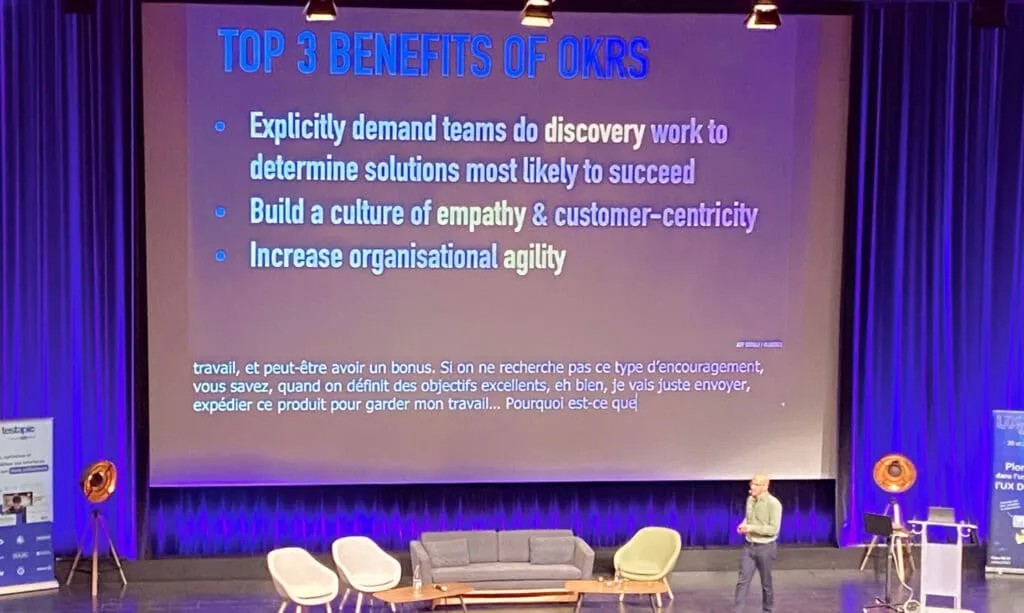
He gives recommendations to designers on how to communicate effectively and create a strategic impact through OKRs:
How the software landscape has shifted
One of the key points raised is that we are now in the world of software, and that continuous improvement is essential. Unlike the era when software products had a defined end, we are now in a world of continuous development where there is no finish line. The speaker stresses the importance of understanding that success isn’t measured by the volume of code produced, but by the positive impact on user behaviour.
Objectives and Key Results (OKRs)
OKRs are presented as a framework for defining objectives and key results that measure success. Good objectives should be qualitative, inspiring, concrete and action-oriented. It is essential to understand the problems to be solved and to frame them in a positive way. Key results should be measurable, ambitious, verifiable and focused on measurable changes in human behaviour. The speaker insists on the importance of focusing on outcomes rather than on production efforts.
A product discovery culture
The keynote also highlights the importance of building a product discovery culture. It is pointed out that the double diamond process is not a one-off activity, but a continuous process in a world that keeps changing. Jeff Gothelf encourages testing hypotheses with MVPs (Minimum Viable Product) and reacting based on the results obtained. He also points out the essential role of the product as a central variable in the process.
Challenges and recommendations
The talk addresses the challenges teams face when putting OKRs into practice. It is noted that the success of OKRs requires collaboration between leadership and teams, as well as a focus on outcomes rather than production efforts. Jeff Gothelf also recommends educating colleagues on design thinking and the Lean UX approach. He also invites them to explicitly ask teams to run discovery closer to customers. Communication and customer-centred empathy are identified as key elements for creating a strategic impact through OKRs.
What to take away
This keynote shows the importance of communication and of creating a strategic impact through OKRs. Designers can play a key role by using OKRs to define inspiring objectives, measure key results and develop a culture of product discovery. By adopting these recommendations, designers can contribute to their team’s success and to reaching the strategic goals of the organisation.
Cognitive dissonance as a design tool
Sébastien L’Hoste
The presentation opens with a metaphor for design with a child throwing a pebble into water, which is distorted by the impact of the projectile. For Sébastien, a design project is the projection of an idea that will transform in order to have an impact on the real world. During this mechanism of transformation, from idea to object, a set of design choices and decisions takes place.
In architecture, the Villa Le Moine drew strong reactions and was described as paradoxical, but there were no explanations for that feeling. That is the reason that pushes Sébastien to look at the mechanisms through which an idea can be passed, indirectly, from a designer to a user.
This villa, with its complex and unexpected design for a person in a wheelchair, is in the end composed of three big architectural archetypes layered on top of each other.
The impossible concept is the idea of taking impossible constraints into account, like the villa’s levitation here, in order to surface solutions. The walls and façades become huge beams that allow the structure to be minimised. The idea is to objectify a concept rather than the object itself.
The erasing of consonances aims to blur or remove everything that would be consonant, like covering the villa’s pillars with mirrors to create the illusion of levitation, in order to set the concept in place and make it impossible to escape from the illusion.
Condensation lets you create paradox by combining two ideas without them being seen distinctly. An opaque monolith that looks like stone becomes a transparent window once you are inside the villa.
So by studying the processes and mechanisms used to create objects, designers develop their thinking as designers.
Legitimising design with data
Clarisse Moisand
Design has a strategic role and so it has to speak the strategic language. By working with Data Driven Design, you can measure the improvement of the user experience and assess the impact of design based on quantitative data. To do that, you have to be able to compare the data against a reference year or against a competitor, for example.
To kick off a data driven design project, you first have to define your objectives based on usage and attractiveness indicators, while setting aside the business objective. Once the objectives are defined, you can build correlation links: the ROI of Design.
Out of all the available indicators, you have to pick your “North Star Metric”, which will set the course for the project and will be used to communicate with decision-makers. Among the 3 main indicators (CES, CSAT and NPS) Clarisse has a preference for the CES (Customer Effort Score) since it focuses on the quality of the experience.
Next, you have to select the indicators to track. Based on the big objective, you look at all the indicators that can give information about that goal. The chosen indicators should be S.M.A.R.T.
Following this selection, you break down the customer journey and define, at each page of the journey, the objectives and the indicators to track (between 2 and 4 indicators per page).
Finally, you can share the data with decision-makers. The data shouldn’t be presented as-is. You have to make it your own to work on a narrative and correlate the data with the business objectives. It is recommended to use Journey Maps, pairing them with quantitative indicators.
Data Driven Design helps clarify objectives. It also brings a new lens to confirm hypotheses. Finally, it allows narratives to be built for decision-makers by presenting them with numbers, which carry more weight with them than verbatims.
Roundtable on eco-design
Anne Faubry, Fabrice Liut, Damien Legendre, Christophe Clouzeau and Raphaël Lemaire
These 5 designers, experts in eco-design, share their commitments to reducing the environmental impact of their craft in digital.
Eco-Design is something specific to France that focuses on designers’ responsibility in eco-design. Beyond the environmental aspect, the benefits of bringing eco-design into your digital services are many: improving performance, boosting SEO and so on.
Usually, the barriers to eco-design in companies are psychological, but also tied to the business model.
To kick off an eco-design approach, many resources are available to designers, such as frameworks and white papers, even though they are still evolving. Among the resources mentioned, there are:
- The Designers Éthique guide, written to be very approachable, with lots of examples and counter-examples.
- The 115 web eco-design best practices framework (V.4), the oldest on the topic and available open source on Github.
- The RGESN (V.1) with 79 criteria aimed at every digital professional, including criteria specific to UX-UI.
In the end, what comes through from the exchanges is that it’s normal to feel a bit lost at first, but it’s through practice and training that we can improve our eco-design approach.
Conclusion
A second day just as rich in content as the previous one, and one we enjoyed exploring.
The form and content of the talks are pretty disparate, but UX Days is always a great opportunity to meet peers and share experience reports.
There are speeches that bring people together, other ideas that divide, but every designer can express their vision of design here (and that’s the main thing).
Once again, a big thank you to the Flupa teams for all this organisation and to the various speakers (whether for talks or workshops).
We’ll be glad to give it another go next year 🙌