Jean-Yves Rigal’s talk “When the designer loses control” at UX Days 2019
“Losing control doesn’t mean going off course.”
Jean-Yves Rigal
Jean-Yves Rigal gives us pointers here to make collaborative work easier, by involving the various stakeholders impacted by the project and showing how to involve them.
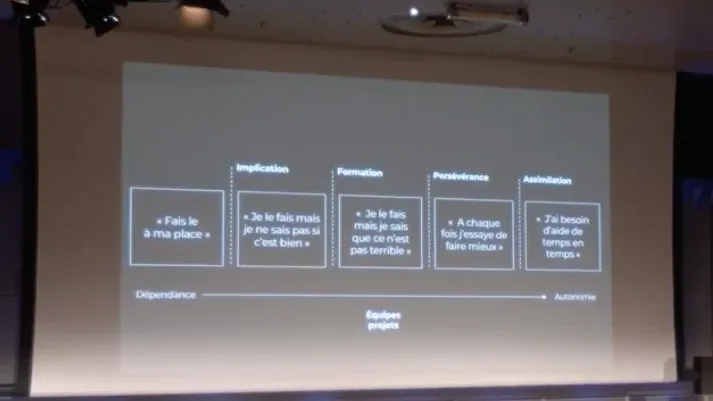
He thus presents the importance of a collaborative approach, which lets the team mature and therefore produce a design. He also highlights the quality and the importance of workshops as accelerators, not as an end in themselves. On top of that, he laid out his method for moving from dependence to autonomy in the design process: 5 key moments. How do you involve your team, your client and so on, towards a final phase of assimilation, to grow their maturity? How do you produce knowledge with your team or your client?
From dependence to autonomy in 5 steps
In his talk, he tries to explain how you move from dependence to autonomy through these 5 key moments:
- “Do it for me”: at this stage, the client or the team member doesn’t feel mature enough in design to do it on their own. The UX designer must try to involve the project teams or the client in the study process.
- “I’m doing it, but I’m not sure it’s any good”. The UX designer can set up design training for the project teams or the client they work with.
- “I’m doing it, but I know it’s not great; I still do it, I hang in there”. This is when the perseverance phase kicks in, leading to the 4th moment:
- “Each time, I try to do better, I’m getting more and more independent, I’m enjoying what I do”. This is when the assimilation phase comes in, when the project team takes on design concepts.
- “I get by, but every now and then I need help, some advice on adjustments, the occasional focus group”. The 5th moment marks the entry into autonomy.
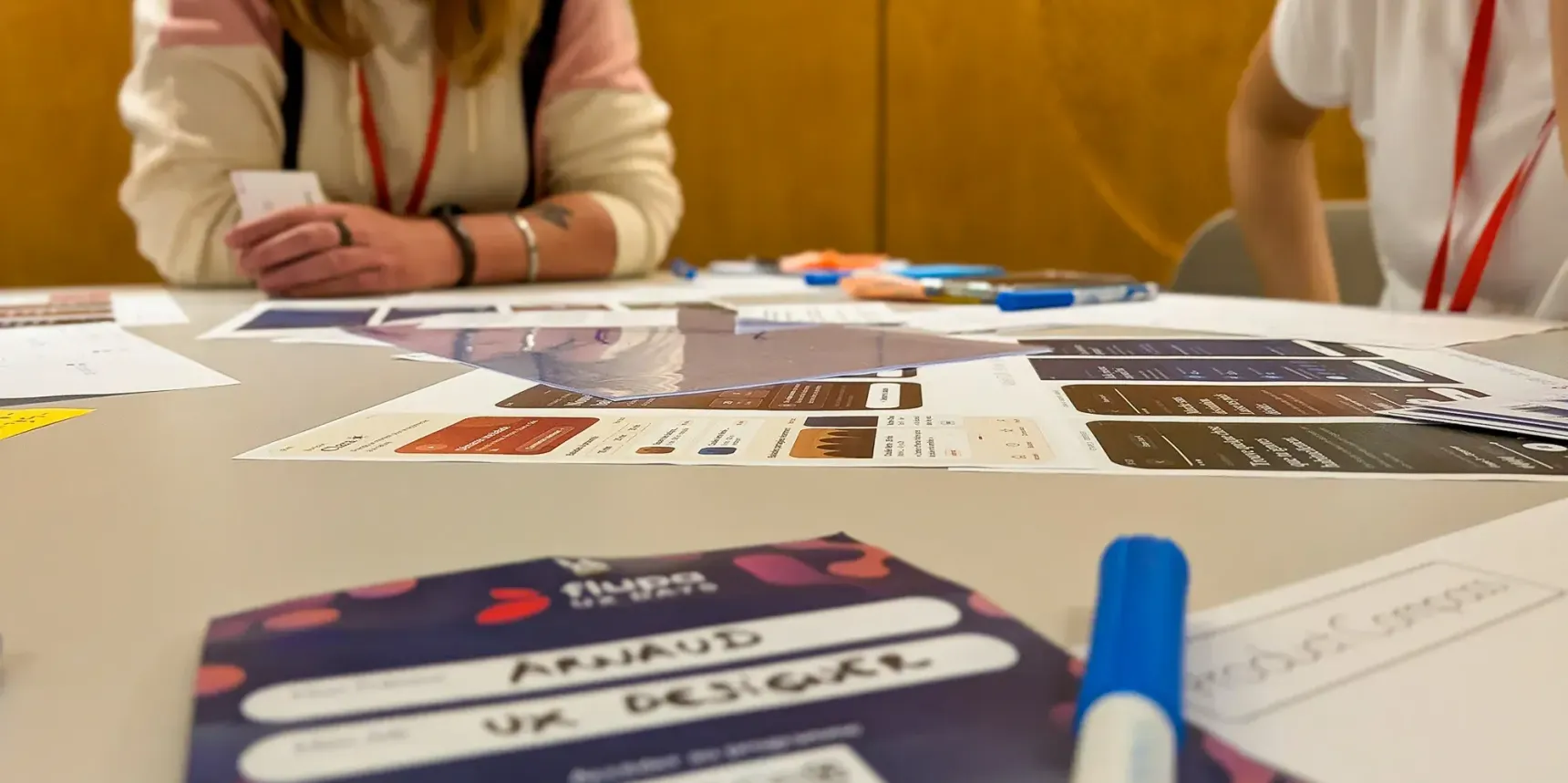
To wrap up, he offered various methods: experience maps, card sorting, sketching, custom paper wireframe kits, and so on, to help us pass on knowledge and go further, to collaborate and grow the maturity of the people we work with.
Patrick Maruejouls’s talk “Systemic designer: towards a new approach to design in the 21st century”
His talk brings another view of design that fits with our current issues. He takes the example of a teaspoon to express his idea. There are countless teaspoons, and to choose one, you have to make choices: the choice of function, the choice of shape, but also going all the way to the choice of process (where does it come from, how is it made, with which materials, and so on). So starting from one question leads to others.
His definition of systemic design is:
- Understand the system: move out of the era of abstraction and into the era of understanding
- Define the real problem to solve: question the problem through the lens of its potential impact on humans and the planet
- Open up the discipline: make exchanges easier between citizens, academic research and industry
- Define an ethics
- Have a lasting impact: imagine a charter framing design practice, action groups, lobbying for a new legislative framework
- Re-found a new story: write together desirable and sustainable futures.
A vision that makes you want to put systemic design into practice, in order to go further in processes that may look simple but are in fact all complex.
Emmanuelle Marévéry’s talk “UX + DATA =”
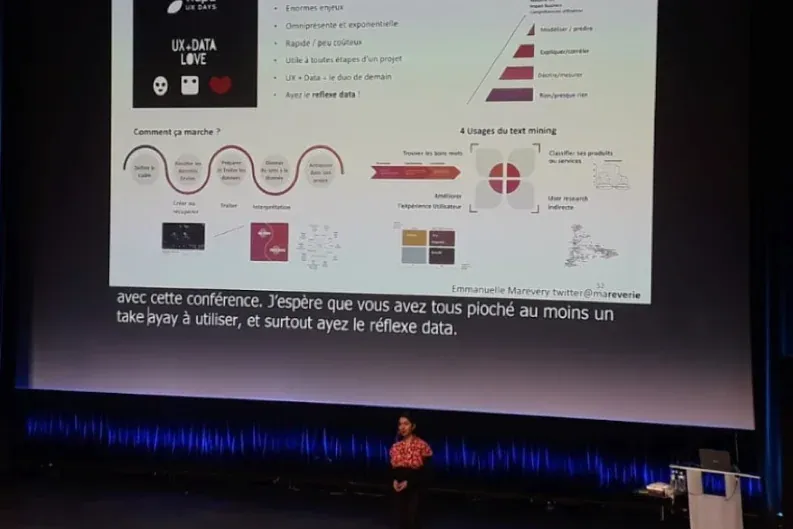
“Give meaning to data: UX can be the compass of data. The more data we have, the better!” In her talk, Emmanuelle Marévéry presents tools that are available to everyone to gather data and bring it together with user feedback from the field. She shows us how to gather data easily and how to deliver good user experiences by collecting DATA. Use DATA to explain user behaviour, to help predict how users will behave.
She presents 4 uses of text-mining (“text-mining when the material is user text rather than figures”):
- Find the right words
- Classify your products and services (menu architecture, and so on)
- How to improve your user experience
- How to do indirect user research
Her goal was for us to walk away from this talk with material to put her ideas into practice in our work, and we did.
“Design and strategy: why and how to get involved in other people’s business” by Morgane Peng
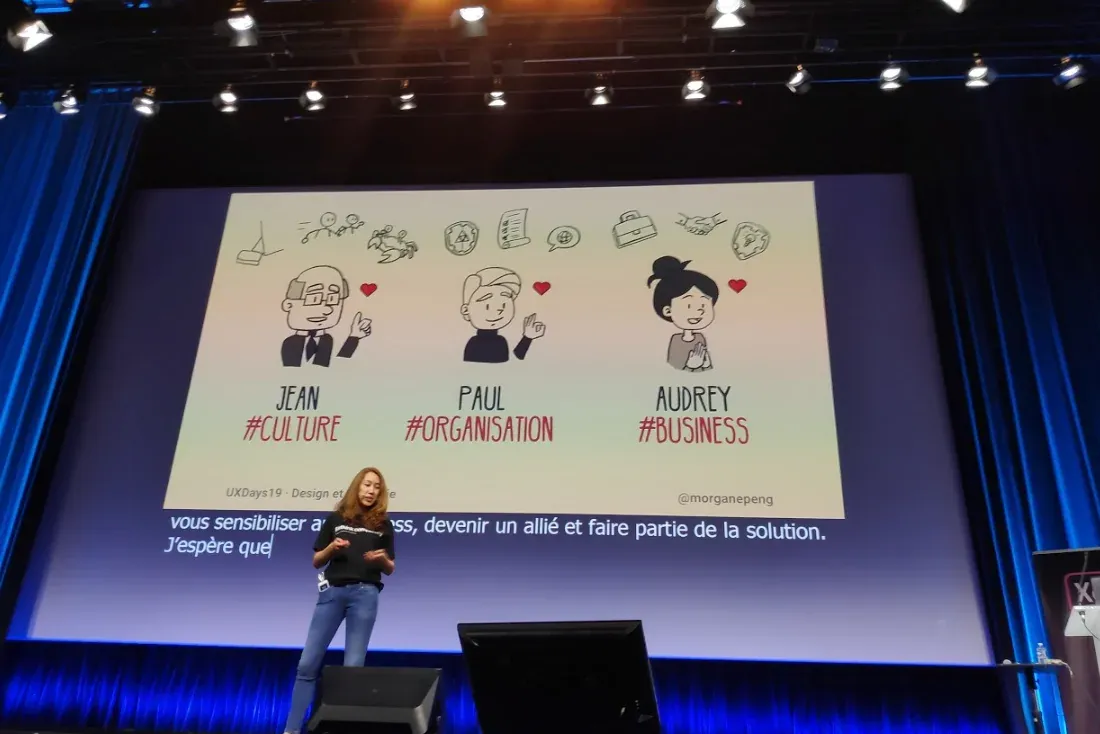
An interesting view on the importance of knowing your counterpart well, in order to have a dialogue that fits their needs. To do that, Morgane Peng created personas of the clients/decision-makers she interacts with at work. And for each persona, she developed a process and a strategy of interaction, in order to talk with them in a way that better fits how they operate.
To do this, she also pointed out the importance of standardising the designer’s methods and processes, and of speaking the company’s language.
Charlotte Breton Schreiner tackles a subject we don’t necessarily think about day to day: “designing for anxious minds”
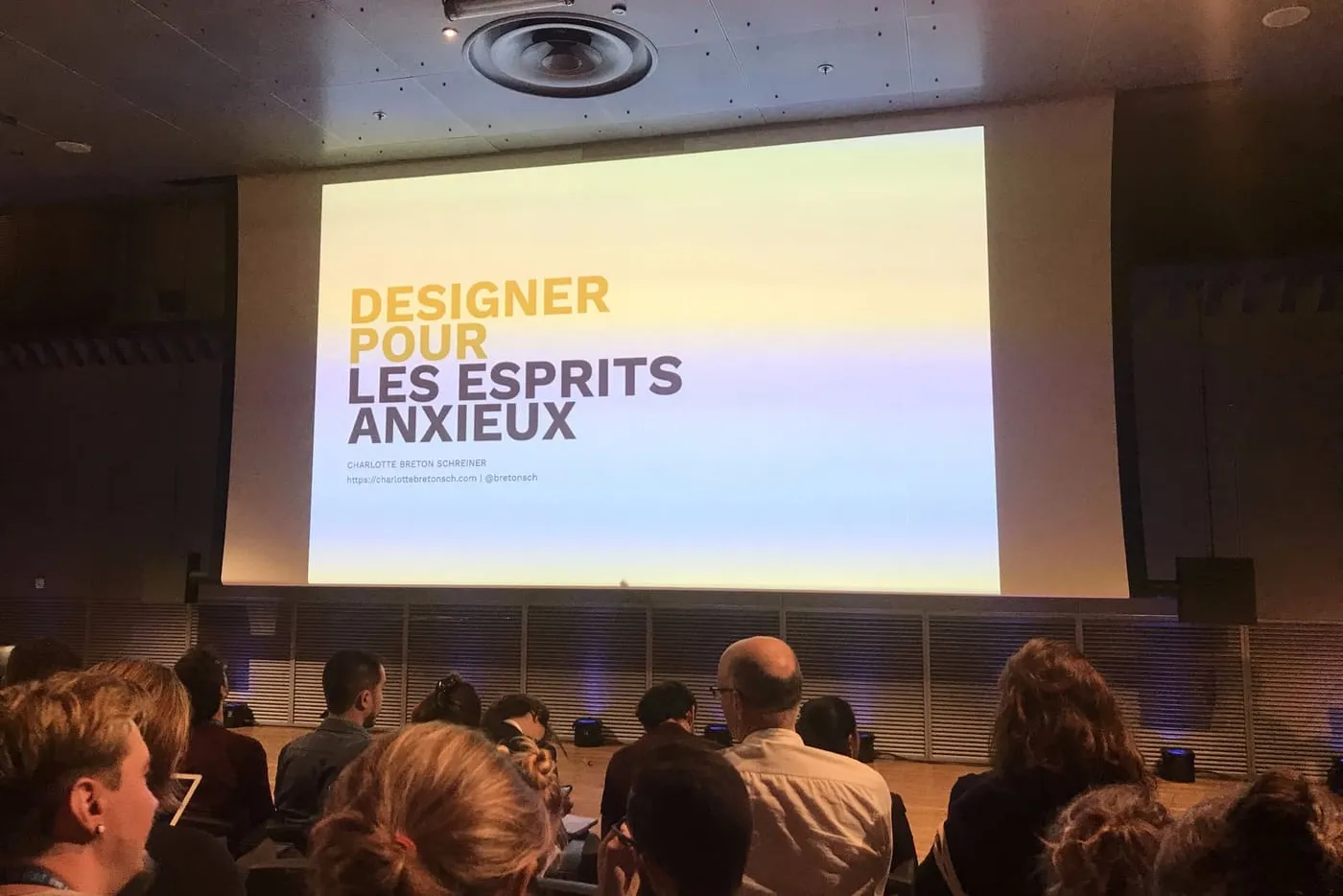
She highlights the fact that anxiety disorders affect millions of people in the world. As this number keeps growing, according to her, designers have the privilege and the responsibility of creating soothing experiences to fight the stress often tied to using new technologies. She explains that there are different anxiety disorders, and that many of us live with them, but don’t talk about them or aren’t necessarily aware of them. She presents the 5 most common anxiety disorders:
- Post-traumatic stress brought on by stressful, frightening or distressing events
- Specific phobias (intense fear of an object, place, situation, etc.) and social phobias (intense fear in some social situations)
- Panic disorder (sudden attacks of panic or fear) and agoraphobia
- Generalised anxiety disorder (excessive and hard-to-control worry).
Bringing all these issues in
At different levels, these disorders can limit our abilities in everyday life, and even become a disability.
She then offers ways to bring these issues into our user-centred designs. Here are 3 tips for designing “calm experiences”:
- Remove any interpretation
- Accept errors
- Be transparent
She backs this up with examples and invites designers to ask themselves more questions about the experience lived by an anxious person. She gave the example of Deliveroo. To accept errors: when you’ve placed an order and got the address wrong, you can’t change it. The user has to call customer support, which can cause anxiety in some people.
Closing keynote: “Doing is the hard part – How to embed service design in organizations” by Marc Stickdorn
Marc Stickdorn, a service design consultant, is well known for his books “This is Service Design Thinking”, “This Design Service Doing” and “This is Service Design Method”. Through 5 points, he shares his point of view:
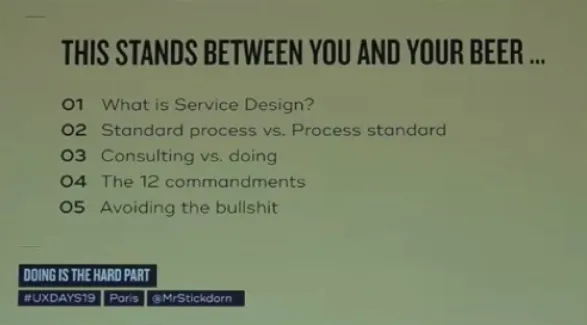
So, how do you embed UX Design within organisations? Marc Stickdorn shares his view of Service Design, as a creative process that underpins much of our economy: the importance of UX research methods to capture actual user behaviour, the importance of trying things out, stepping back, pre-testing for our thinking, finding paths for improvement and avoiding building poor outputs. They are essential in our design thinking.
On top of that, he points out the importance of triangulation (using several research methods, cross-checking data, and so on), in order to be more accurate in our analysis of results and to get as close as possible to what users actually do. He also highlights the quality of field interviews to capture actual user behaviour.
Service Design
He also presents Service Design as a facilitator that focuses on user experience, on bringing together several perspectives, on user function, usability, production, aesthetics and on visualising/projecting use. This is why the designer should always work in a team. Service Design is therefore teamwork.
He also shares several interviews with various people: Belina Raffy, Birgit Mager, and so on, who give their thoughts on the “yes, but”.
“It helps you think about things you hadn’t thought of before, think about resources, ideas, in new ways, but don’t start your sentence with ‘yes, but’ because you end the conversation before even getting your idea across.”
Belina Raffy
On top of that, Birgit Mager explains the importance of understanding the problem, a task that takes far more time than finding a solution.
Wrap-up on UX Days 2019
To wrap up, this day was once again rich in lessons. It was the occasion for all of us to meet up and exchange around our craft as UX researcher, UX designer or UX strategist.
All this to say that this edition was once again a success, complete, varied and, above all, attended by many UX designers from across France. Thank you to the whole organising team for their work and to the speakers.