We use a huge number of loyalty programs every day, whether at the checkout in a store, at the ordering kiosk in a restaurant and above all in our mobile apps. So we ran a comparative study of loyalty programs in apps to try to identify which mechanics existed, what makes us like one loyalty program more than another and, of course, what the benefits of these loyalty programs are, both for the business and for the user.
For this study, we compared 27 loyalty programs across 8 different industries, from mass retail to entertainment, e-commerce, sport and so on. That let us identify, among other things, 5 loyalty mechanics currently in use in production.
Accumulating points
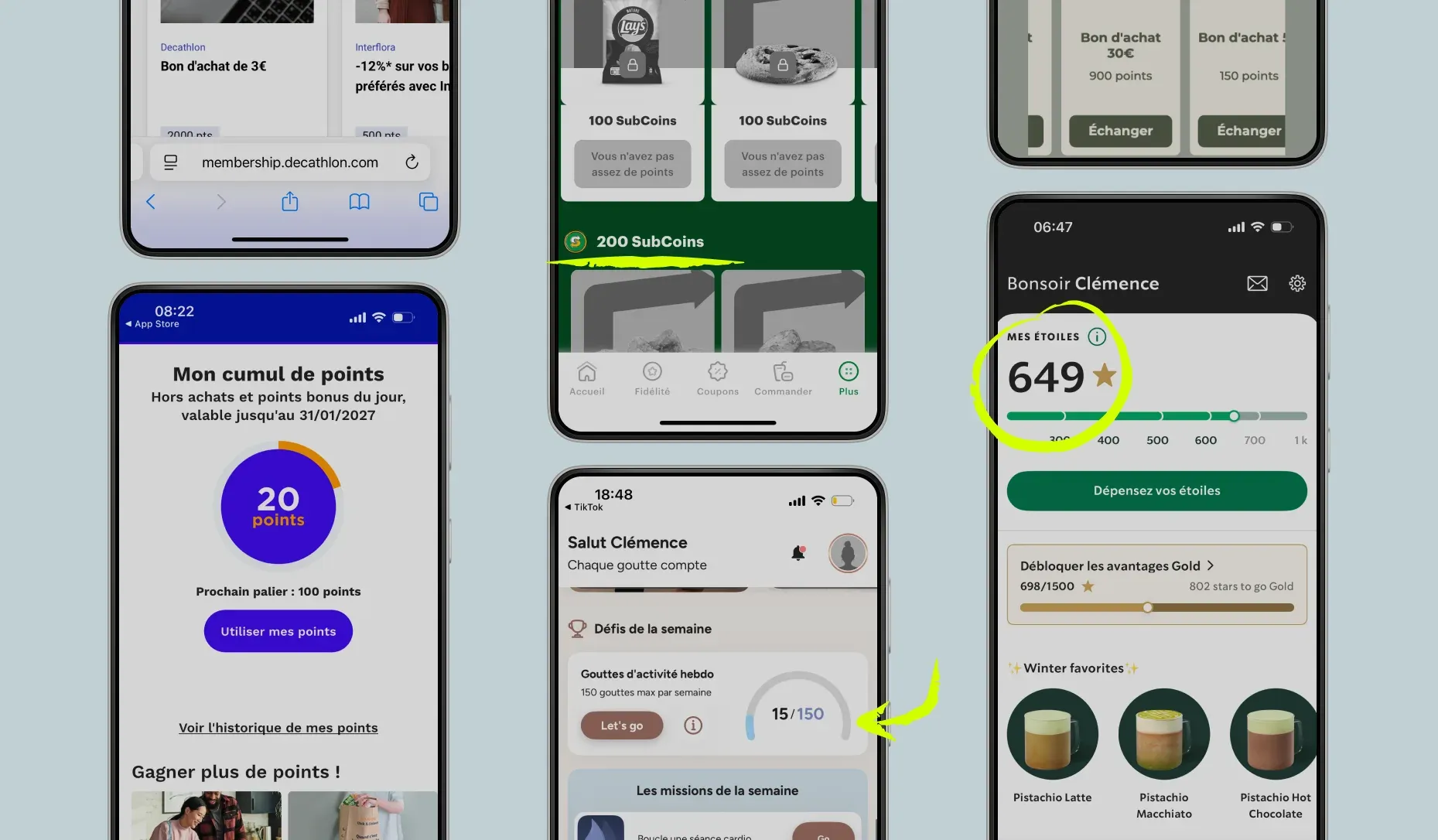
The first loyalty mechanic is accumulation through a points system. Using points is the loyalty mechanic you could really compare to a Swiss army knife. You can do lots of things with points. They also have the advantage of making progress measurable, as with experience points (XP).
But more generally, what we noticed is that points were notably used to represent a purchase amount. Several ratios are possible. At Lidl, 1 euro equals 1 point. At Starbucks, 1 euro equals 10 stars, and so on. So in practice, you can tie a number of points to an amount.
Points can also be earned through bonus actions or missions. For example, leaving a review, following the brand on social media, answering short quizzes, making a first purchase, and so on. It can also be a weekly goal to encourage people to come back to the loyalty program regularly. Points can also be earned through recurring actions. For example, doing regular physical activity for Decathlon. Or simply logging in to the app, and so on.
And finally, points can also be tied to referrals. When a user refers someone, points are shared between them and the person they referred.
For points, there are several things you need to think about before setting up this mechanic. First, the name you want to give the points. It’s an excellent way to build a brand identity. Take Starbucks: they use the word stars. Flying Blue talks about Miles. So in practice, you can customise the points mechanic by building a whole world around the name given to the points. Even if, underneath, it’s the same thing.
You also need to think about the expiry date of the points. Is there an expiry date at all? And if there is, what is it? In some loyalty programs, points earned are valid for a few months. In others, it’s a full year or a rolling 12 months, for example.
Then there’s how the points are earned. Will it be through actions, through a ratio based on the amount spent, through missions, bonuses, referrals, and so on.
And finally, of course, the user benefit of accumulating these points. What will they let the user do? In concrete terms, how will they be able to spend these points? Are we talking about a rewards catalogue with vouchers, discounts, products, donations, and so on? Does each reward have a price? Or is it more of a system of points tiers that unlock features, unlock products, and so on?
Tiers
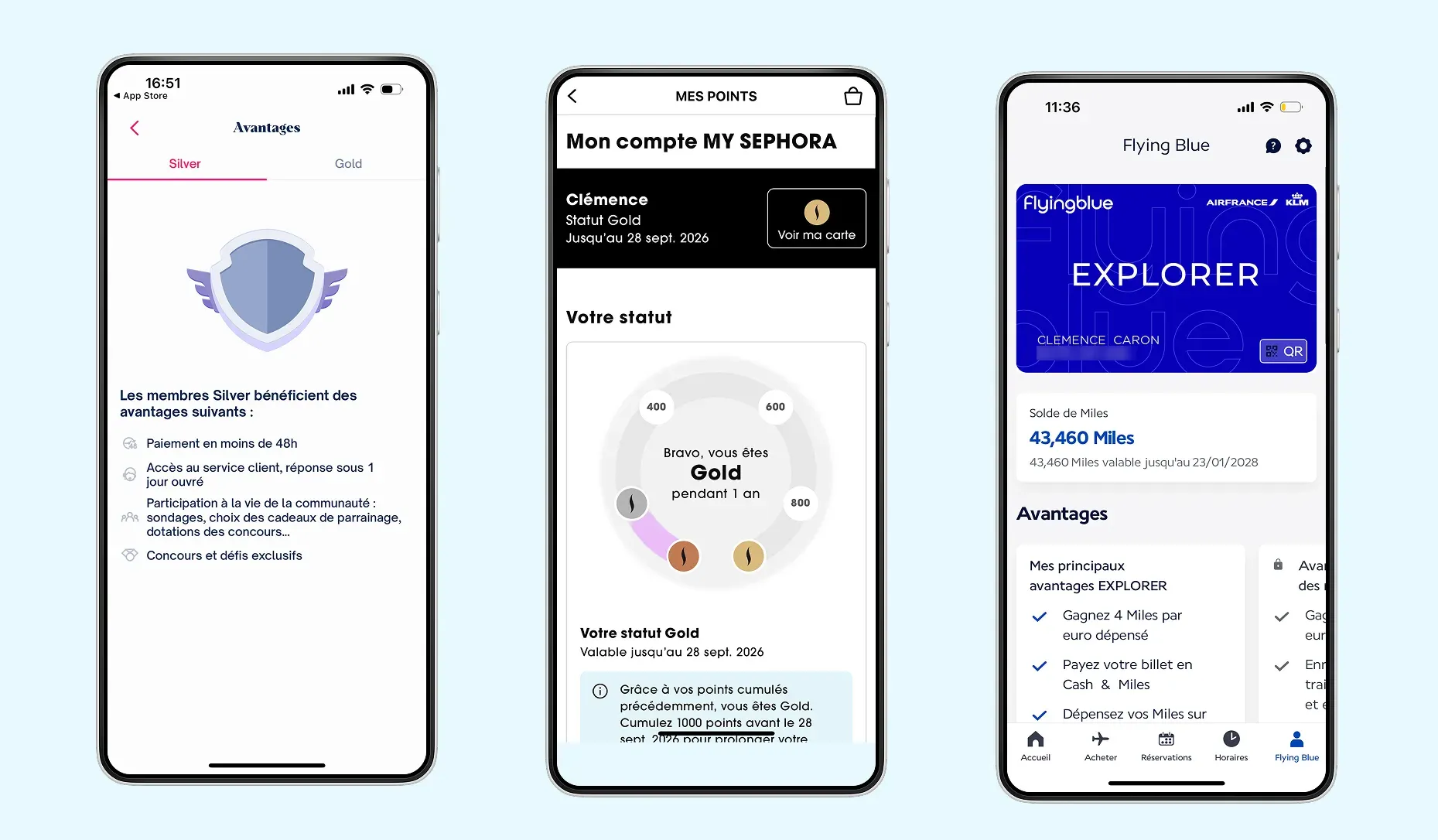
The next mechanic is more about progression: tiers. Above all, tiers are a way to reward loyalty. Some loyalty programs have several tiers. Either a two-tier system like Shopmium. That is, there’s a basic loyalty tier, then a so-called “loyal” tier, which of course comes with different benefits.
Sometimes there are also three tiers. So there’s this idea of a ladder. You move up in loyalty. That’s the case at Booking or Sephora, for instance. And sometimes there are even more tiers to build even stronger engagement. That’s the case for Flying Blue or the sports app Trainsweateat.
Reaching a given tier also gives access to exclusive perks. You can get access to promotional days, in Sephora’s case. You can also get access to extra experiences that people on lower loyalty tiers don’t get. And of course, the different tiers also come with a scale of benefits. The rewards increase with the user’s tier. Either it’s the reward that increases, or it’s the number of benefits that increases.
When we talk about tiers, there’s also the whole question of how a tier is kept. Do you have to meet a certain number of conditions every year, for example? Do you have to perform recurring actions? That’s the case for Booking, for example. Or is the tier yours for good?
Instant rewards
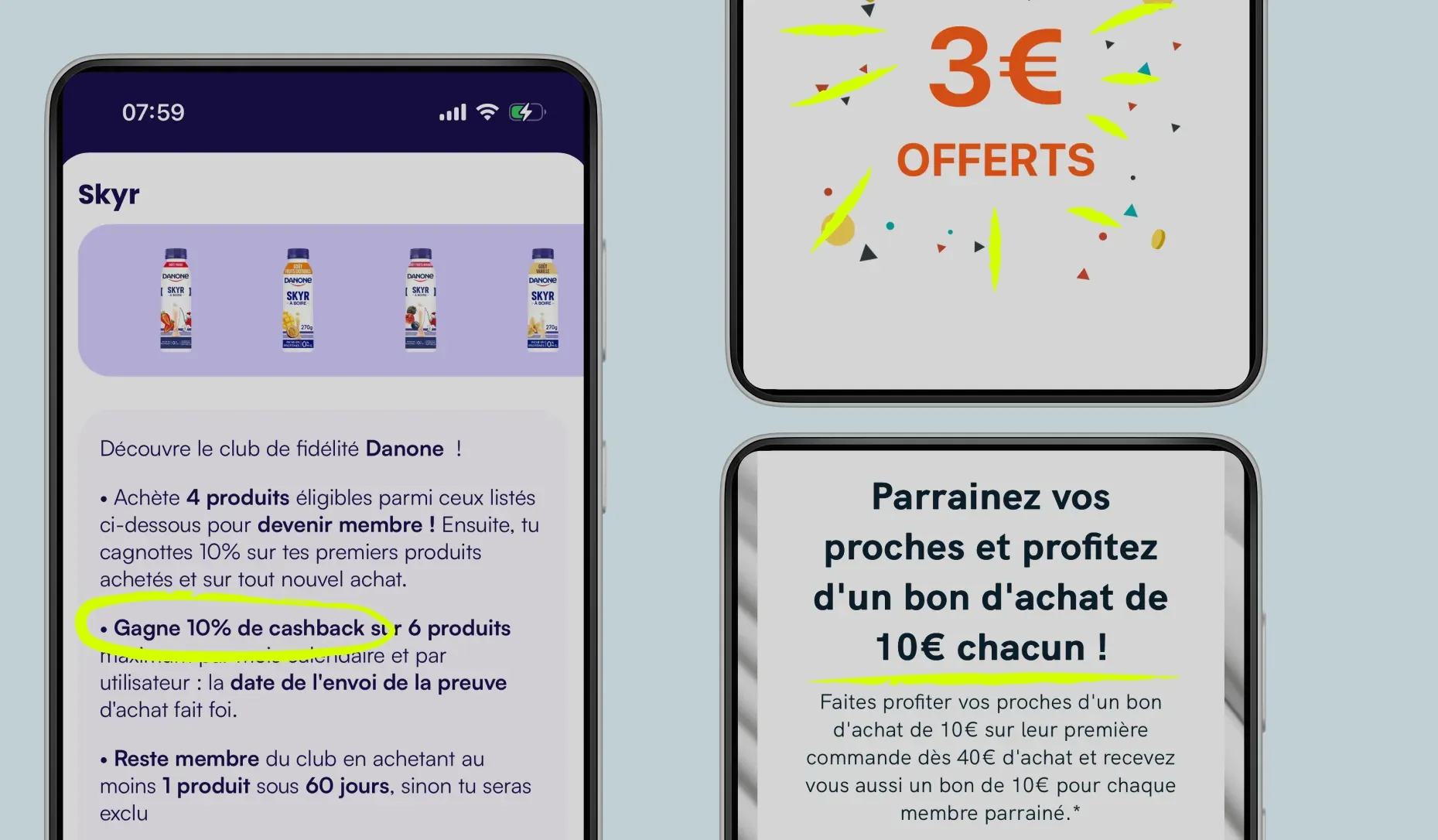
The third mechanic is about accumulating gains: instant rewards. It’s simply earning small amounts right away, often called “cashback”. It can be, for example, a fixed amount paid immediately or a percentage of the amount spent. There can also be instant rewards of higher value, such as gift cards or discounts. Instant rewards can also be tied to actions the user completes. It’s a fairly rarely used mechanic, but you usually find it when someone creates an account or refers a friend.
Badges
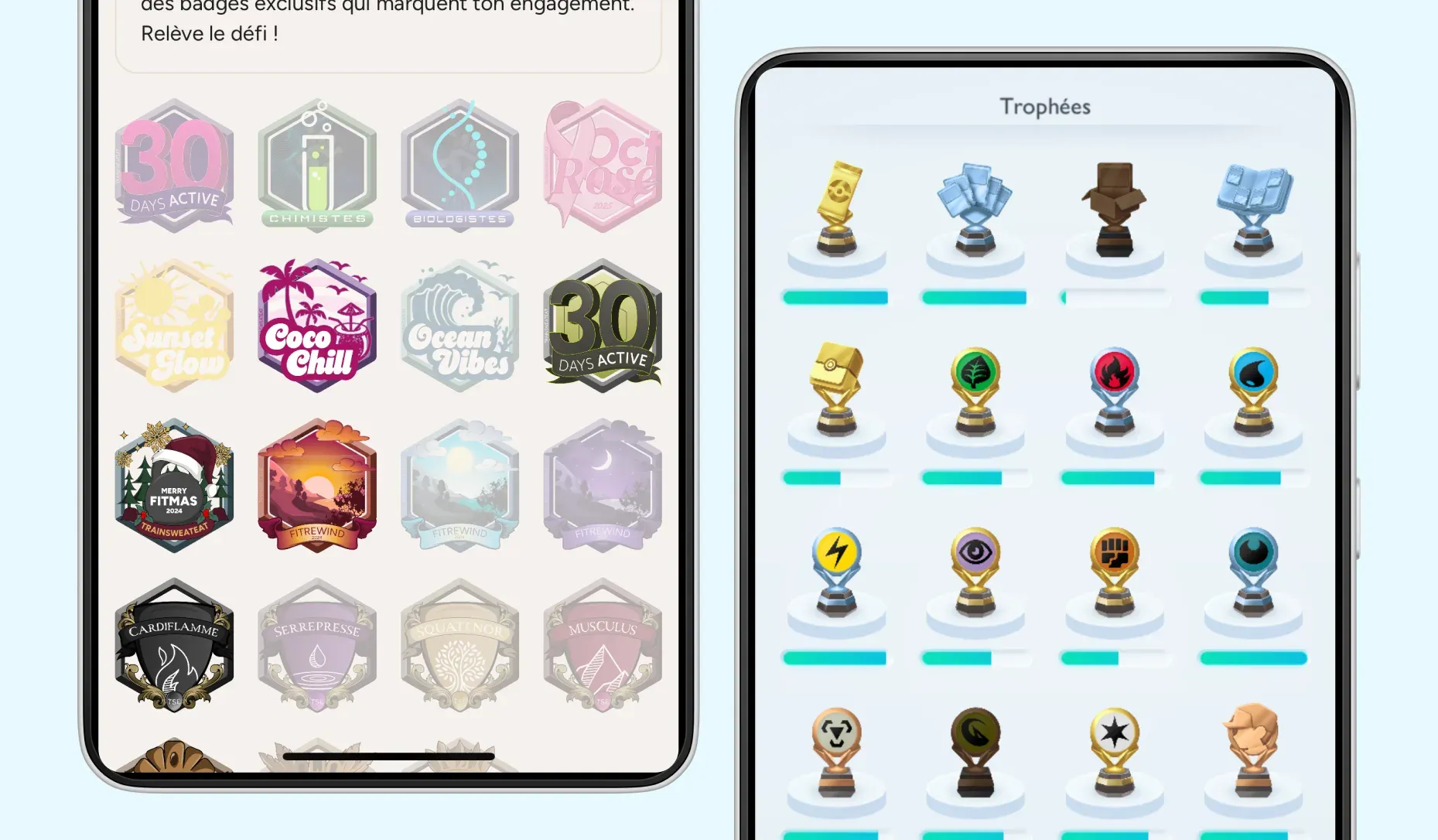
The fourth mechanic we studied is based on collecting: badges. Badges are a way to challenge the user. This mechanic brings in gamification and plays on several collecting drivers. You can have badges to collect by theme; it can be about the number of badges, the type of badges, the variety of badges… Badge collections show up a lot in sports apps, but also in some mobile games, such as Pokémon TCG.
Badges are also rewards. Earning a badge can come with a reward when the badge is won. It can also unlock exclusive content.
From a gamification point of view, what’s interesting first of all is that being able to see the missing badges makes the user want to complete their collection. You can also set up a way for users to compare themselves, to see where another user stands relative to their own progress, and to visualise that progress with, for example, progress bars towards a tier. That’s the social, sharing side of the program, with competitions between friends, for example.
Subscription
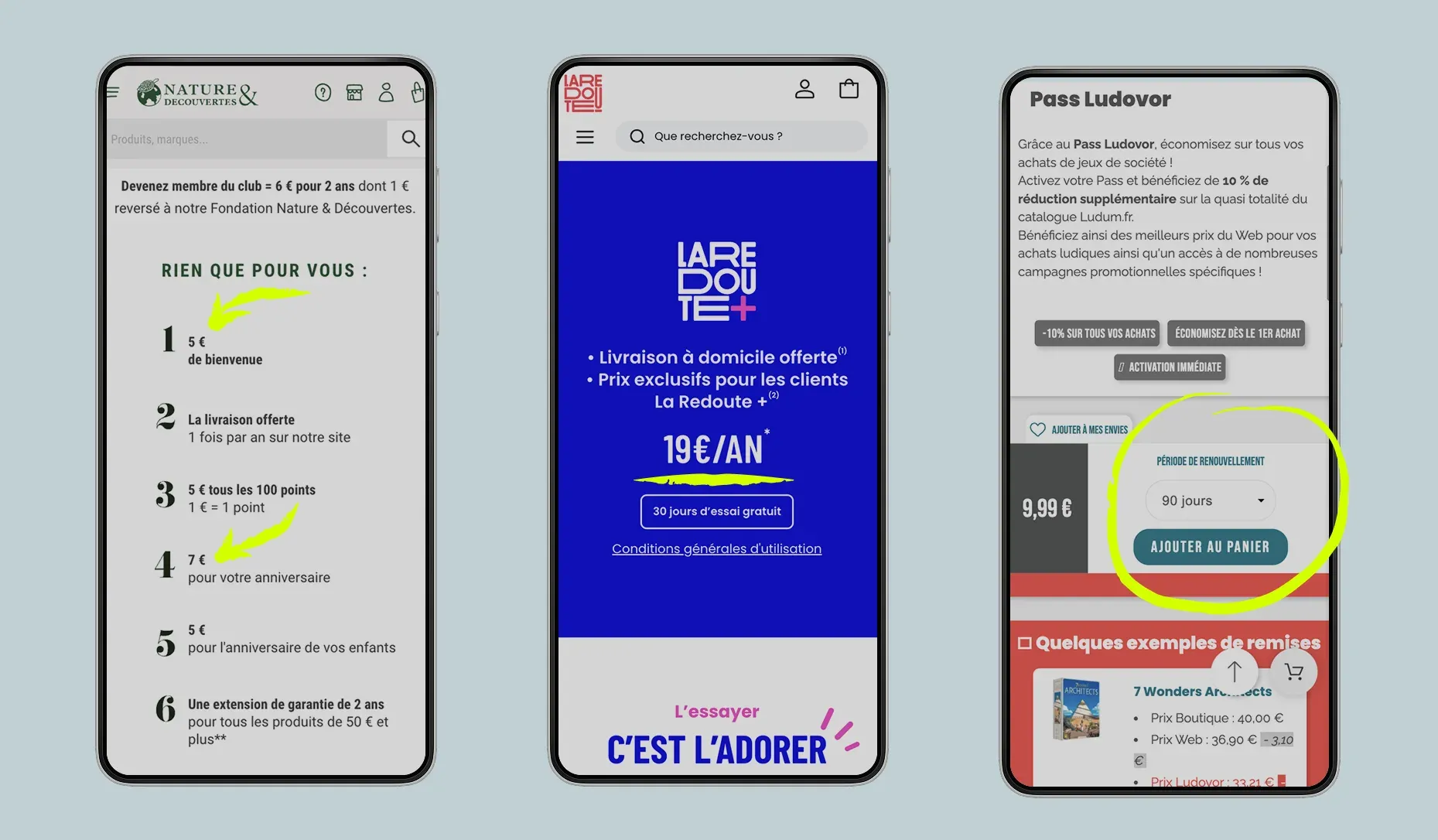
And the last mechanic we were able to study is a paid one: the subscription system. A subscription simply means loyalty that you pay for. Either you can have a hybrid loyalty program, meaning the user can choose to pay quarterly or yearly to access extra benefits in the loyalty program. For example, La Redoute offers this mechanic, tied to free delivery or to discounts all year round, and so on.
Or, for some, the loyalty program is 100% paid. The only way into the loyalty program is to pay. And in that case, it’s usually a system where the subscription amount is paid back in vouchers, as with Nature et Découvertes, which gives a voucher when you subscribe and then vouchers for family birthdays. What’s interesting is that customers who subscribe get benefits that come with it, but they’re also much more likely to come back to the product regularly, since they’ve made a financial commitment to it.
Building the program into the app
When you want to build a loyalty program into an app, the areas worth working on start with the different stages of the user journey where you can present the loyalty program. To begin with, you can add a short introduction to the loyalty program in the app’s onboarding. The idea isn’t to reveal all the rewards and all the benefits of the loyalty program, but really to make the user understand that this loyalty program exists, that it’s there. Above all, it will make them want to come and discover the program’s benefits, without giving too much away, since this is an onboarding step and the user may not yet fully know how the app works.
What also matters is making this loyalty area easy to reach, and so you regularly find a dedicated loyalty entry in the menu. The name in the menu should put the emphasis on rewards or benefits, to draw the user to this area. And it’s an area where, depending on the mechanics chosen, the user will find their points balance with its history, or the rewards catalogue, possibly special offers or the current challenges and missions, but also the full explanation of how they earn points, how the program works, and so on.
You can also add inserts in the journeys to present the loyalty program. For example, with cards dedicated to the loyalty program. You can place them in different strategic spots. On the home screen, among product pages, in the checkout flow, and so on. You can also tie these secondary journeys to rewards. Highlighting the loyalty program in secondary journeys can be useful to make sure the user will, at some point, come and find out about the loyalty program if they haven’t already.
And finally, to bring the loyalty program to life, interactions and micro-animations matter a great deal. For example, when a user earns points, it’s important that the interface clearly shows them how many points they’ve accumulated, and that they can quickly get to their loyalty area. And pairing these elements with a micro-animation will bring the loyalty program to life. You can, for example, show a balance growing or a reward being unlocked, and so on. The loyalty program has to be visible and lively, but it mustn’t become intrusive either. So getting the balance right is very important.
Challenges screen of a reading app, in French. Tapping the “Récupérer” (Claim) button on the “Trouver Booky” (Find Booky) challenge sets off confetti. A “+15” and “+20 XP” card appears then fades, the counter goes from 355 to 370 and the button changes to “Récupéré” (Claimed).
“Missions quotidiennes” (Daily missions) screen of a mobile game, in French. Tapping “Tout terminer” (Complete all) validates the three missions and the gauge fills up. The rewards to collect appear at the top of the screen, then an “Objets reçus” (Items received) window shows the two items won, closed with “OK”.
What makes a program work
In the end, for a loyalty program to work, you first need to combine mechanics. The most sophisticated loyalty programs stack two, or even three or four, of the mechanics we covered earlier. That lets you engage users through different drivers.
Second, you need to keep users engaged on a regular basis. And for that, having missions or challenges, which can be one-off, increases how often people use it. For example, seasonal challenges, with a campaign around the holidays or festive season. They encourage regular use by playing on the fear of missing out (FOMO). The more regular use is needed, the more gamification mechanics there will be.
Next, there’s a choice to make between a loyalty program that aims for simplicity and one that aims for sophistication. There really are two main strategic approaches. On one side, loyalty programs that bet on clarity, meaning one or two simple drivers and small rewards; on the other, loyalty programs that play on complexity as a source of value, meaning nested drivers, eligibility conditions, big rewards, and so on.
And finally, what also counts is brand attachment. Small, regular rewards engage customers over the long term and build attachment to the brand, unlike big, rare rewards, which users may instead find disappointing. Small rewards don’t have to be monetary. Indeed, what you could call “social rewards”, such as the streaks in Duolingo or Snapchat, play on this brand attachment.
An effective loyalty program is above all one that has been designed around its target users. You need to understand them to know what will get them engaged and why they’ll come back and use the loyalty program. That’s why, on top of this comparative benchmark, it’s essential to run surveys directly with future users to gather their expectations and needs regarding the creation of a loyalty program, so you can build THE program suited to the audience you’re targeting.