So, what is attention?
It was at the end of the 19th century that William James (opens in new window), a pioneer of psychology in the US and a recognised philosopher, put forward one of the first formal definitions of attention from a cognitive point of view. For James, attention would be:
“the taking possession by the mind, in clear and vivid form, of one out of what seem several simultaneously possible objects or trains of thought […]”
What we can take from this is that it’s about being aware of one stimulus among others.
Now let’s leap 100 years into the future.
By the end of the 20th century, Prof. M. Marsel Mesulam, a specialist in behavioural neurology, defines attention as:
“the preferential allocation of limited resources to events that are relevant from a behavioural point of view”
For Mesulam, attention comes down, in a way, to processing the stimuli with which it’s worth interacting.
So do we always control our attention?
True, both of the above definitions present attention as something controlled, but picture yourself in an office without a sound, when suddenly your colleague on the phone is telling a friend how their evening went. You now know they loved that new restaurant, despite the slightly high prices. But did you choose to pay attention to that information, or did it reach you involuntarily?
This is where many cognitive science researchers agree. Indeed, we don’t necessarily choose the stimulus we immediately pay attention to.
Did someone mention cocktail party?

In 1953, Colin Cherry, a British cognition specialist, looked at how we manage to isolate a sound in a hubbub. For example, that concert where, despite the music and the crowd noise, you manage to make out what your friend, right next to you, is saying.
The recipe for a successful Cocktail party, Cherry style:
- Present subjects with different audio information in each of their two ears;
- Ask the subjects to focus on only one of the two sounds;
- The subjects have to transcribe what they heard of the target message.
Result: the attention paid to one ear leads to better encoding of the messages reaching it, because our attentional resources will select the information that is relevant to us and try to inhibit as best they can the ones we’re not interested in.
So do we control attention or not?
Well, yes and no. Because attention is often seen as a single process, when it actually operates in a multidimensional way.
Multi-what?
Multidimensional, meaning that a range of dimensions are involved in the attentional process, and they constantly interact with one another:
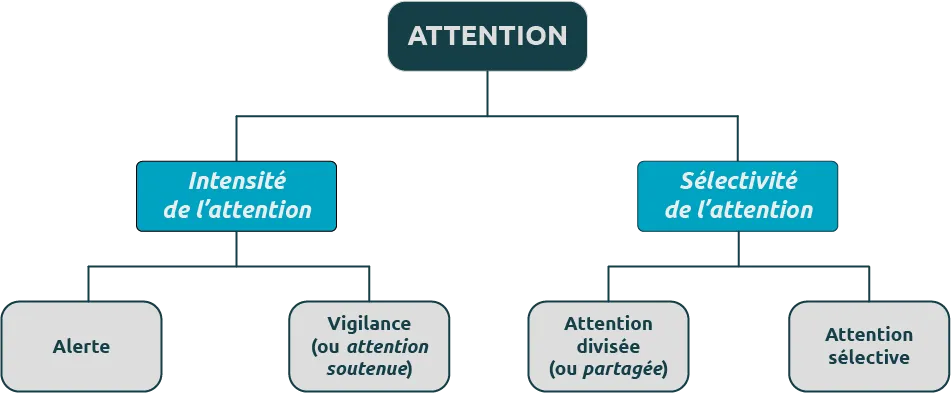
Selection
We are continuously exposed to a stream of stimuli that we can’t control. To avoid overloading working memory, attentional resources will filter the information from our environment and take the ones that are relevant to us at any given moment (the Cocktail party effect is a good example). This is called selective attention.
Distribution
“Of course I can work and listen to music at the same time!” You’ve never tried? Well, here’s your chance. In this case, attentional resources are spread out, distributed across a “limited set” of interesting stimuli. The concept here is that of divided attention, because we divide/spread attentional resources across several stimuli. That said, remember that attentional resources are themselves limited. So it will be all the harder to focus the more stimuli there are.
Regulation
Imagine you’re driving your car. You’re comfortable at first, but focusing on the road requires a cognitive effort, because you maintain a certain state of focus, which will produce fatigue over time. This is called sustained attention, because you maintain a “high and steady level of efficiency over a long period of time” (Seron and Liden, 2000).
Control
It’s race day for the marathon you’ve been preparing for. You’re at the starting blocks waiting for the start signal, when the whistle blows. Why do you manage to start at the right moment (or not)? Because you’ll have been more or less attentive to the start signal. In this case, this is called an alert state: we can prepare ourselves in less than a second to perform an action triggered by a warning signal.
Researchers Van Zomeren & Brouwer (1994) have also proposed an attentional model, describing attention as a prerequisite for any other cognitive function, since it enables the latter to work properly:
“I’m so used to it that I don’t even pay attention any more.”
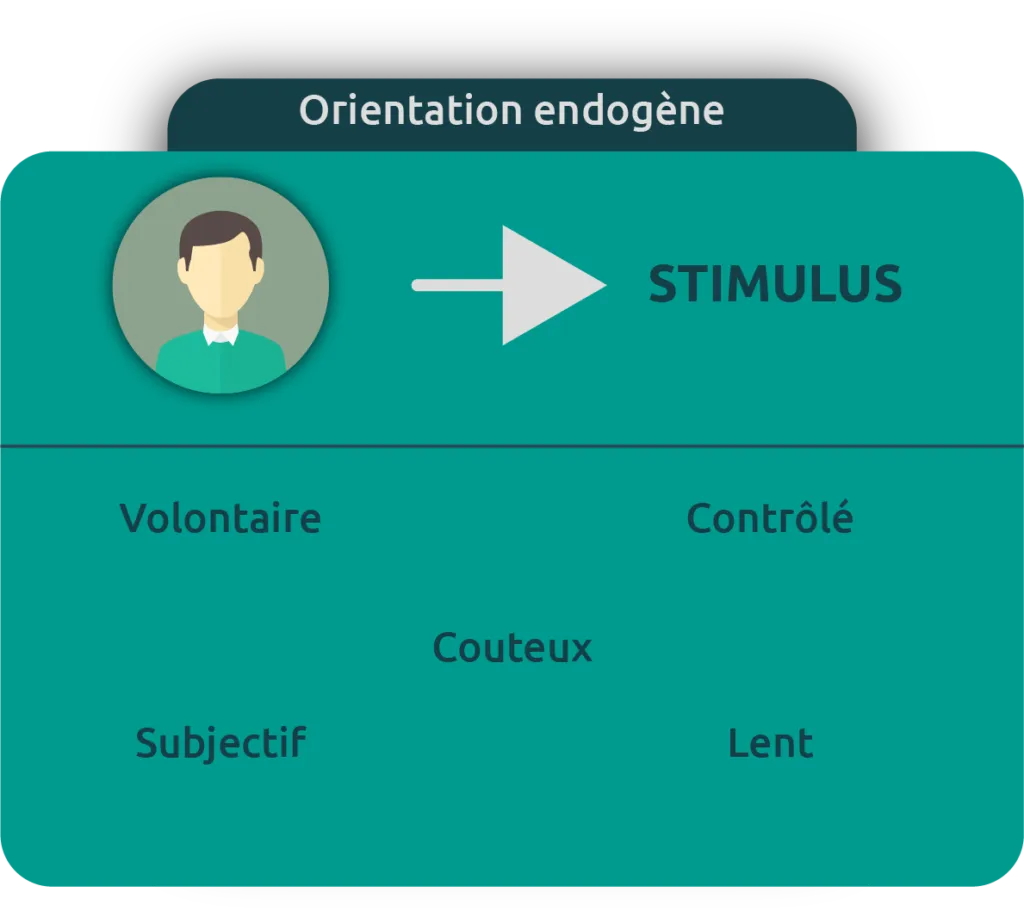
When learning, you need to concentrate and put in some effort to perform the expected action. But with practice, you become more and more experienced. Producing the action gets simpler and simpler, sometimes to the point of doing it automatically (example: young children learning to walk). Our different attentional processes can therefore be in two different “modes”. We then talk about orientation, and more specifically about endogenous and exogenous orientation.
Don’t panic, we’ll explain:
- When we choose to pay attention to a stimulus (top-down, example: searching for information on a website), we do it in an active, controlled and subjective way. This is endogenous orientation (“coming from within”).
- When a stimulus draws our attention (bottom-up, example: a pop-up window), we pay attention to that stimulus in a passive, automatic and objective way. This is exogenous orientation (“coming from outside”). We react to the stimulus that comes to us.
Of course, other cognitive models are proposed to shed light on the mystery of attention. Some are more specific and/or have a more unified view of this mechanism. Still, you now have some basics that can come in handy.
As you can see, paying attention to a stimulus (whether voluntarily or not) first requires perceiving it. In a design context, you will therefore have to ask yourself which information you want to direct users’ attention towards, and the means used to do so (the salience of elements and warning signals, the focus duration needed for a specific task, the amount of information to process at the same time, and so on).
Now it’s your turn to pay more attention. ;)
References on attention
Masson, M. (2011). Rééducation des processus attentionnels: approche sur simulateur de conduite: application au traumatisme crânien et au vieillissement normal (Doctoral thesis). Université Claude Bernard - Lyon I.